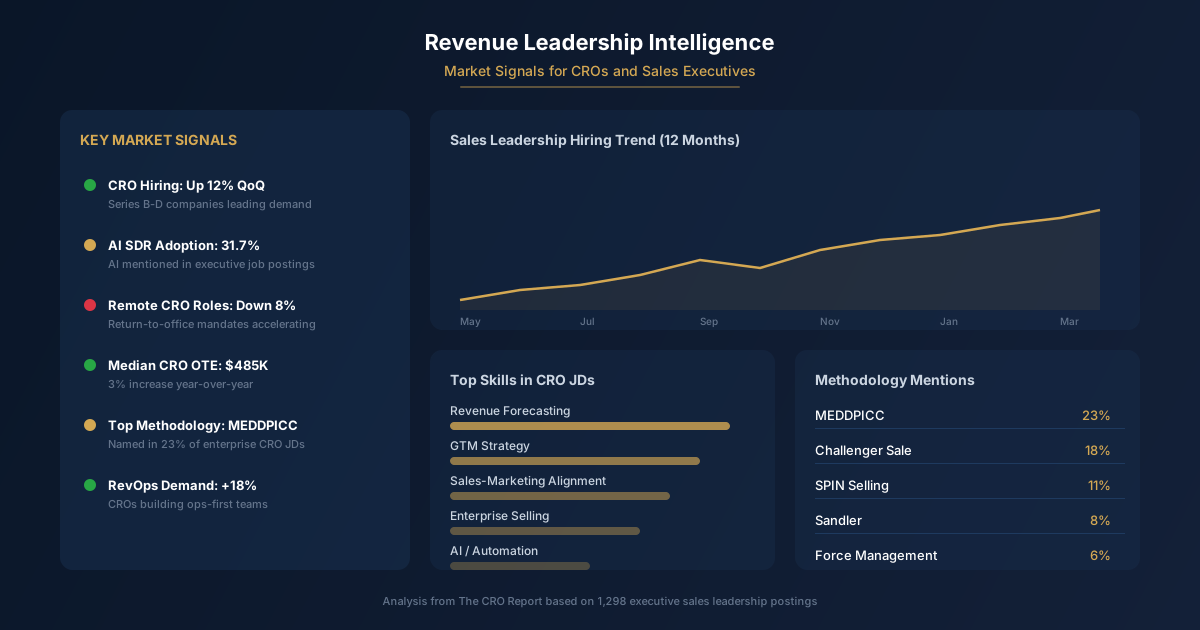
Every week I scan executive sales job postings and tag them for keywords, tools, and requirements. The dataset now covers 1,298 VP and C-level sales roles. One number keeps coming up in conversations: 31.7% of those postings mention AI or ML somewhere in the listing.
That sounds like a big number. Nearly a third of all executive sales roles want AI experience. If you're a VP Sales reading LinkedIn thought leadership about how "AI is reshaping sales leadership," the 31.7% seems to confirm the panic. Time to overhaul the resume. Time to take a course. Time to figure out what a large language model actually does.
Except the number doesn't mean what most people think it means. When you actually read the postings, the picture is very different from the headline. Most of those 411 mentions have nothing to do with requiring AI skills from the sales leader. And GenAI specifically? That shows up in 21 postings. 1.6% of the total dataset. That's the number worth paying attention to.
Data source: Based on analysis of 1,298 executive sales postings tracked weekly by The CRO Report. Keywords are extracted from full posting text including company descriptions, role descriptions, qualifications, and requirements. Industry, tools, and keyword data come from our market intelligence tracking.
The 31.7% Number: What It Actually Means
When a job posting mentions AI, it can mean three very different things. Understanding which category a posting falls into changes how you should interpret the number entirely.
The CRO Report's analysis of 1,298 executive sales postings reveals that generative AI appears in just 1.6% of requirements (21 postings), while broader data-driven approaches appear in 26.3% (341 postings).
Category 1: Companies Selling AI Products
This is the largest bucket. A company that builds AI-powered software needs a VP Sales. The job description mentions AI because that's what the product does. The company overview says "we're building AI solutions for healthcare." The role description says "sell our AI platform to enterprise accounts." AI appears in the posting because of the product, not because the sales leader needs to be an AI expert.
Consider the industry breakdown in our data. Healthcare and Tech each account for roughly 720 postings. Many of the tech companies in our dataset are building AI products. When they hire a VP Sales, AI shows up in the text organically. The sales leader needs to understand the product well enough to sell it. That's different from needing AI expertise as a core competency.
Category 2: AI as a Company Buzzword
Some postings include AI in the company description or mission statement without any connection to the sales role itself. "We leverage AI and machine learning to transform..." appears in the About Us section, and the actual role requirements are standard: build a team, hit a number, manage pipeline, report to the CEO. AI is in the posting. AI is not in the job.
Category 3: Actual AI Requirements for the Sales Leader
This is the smallest category. These are postings that specifically ask the VP Sales or CRO to bring AI experience, implement AI tools, or develop AI-driven sales strategies. They say things like "experience deploying AI-powered sales tools" or "build an AI-first go-to-market motion." These postings exist, but they're a fraction of the 411 total.
The breakdown matters because it changes the career calculus. If most of the 31.7% is Category 1 and 2, then the market isn't actually demanding AI skills from sales leaders at the rate the headline number suggests.
GenAI at 1.6%: The Actual Requirement Is Thin
Of 1,298 postings, 21 mention GenAI or generative AI specifically. That's 1.6%.
This number matters because GenAI is the part of AI that's actually new. Machine learning has been embedded in sales tools for years. Salesforce Einstein launched in 2016. Predictive lead scoring has been around for a decade. When someone says "AI in sales" in 2026, they usually mean generative AI: tools that write emails, summarize calls, draft proposals, create forecasts from unstructured data.
The fact that only 1.6% of executive sales postings specifically reference GenAI tells us that companies haven't yet formalized generative AI as a hiring requirement for sales leaders. They may be using it internally. Their reps may be using ChatGPT to write emails. But the people writing job descriptions for VP Sales roles haven't decided that GenAI experience is something they need to screen for.
Compare this to other keywords in the dataset:
Keyword
Mentions
% of Postings
Scale / Scalable
591
45.5%
Go-to-Market / GTM
488
37.6%
AI / ML
411
31.7%
Data-Driven
341
26.3%
SaaS
262
20.2%
Cloud
151
11.6%
GenAI
21
1.6%
"Scale" and "GTM" dominate. Companies hiring executive sales leaders want people who can build and grow revenue engines. "Data-driven" at 26.3% outpaces GenAI by a factor of 16. The market is telling you what it values: the ability to scale a go-to-market organization using data. AI is part of the landscape. It isn't the defining qualification.
What Companies Actually Mean by "AI Experience"
When a posting does ask for AI experience in a sales leadership context, it generally falls into three buckets. Each one requires different preparation.
Product Fluency
The company sells AI or has AI embedded in its product. They want a sales leader who can speak credibly about AI to technical buyers. This doesn't require deep technical knowledge. It requires the ability to translate technical capabilities into business outcomes, handle objections from skeptical CTOs, and position against competitors in a crowded AI market. If you've sold complex technology before, this is a lateral move.
Operational Implementation
The company wants a sales leader who'll deploy AI tools within the sales organization. Use AI for forecasting. Implement conversation intelligence. Automate parts of the outbound motion. This is about tool adoption and process design, not about building AI systems. It's the sales ops version of AI expertise.
Strategic Vision
A smaller number of roles, typically at AI-native companies, want a sales leader who can shape the company's AI strategy as it relates to go-to-market. These are senior roles where the line between product strategy and sales strategy blurs. They're looking for someone who understands AI well enough to inform product decisions based on market feedback.
The vast majority of "AI experience" requests fall into the first two categories. You don't need a machine learning background. You need to have sold technical products and used modern sales tools.
Where AI Actually Matters in Sales Leadership
Set aside what postings ask for. Where does AI change the game for a VP Sales in 2026? Three areas stand out based on how companies are actually deploying these tools.
Forecasting Accuracy
AI-driven forecasting tools aggregate deal signals (email engagement, call sentiment, CRM activity, stakeholder mapping) and produce probability-weighted forecasts that are more accurate than rep-submitted numbers. For a VP Sales, this changes the forecasting cadence from gut-feel pipeline reviews to signal-based analysis. The leaders who adopt this approach spend less time chasing reps for updates and more time working the deals that need attention.
Our data shows 341 postings (26.3%) use the phrase "data-driven." That's the signal. Companies want leaders who operate on data rather than instinct. AI forecasting tools are the practical application of that preference.
Coaching and Rep Development
Conversation intelligence platforms record, transcribe, and analyze sales calls. They flag patterns: which reps talk too much, which discovery questions correlate with closed deals, where objection handling breaks down. A VP Sales with 15 direct reports can't sit on every call. Conversation intelligence makes coaching scalable in a way that wasn't possible five years ago.
Gong appears in 4 of our 1,298 tracked postings as a named tool. That's a low number relative to its market presence, which suggests companies aren't yet listing specific AI tools in their job descriptions the way they list Salesforce (180 mentions) or Outreach (65 mentions). The tool is widely used. The hiring requirement hasn't caught up.
Pipeline Generation and Prioritization
AI-powered SDR tools and intent data platforms are changing how pipeline gets built. Tools that score accounts based on buying signals, automate personalized outreach sequences, and surface high-intent prospects reduce the manual effort in top-of-funnel. A VP Sales who understands these tools can build a more efficient pipeline engine with fewer resources.
This is where the practical value of AI literacy shows up. Not in the job posting requirements, but in the operating leverage it gives you once you're in the role.
The Tools Landscape: What's Named in Postings vs. What's Actually Used
There's a gap between the tools companies mention in job postings and the tools their sales teams actually use. Postings tend to name established platforms. Teams tend to adopt newer tools faster than the JDs get updated.
Tool
Mentions in Postings
% of 1,298
Salesforce
180
13.9%
Outreach
65
5.0%
HubSpot
48
3.7%
Gong
4
0.3%
Salesforce at 180 mentions isn't surprising. It remains the default CRM in enterprise sales, and companies list it because they want confirmation that you've worked in that ecosystem. Outreach at 65 reflects the dominance of sales engagement platforms in modern outbound motions. HubSpot at 48 skews toward mid-market and companies that run marketing and sales on a single platform.
Gong at 4 mentions is the interesting data point. Conversation intelligence is one of the fastest-growing categories in sales tech. Gong, Chorus (now part of ZoomInfo), and similar platforms are standard at most scaling B2B companies. But only 4 out of 1,298 postings name Gong as a requirement. That suggests conversation intelligence is treated as a "nice to have" in hiring, even though it's close to mandatory in practice.
The broader pattern: companies list CRM and engagement platforms as explicit requirements. AI-powered tools like conversation intelligence, forecasting platforms, and intent data providers are used widely but rarely gate hiring decisions. If you know Salesforce and a major engagement platform, you're covered for what postings ask. Everything else you'll learn on the job, or bring as a differentiator.
The AI Skills Gap in Sales Leadership: Real vs. Hype
There's a lot of noise about an "AI skills gap" in sales leadership. The argument goes: sales leaders who don't adopt AI will be left behind. Companies will only hire AI-savvy executives. The future belongs to the VP Sales who can prompt-engineer their way to quota.
The data doesn't support that narrative yet. Here's what it does support.
What's Real
Data fluency is non-negotiable. 26.3% of postings mention data-driven approaches. Companies expect you to make decisions based on metrics, not intuition. This predates AI and will outlast the current hype cycle.
Tool adoption speed matters. Sales tech stacks are evolving. The VP Sales who takes six months to evaluate a new tool while competitors deploy in six weeks loses ground. AI tools are part of this broader adoption curve.
Scalability is the priority. 591 postings (45.5%) mention scale or scalability. The market values leaders who can build repeatable, efficient revenue processes. AI tools can accelerate that. But the skill is building scalable systems, not AI fluency specifically.
What's Hype
"Every sales leader needs an AI strategy." At 1.6% GenAI mention rate, the market disagrees. Most companies need a revenue strategy that may include AI tools. That's different from needing an AI strategy.
"AI will replace sales managers." If that were imminent, companies would be hiring fewer VPs, not posting 1,298 openings that we're tracking. The role is evolving. It isn't disappearing.
"You need to be technical to lead a modern sales org." SaaS experience (262 mentions, 20.2%) and GTM strategy (488 mentions, 37.6%) rank far above any technical requirement. Companies want business leaders who understand technology, not technologists who understand business.
What This Means for Your Resume and Career
If you're a VP Sales or aspiring CRO evaluating how to position yourself in this market, the data points to a few concrete takeaways.
The Foundation Still Wins
GTM strategy, pipeline management, team building, forecasting discipline, and cross-functional alignment are what companies screen for. Look at the keywords: scale (45.5%), GTM (37.6%), data-driven (26.3%), SaaS (20.2%). These are the table stakes. AI experience is additive, not foundational.
Industry Context Matters More Than Tool Knowledge
Healthcare and Tech each account for roughly 720 of the 1,298 postings in our dataset. If you're in healthcare sales leadership, your industry expertise is far more valuable than your ability to use an AI forecasting tool. Same for cybersecurity, fintech, or any vertical with specific buyer dynamics. Companies hire for context. They train for tools.
Show Outcomes, Not Tools
Instead of listing AI tools on your resume, show the outcomes they enabled. "Improved forecast accuracy from 65% to 88% by implementing signal-based pipeline analytics" lands differently than "experienced with AI forecasting tools." The result matters. The tool is the mechanism.
Know Enough to Be Conversant
You don't need to build an AI model. You do need to understand how AI tools work at a functional level: what conversation intelligence does, how predictive scoring works, what intent data platforms provide. When a CEO asks "what's our AI strategy for sales?" you should have a point of view. That point of view can be "we should deploy AI where it creates operating leverage, starting with forecasting and call coaching" rather than a 40-page transformation plan.
Watch the Trajectory, Not the Snapshot
The 1.6% GenAI number is a snapshot from January 2026. It was probably close to zero a year ago. A year from now it could be 5% or 10%. The trend direction matters more than the current level. Subscribe to sources that track this data over time, run your own experiments with AI tools, and build a working knowledge incrementally. The leaders who'll be best positioned in 2027 are the ones building AI fluency now, not because the postings demand it today, but because the trajectory is clear.
The remote vs. on-site split in our data (311 remote roles, 393 on-site across VP positions) also intersects with AI adoption. Remote sales leaders tend to lean harder on technology and data because they can't walk the floor. If you're targeting remote roles, demonstrable comfort with AI-powered management tools becomes a stronger differentiator.
The bottom line: AI/ML appears in 31.7% of executive sales postings, but the actual requirement for AI proficiency in sales leadership is thin. GenAI-specific mentions sit at 1.6%. Companies are hiring for scale, GTM strategy, and data fluency. AI tools are part of the toolkit. They're not the job description.
Frequently Asked Questions
How important is AI experience for VP Sales roles in 2026?
AI/ML appears in 31.7% of executive sales postings tracked by The CRO Report, but most of those mentions relate to selling AI products rather than requiring AI proficiency from the sales leader. GenAI-specific requirements appear in just 1.6% of postings. For most VP Sales roles, strong pipeline management, forecasting accuracy, and data-driven decision-making still outweigh AI-specific experience. Familiarity with AI-powered sales tools like Gong, Clari, and conversation intelligence platforms is increasingly expected but rarely a gating requirement.
What percentage of sales leadership jobs require AI experience?
Based on 1,298 executive sales postings analyzed by The CRO Report, 411 (31.7%) mention AI or ML somewhere in the listing. However, only 21 postings (1.6%) specifically mention GenAI. The majority of AI mentions appear in job descriptions at companies selling AI products, not in the qualifications or requirements section. The actual requirement for AI proficiency in sales leadership remains thin.
What AI tools should VP Sales leaders know?
Salesforce appears in 180 of 1,298 executive sales postings, making it the most referenced platform. Outreach appears in 65 postings, HubSpot in 48, and Gong in 4. Beyond named tools, companies increasingly expect fluency with conversation intelligence, AI-powered forecasting, and pipeline analytics. The specific tool matters less than your ability to use data and automation to drive revenue outcomes.
Is GenAI changing how companies hire sales executives?
Not yet in a meaningful way. GenAI appears in just 1.6% of executive sales postings (21 out of 1,298). The broader data-driven trend is more significant: 341 postings (26.3%) mention data-driven approaches, 488 mention go-to-market/GTM strategy, and 591 reference scale or scalability. Companies are hiring sales leaders who can build scalable, data-informed revenue engines. GenAI is a small part of that picture so far.
Do I need AI experience to get a VP Sales job?
For the vast majority of VP Sales roles, no. AI-specific experience is not a gating requirement. What companies consistently ask for is the ability to build and scale revenue organizations using data, with 26.3% of postings mentioning data-driven approaches and 45.5% referencing scale. Familiarity with modern sales tech stacks (CRM, engagement platforms, analytics) is expected. Deep AI expertise is only relevant if you're targeting roles at AI-native companies or companies building AI products.
Methodology & Disclosure: All data comes from 1,298 executive sales job postings tracked weekly by The CRO Report since 2025. Keywords are extracted from full posting text including company descriptions, role descriptions, qualifications, and requirements. AI/ML mentions (411) capture any instance of "artificial intelligence," "AI," "machine learning," or "ML" in the posting. GenAI mentions (21) capture "generative AI," "GenAI," "gen AI," or "generative artificial intelligence." Tool mentions are based on exact name matches. Keyword frequency does not indicate whether the term appears in requirements, preferences, or company descriptions. This distinction matters and is discussed in the article. Updated January 31, 2026.
The CRO Report is run by Rome Thorndike, VP Revenue at Firmograph.ai. 15+ years in B2B sales leadership including Salesforce, Microsoft, Snapdocs, and Datajoy (acquired by Databricks). MBA from UC Berkeley Haas.