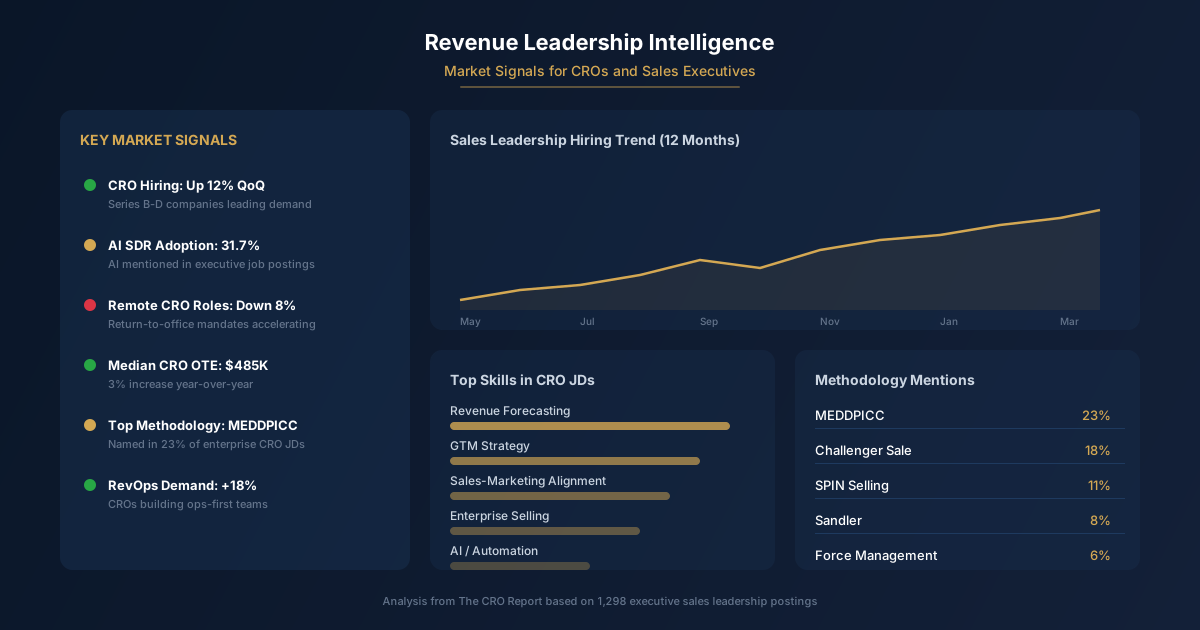
Consultative Selling Is Crushing MEDDPICC in Job Postings. Should You Care?
172 mentions vs 117 across 1,298 executive sales postings. A 47% gap that tells you less about which methodology is better and more about how companies actually think about hiring.
Consultative selling shows up in 172 of 1,298 executive sales postings we track at The CRO Report. MEDDIC/MEDDPICC shows up in 117. That's a 47% gap, which sounds decisive until you think about what's actually being measured. One is a broad selling philosophy. The other is a specific deal qualification framework. Comparing them head-to-head is a bit like comparing "athletic" to "CrossFit." Both describe something real. They're just operating at different altitudes.
But the data is the data. Companies write job descriptions with intent. When 172 hiring managers type "consultative selling" and only 117 type "MEDDPICC," that gap tells you something about how the market frames what it wants from sales leaders. Whether it should change how you train your team or position yourself as a candidate depends on why the gap exists.
Here's the full breakdown.
Data source: Based on analysis of 1,298 executive sales postings (VP Sales, SVP, CRO) tracked weekly by The CRO Report. Methodology mentions are extracted via keyword matching across full job descriptions. A single posting can mention multiple methodologies, so these categories aren't mutually exclusive. Updated February 1, 2026.
The Numbers: Full Methodology Breakdown
Eight methodology categories appear frequently enough to track. Here's where they land across 1,298 postings.
Methodology
Mentions
% of Postings
Consultative Selling
172
13.2%
MEDDIC/MEDDPICC
117
9.0%
Enterprise Sales
102
7.9%
Channel/Partner
87
6.7%
Challenger Sale
16
1.2%
PLG/Product-Led
16
1.2%
Value Selling
14
1.1%
Account-Based (ABM)
11
0.8%
A few things jump out. The top two, consultative selling and MEDDPICC, account for a combined 22.2% of postings. That means roughly 78% of VP Sales job descriptions don't mention either one by name. Most companies describe what they want in terms of outcomes ("build and scale an enterprise sales team") rather than methodology labels.
The drop-off after Channel/Partner is steep. Challenger Sale at 16 mentions, Value Selling at 14, PLG at 16, ABM at 11. These are established frameworks with dedicated training programs, books, and consulting ecosystems. But they barely register in how companies write job descriptions for senior sales leaders.
Many postings mention more than one methodology. A single JD might reference "consultative selling approach" in one paragraph and "MEDDPICC experience preferred" in another. These aren't competing requirements. They're describing different layers of how the company wants deals run.
Why Consultative Selling Leads
Three factors drive the 172-to-117 gap. None of them mean consultative selling is "better" than MEDDPICC.
It's a broader label
Consultative selling describes an approach to buyer interactions. Ask questions. Understand the problem. Position as a trusted advisor. It's philosophical, not procedural. A company that writes "consultative selling experience required" is saying "we want someone who builds relationships and understands our buyers," not "we need you to follow a specific 7-step framework." That breadth makes it easier to include in a job description because it applies to nearly any complex sale.
MEDDPICC is specific. It's an acronym with defined components: Metrics, Economic Buyer, Decision Criteria, Decision Process, Paper Process, Identify Pain, Champion, Competition. Writing "MEDDPICC experience required" signals that the company has adopted or plans to adopt that exact framework. Fewer companies are willing to commit to that specificity in a JD.
Industry mix matters
Healthcare accounts for 720 of 1,298 postings in our dataset. Financial Services contributes 589. Technology/Software sits at 719. These massive verticals lean heavily toward consultative language. Healthcare buyers, hospital administrators, health system CIOs, clinical leaders, expect relationship-driven selling from their vendors. Financial Services has similar dynamics. Long relationships, trust-based buying, regulatory complexity that rewards a consultative approach.
MEDDPICC concentrations are different. Cybersecurity, where MEDDPICC appears in 21.4% of postings, punches well above its weight. Technology/Software companies with complex enterprise products are another stronghold. But these verticals are smaller than Healthcare and Financial Services in absolute posting volume, so they can't offset the sheer number of consultative mentions coming from larger verticals.
It's less intimidating to candidates
This is the pragmatic reason. A VP Sales job description that says "MEDDPICC required" immediately filters out candidates who haven't been trained on that specific framework. Some of those filtered candidates might be excellent sales leaders who could learn MEDDPICC in a week. The hiring manager loses access to them.
"Consultative selling experience" captures a much wider applicant pool. Almost every experienced sales leader has done some version of consultative selling, even if they've never called it that. The term functions as a signal that the company values a certain selling style without creating a hard filter on a specific certification or training program.
Where MEDDPICC Wins
117 mentions out of 1,298 postings. On the surface, that looks like a distant second place. In context, it's a remarkable showing for a named framework.
Compare MEDDPICC's 117 to everything else with a proper name. Challenger Sale: 16. Value Selling: 14. Those frameworks have best-selling books, dedicated training organizations, and decades of presence in the sales world. MEDDPICC outpaces them by 7x to 8x in hiring demand. Nobody else is close.
The 117 figure also understates MEDDPICC's influence. Companies that run MEDDPICC internally don't always put it in the job description. They screen for it during interviews instead, asking candidates to walk through how they'd qualify a deal or describe the decision process at their last closed account. The framework shows up in practice more often than it shows up in JDs.
Where MEDDPICC concentrates tells the real story. In complex enterprise deals, where Enterprise Sales appears in 102 postings, MEDDPICC gives you something consultative selling doesn't: a structured system for tracking deal health. Consultative selling tells you how to have a conversation. MEDDPICC tells you whether that conversation moved the deal forward, whether you've identified the economic buyer, whether the champion can mobilize internally, whether the paper process has a timeline.
Cybersecurity is the clearest example. With 145 postings in our dataset and MEDDPICC appearing at 21.4%, that vertical has the highest concentration of MEDDPICC requirements of any industry we track. The reason is straightforward: cybersecurity deals are multi-stakeholder, multi-quarter, and technically complex. A framework that forces you to map decision criteria and paper process for every opportunity isn't optional. It's survival.
They're Not Competitors, They're Layers
The framing of "consultative selling vs MEDDPICC" makes for a good headline. It doesn't reflect how high-performing sales organizations actually operate.
Consultative selling is how you run discovery and build relationships. It governs the quality of your conversations with buyers. How you ask questions. How you uncover pain that the prospect hasn't fully articulated. How you earn the right to propose a solution by demonstrating that you understand the problem better than anyone else who's walked into that room.
MEDDPICC is how you qualify and track deals. It governs the rigor of your pipeline. Do you have a champion? Can you name the economic buyer? Have you confirmed the decision criteria? Is there a paper process, and do you know the timeline? These aren't conversation techniques. They're deal management checkpoints.
The best sales orgs use both. A rep runs a consultative discovery call, then updates their MEDDPICC fields in Salesforce (which appears in 180 of 1,298 postings, by the way, dominating HubSpot's 48). The consultative approach produces the insights. MEDDPICC captures those insights in a structure that managers can inspect, forecast from, and coach against.
The data supports this layering. Channel/Partner at 87 mentions often appears alongside consultative selling, because partner-driven deals require strong relationship skills with both end buyers and channel partners. Enterprise Sales at 102 mentions frequently pairs with MEDDPICC, because deals above a certain complexity threshold need qualification rigor to avoid wasted cycles.
If you're building a methodology stack, think layers, not choices. Consultative selling is the foundation. MEDDPICC is the structure you build on top. Neither works as well without the other.
What This Means for Hiring
The consultative-vs-MEDDPICC data has different implications depending on which side of the hiring table you're sitting on.
If you're writing job descriptions
"Consultative selling" in your JD casts the widest net. More candidates self-identify with that label, and the term doesn't filter out strong leaders who might use different framework vocabulary. If you're at a company that runs MEDDPICC internally, consider listing it as "preferred" rather than "required." You'll still attract MEDDPICC-trained candidates while keeping the door open for people who've run equivalent qualification processes under different names.
If you're a candidate
MEDDPICC fluency is a differentiator precisely because fewer people have it. 172 postings ask for consultative selling, meaning you're competing against a larger pool of candidates who can credibly claim that experience. 117 postings ask for MEDDPICC, with a smaller qualified pool chasing those roles. The supply-demand ratio favors MEDDPICC specialists. If you can demonstrate both consultative selling instincts and MEDDPICC rigor, you're positioned for the widest range of opportunities.
If you're building a team
Teach consultative selling as the foundation. Every rep on your team should know how to run a discovery call that uncovers real pain, maps stakeholders, and positions your solution against the buyer's actual criteria. Layer MEDDPICC on top for deals above a certain threshold, maybe $100K ACV, maybe $250K, wherever your deal complexity spikes. Require MEDDPICC fields in your CRM for those deals. Make it the language of your forecast reviews and pipeline inspections. The consultative skills get your reps into the deal. The MEDDPICC framework tells you whether the deal is real.
The Methodology Nobody Talks About
Enterprise Sales at 102 mentions and 7.9% of postings. Technically, it's not a methodology. It's a description of a sales motion. But companies use it as shorthand, and it appears in enough job descriptions to warrant attention.
When a JD says "enterprise sales experience required," it means: you need to sell six-figure (or seven-figure) deals to large organizations with complex buying committees and long sales cycles. It signals multi-threading, executive engagement, proof-of-concept processes, procurement navigation, and legal review. All the things that make a deal take six months instead of six days.
Enterprise Sales as a label tends to co-occur with either consultative selling or MEDDPICC, sometimes both. The company wants the approach (consultative) and the framework (MEDDPICC) to be applied within the context of the motion (enterprise). These three pieces fit together. They describe what the company sells, how reps should engage buyers, and how deals should be tracked.
The 102 figure also helps calibrate the rest of the table. Enterprise Sales at 7.9%, Channel/Partner at 6.7%, and then everything else below 1.5%. Most methodology-related language in job descriptions clusters around these top four: consultative selling, MEDDPICC, Enterprise Sales, and Channel/Partner. The long tail of named frameworks barely registers.
That concentration has a practical implication. If you're fluent in consultative selling, MEDDPICC, and enterprise deal mechanics, you're covered for the vast majority of methodology-related requirements in the current VP Sales hiring market. Adding Challenger or Value Selling certification is fine, but the marginal return is small compared to depth in the top three.
The takeaway: Consultative selling and MEDDPICC aren't in competition. Consultative selling leads in job postings (172 vs 117) because it's a broader term that describes an approach rather than a framework. MEDDPICC's 117 mentions make it the dominant named framework by a wide margin. The best sales organizations treat them as complementary layers. If you're hiring, use "consultative" for reach and "MEDDPICC" for specificity. If you're a candidate, invest in both.
Frequently Asked Questions
What is consultative selling?
Consultative selling is a sales approach centered on understanding the buyer's problems before proposing solutions. Instead of leading with product features, the seller runs deep discovery to uncover pain points, business impact, and decision criteria. It appears in 172 of 1,298 executive sales postings tracked by The CRO Report (13.2%), making it the most frequently cited methodology in VP Sales job descriptions.
What is the difference between MEDDPICC and consultative selling?
Consultative selling is a broad approach to how you engage buyers, focused on asking questions and building relationships through expertise. MEDDPICC is a specific deal qualification framework that tracks Metrics, Economic Buyer, Decision Criteria, Decision Process, Paper Process, Identify Pain, Champion, and Competition. They operate at different layers: consultative selling governs how you run conversations, MEDDPICC governs how you qualify and track deals. The best sales organizations use both together.
Should I learn consultative selling or MEDDPICC first?
Consultative selling first. It's the foundational skill that teaches you how to run discovery, ask layered questions, and position as a trusted advisor. MEDDPICC builds on top of that foundation by giving you a framework to qualify deals and track progress through complex buying cycles. In job postings, consultative selling appears 47% more often than MEDDPICC (172 vs 117 out of 1,298 postings), which means more roles expect it as a baseline skill.
What are the sales methodology trends in 2026?
Based on 1,298 executive sales postings, consultative selling leads at 172 mentions (13.2%), followed by MEDDIC/MEDDPICC at 117 (9.0%), Enterprise Sales at 102 (7.9%), and Channel/Partner at 87 (6.7%). Challenger Sale appears in only 16 postings (1.2%), and Value Selling in 14 (1.1%). The trend favors broad, relationship-driven approaches in job descriptions, with specific frameworks like MEDDPICC concentrated in complex enterprise and cybersecurity roles.
What is the best sales methodology for startups?
For early-stage startups, consultative selling provides the most versatile foundation because it adapts to any deal size and buyer type. As deal complexity increases and average contract values climb above six figures, layering MEDDPICC on top gives your team a structured way to qualify opportunities and avoid wasting cycles on deals that won't close. PLG/Product-Led appears in 16 of 1,298 postings (1.2%), relevant if your startup has a self-serve product with enterprise upsell potential.
The CRO Report newsletter tracks which methodologies companies actually hire for, how comp varies by framework, and what's shifting in the executive sales market. Updated weekly with new posting data.
Methodology & Disclosure: All data comes from 1,298 executive sales job postings (VP Sales, SVP Sales, CRO, and equivalent titles) tracked weekly by The CRO Report. Methodology mentions are extracted via keyword matching across full job description text. A single posting can reference multiple methodologies, so category totals exceed 1,298 when summed. Industry breakdowns: Healthcare (720 postings), Technology/Software (719), Financial Services (589), Cybersecurity (145). CRM mentions: Salesforce (180), HubSpot (48). The dataset captures a snapshot of active postings and is not a longitudinal trend study. Updated February 1, 2026.
The CRO Report is run by Rome Thorndike, VP Revenue at Firmograph.ai. 15+ years in B2B sales leadership including Salesforce, Microsoft, Snapdocs, and Datajoy (acquired by Databricks). MBA from UC Berkeley Haas.