Every CRO interview questions article you've read was written for the person on the other side of the table. The hiring manager. The board member. The CEO trying to figure out if you can run their revenue org. This one's different. This is for you, the candidate, walking into a chief revenue officer interview and trying to figure out if the company deserves you.
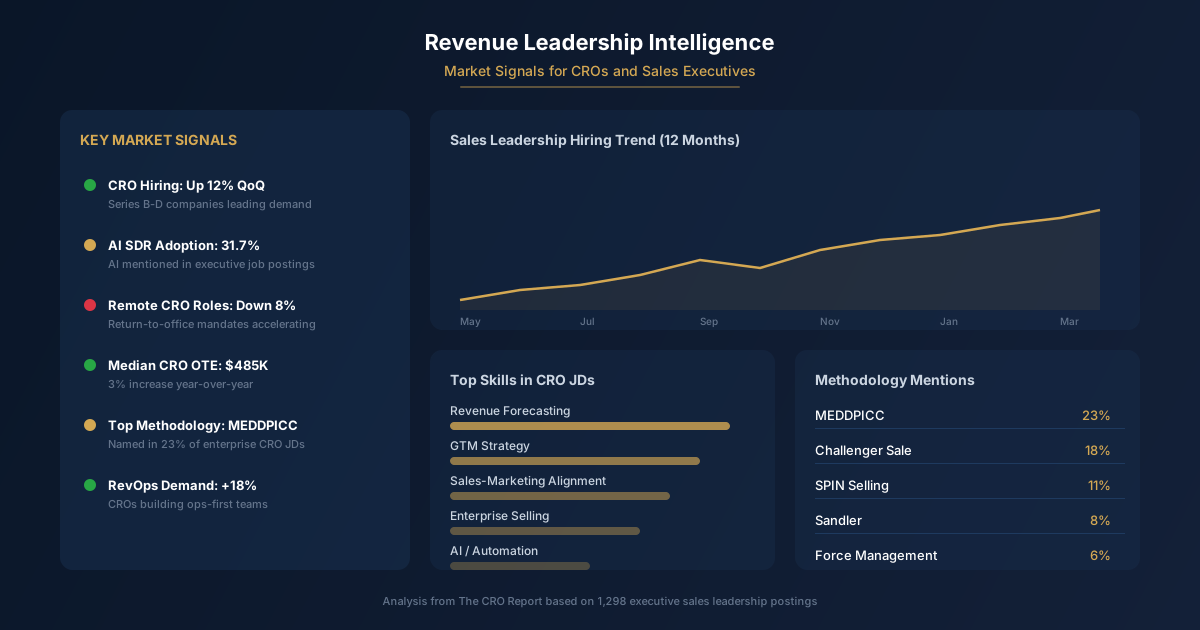
We analyze CRO roles weekly at The CRO Report. Right now we're tracking 1,349 executive sales postings, 26 of them C-level with disclosed salary data showing an average base of $231,873 to $302,246. We see what companies say in their postings. We see what they leave out. And the gap between those two things is where your CRO interview preparation should live.
Most of the questions to ask in a CRO interview that you'll find online are soft. They're designed to make you look thoughtful without actually surfacing information you can use to make a decision. The questions below are different. They come from patterns in the data, from the red flags we see repeated across hundreds of postings, and from the reality that a CRO role accepted without proper diligence is the most expensive career mistake you can make. They're organized by category, and each section includes context on why the question matters based on what we actually see in the postings.
Data source: Based on analysis of 1,349 executive sales postings tracked weekly by The CRO Report. Salary data reflects 26 C-level postings with disclosed base compensation. Red flag language counts pulled from full dataset keyword analysis. Updated February 1, 2026. Full methodology in the disclosure at bottom.
Financial Health Questions
Postings tell you the title, the location, and sometimes the comp. They almost never tell you whether the company can afford the role they're filling. That's on you to find out.
"What's the current burn rate and runway?"
This applies to any company that hasn't reached profitability. If they're Series B with 18 months of runway, you're building on a clock. If they're Series D with 36 months, the pressure is different. Both are fine. You just need to know which one you're signing up for.
"What was last quarter's net revenue retention?"
NRR tells you whether the existing customer base is growing or shrinking. A CRO who walks into a company with 85% NRR is spending half their time plugging holes. A CRO at 120% NRR has expansion revenue doing some of the work. The job description won't distinguish between these two realities. The question will.
"What's the path to profitability timeline the board has approved?"
Boards have timelines. They don't always share them with candidates. But the answer to this question tells you whether you're being hired to grow at all costs or grow efficiently. Those require different playbooks, different team structures, and different risk tolerances.
"How is the sales team currently against plan?"
If the team is at 40% of plan when you walk in, that's the baseline you're inheriting. You'll spend your first two quarters diagnosing and restructuring before you can build. If they're at 90%, you're optimizing. Both are valid CRO mandates, but they're different jobs with different timelines to show results.
Here's why these questions matter in context: 54.8% of the executive postings in our dataset disclose salary. Almost none disclose financial health metrics. The information asymmetry is deliberate. Companies control the narrative through the posting. Your job in the interview is to fill in what they left out.
Company stage adds another layer. In our data, Seed/Series A companies (14 postings) and Series A/B (38 postings) are the most likely to have constrained runway. Series C/D companies (79 postings) and Late Stage (27 postings) typically have more financial breathing room, but not always. Enterprise/Public companies (195 postings) have different financial pressures entirely, usually margin and growth rate targets from public market investors. The financial health questions need to be calibrated to the company's stage, but they need to be asked at every stage.
Predecessor Intel Questions
This is the most important category. Everything else is secondary if you don't understand what happened to the person who had this job before you.
"Why did the last person in this role leave?"
Listen carefully to the answer. "They decided to pursue other opportunities" is a non-answer. "We mutually agreed it wasn't the right fit" usually means they were fired. "They were here for two years and left for a CEO role" is informative. The specificity of the answer correlates with how honest the company is being.
"How long were they in the role?"
CRO tenure across the industry averages around 18 to 24 months. If the last person was there for 8 months, something went wrong. If they were there for 4 years, that's a strong signal about the company's ability to support a revenue leader.
"How many people have held this title in the last 3 years?"
Three CROs in four years. You see it more often than you'd expect. When that happens, the problem isn't the people. The problem is the company. Maybe the board's expectations are unrealistic. Maybe the CEO can't stop selling directly. Maybe the product isn't ready for the go-to-market motion they're hiring for. Whatever the cause, a revolving door at the CRO level means the system is broken, and you're unlikely to be the exception.
"Who's been running the sales team in the interim?"
The gap between the last CRO and you is telling. If the CEO stepped in and ran sales for six months, you need to understand whether they'll actually let go. If a VP of Sales has been running the org effectively, you need to understand why they weren't promoted and how they'll feel about reporting to you. If nobody was really in charge, the org has been drifting, and you're inheriting whatever that drift created.
Predecessor data is the single highest-signal category of questions in CRO interview preparation. A company can have strong financials, a great product, and a reasonable board, and still burn through CROs because of a structural problem that only surfaces after you're in the seat. The predecessor questions are how you find out before you sign the offer letter instead of three months after.
Board and Leadership Questions
The reporting structure and board composition tell you more about the actual scope of the CRO role than anything in the job description.
"Who does this role report to?"
A CRO reporting to the CEO has a fundamentally different job than a CRO reporting to a COO or CFO. The CEO reporting line means direct access to strategy, board conversations, and resource allocation decisions. The COO line means you're one layer removed from those conversations, and someone else is interpreting your needs to the board. Neither is automatically wrong. But you should know which one it is before you accept.
"Is there a board member with sales or GTM operating experience?"
Boards with GTM operators understand the realities of building pipeline, managing quota, and the lag between investment and results. Boards without that experience tend to react to quarterly numbers without context. A board member who's been a CRO or VP Sales before will ask better questions, set more realistic expectations, and give you air cover when a quarter comes in light because of a strategic bet you made.
"How involved is the CEO in sales decisions today?"
Some CEOs are founder-sellers who built the first $10M themselves and struggle to let go. Others checked out of sales years ago and want someone to own it completely. You need to know which version you're walking into. A CEO who still shows up on discovery calls and overrides pricing in the final hour will undermine your authority regardless of your title.
"What's the board's expectation for this role in the first 12 months?"
Get this in concrete terms. "Double revenue" is a number you can evaluate. "Transform the go-to-market" is vague enough to mean anything, which means it'll mean whatever the board decides it means when they're evaluating you at month nine. Push for specifics. If they can't articulate specific outcomes, the role hasn't been scoped properly.
Power dynamics at the leadership level determine how much of the CRO title translates into actual authority. You can have CRO on your business card and still need sign-off from the CEO to change territory assignments, from the CFO to adjust pricing, and from a board member to hire a new VP. Understanding those dynamics before you accept means you can negotiate for the authority you need, or walk away if it isn't available.
Sales Org Reality Questions
The sales team you're inheriting is the variable that determines your first 90 days. The posting rarely gives you enough to assess it.
"What's the current team size and structure?"
Are there 8 AEs and no SDRs? 40 reps across three segments with dedicated SEs? A single team of 12 doing everything from prospecting to closing? Structure tells you what the company values. Lack of structure tells you what they haven't figured out yet.
"What's the average rep tenure?"
A team where the average tenure is 14 months is a team where people keep leaving. That's a management problem, a comp problem, a culture problem, or all three. A team with 3-year average tenure has stability and institutional knowledge. Both scenarios are solvable, but the effort required is completely different.
"What's the current tech stack?"
Our data gives you a baseline for what to expect. Across 1,349 executive postings, Salesforce appears in 180, Outreach in 65, HubSpot in 48. If the company is running HubSpot at $50M ARR with an enterprise sales motion, that tells you something about how much investment has gone into sales infrastructure. If they're on Salesforce with Outreach, Gong, and Clari, they've made the standard investments and you're inheriting a functional stack.
"What methodology does the team use today?"
In our dataset, Consultative Selling appears in 172 postings, MEDDIC/MEDDPICC in 117, and Enterprise Sales in 102. These aren't interchangeable. A team trained on MEDDPICC has a qualification discipline that a team with no formal methodology doesn't. If you're planning to implement MEDDPICC and the team has never used any framework, budget six months for adoption before expecting results.
"What's the current quota attainment across the team?"
Not the top rep. Not the average. The distribution. If 2 of 20 reps are hitting quota, that's a systemic issue with territory design, product-market fit, or target setting. If 14 of 20 are at 80% or above, you're tuning an engine that works. The answer to this question determines whether your first hire is a sales enablement leader or a new head of sales ops.
The sales org reality questions serve a second purpose beyond information gathering. They show the interviewer that you've done this before. A candidate who asks about quota distribution, rep tenure, and methodology specifics is signaling operational depth. A candidate who asks about "the team's energy" is signaling that they've never inherited a broken org. In a CRO interview, the specificity of your questions is itself a qualification signal.
One more thing on tech stack: 85 postings in our dataset use the phrase "self-starter." At the CRO level, that phrase is worth probing. It can mean the company has a lean ops team and expects the CRO to be hands-on with systems and reporting. It can also mean they have no infrastructure and expect you to build it while also hitting a number. If you see "self-starter" in the posting, the tech stack and support structure questions become even more important.
Comp and Equity Questions
You have data here. Use it.
Our tracking shows 26 C-level roles with salary data. Average base: $231,873 to $302,246. Median base: $220,450 to $263,750. That's the market. If someone offers you $180K base for a CRO role, they're either below market or the title doesn't match the scope.
"What's the base range for this role?"
Ask this early. 198 of 1,298 postings in our dataset use "competitive compensation" instead of disclosing a number. If they won't share a range by the second conversation, that's data. Companies that know what the role is worth aren't afraid to say it.
"What's the variable structure and OTE?"
Variable at the CRO level varies wildly. Some companies do 60/40 base-to-variable. Others do 80/20. The structure tells you how much the company ties comp to short-term results versus long-term building. A heavy variable split means they're optimizing for quarterly performance. A heavier base split means they're giving you room to invest in changes that take time to pay off.
"What's the equity grant and vesting schedule?"
At the CRO level, equity is a significant portion of total comp. Standard vesting is four years with a one-year cliff, but variations exist. Ask about the current 409A valuation or the last preferred price, the total shares outstanding, and whether there's a refresh policy. If the company can't answer these questions clearly, their equity might not be worth what they're implying.
"Is there a sign-on bonus?"
Sign-on bonuses exist for a reason: they compensate for unvested equity you're leaving behind, cover the variable income gap during your ramp period, or both. If you're walking away from six figures in unvested equity at your current company, a sign-on is a reasonable ask. Don't treat it as a bonus. Treat it as a bridge.
"What are the accelerator terms?"
Accelerators define what happens when you exceed plan. Some companies offer 1.5x for performance above 100%, others go to 2x or even uncapped. The accelerator structure tells you how much the company rewards outperformance. No accelerators, or weak ones, means the company is optimizing for predictability over upside. That might be fine. But you should know before you negotiate.
The company stage data in our tracking gives additional context for comp expectations. Seed/Series A companies (14 in our dataset) will lean heavily on equity with lower base. Series C/D (79 postings) and Enterprise/Public (195 postings) will have higher base ranges with more structured variable plans. Know where the company sits and benchmark accordingly.
One note on the "competitive compensation" problem. Of 1,298 postings with compensation language, 198 use the phrase "competitive compensation" or close variants without disclosing a number. That's 15.3% of the dataset. At the CRO level, vague comp language is a yellow flag. Companies hiring for a $250K+ base role who won't put a range in the posting are either testing the market (seeing what candidates will accept), or they haven't decided what the role is worth. Both are worth knowing. If they won't share a range by the second conversation, consider what other information they might withhold once you're on payroll.
The Questions You Should Never Ask (That Everyone Asks)
Three questions show up in every interview prep article. All three are useless at the CRO level.
"What does success look like in this role?"
This sounds thoughtful. It isn't. It's so open-ended that any answer feels adequate, and you learn nothing concrete. Replace it with the specific board expectations question above. "What's the board's expectation for this role in the first 12 months?" gives you a measurable answer. "What does success look like?" gives you a motivational poster.
"Tell me about the culture."
Nobody answers this honestly in an interview. You'll hear about collaboration, transparency, and being mission-driven. You'll learn nothing about whether the CEO micromanages, whether sales and product actually talk to each other, or whether the last three people in your role were quietly pushed out. Skip the culture question. Ask the predecessor questions instead. Those give you the real culture data.
"What's a typical day like?"
There is no typical day at the CRO level. Monday is a board prep call and a pricing negotiation. Tuesday is a pipeline review and an HR conversation about a rep on a PIP. Wednesday is a customer escalation and a planning session with the CFO. Asking about a typical day signals that you haven't held a role at this altitude before. Ask about priorities and constraints instead.
The common thread across all three of these questions: they're borrowed from interview guides written for individual contributors and mid-level managers. They don't translate to the CRO level. Your questions should reflect the scope of the decisions you'll be making. Financial health, org structure, board expectations, comp benchmarks. Those are the categories that matter. Everything else is noise dressed up as preparation.
248 postings in our dataset mention "fast-paced environment." At the CRO level, every environment is fast-paced. The phrase adds zero information. What you want to know is whether the pace is driven by growth (good) or by chaos (bad). The questions above, particularly the predecessor and board categories, will tell you which one you're walking into.
Frequently Asked Questions
What questions should I ask in a CRO interview?
Focus on five categories: financial health (burn rate, NRR, path to profitability), predecessor intel (why the last person left, how many have held the role), board and leadership dynamics (reporting structure, board GTM experience, CEO involvement in sales), sales org reality (team size, rep tenure, tech stack, quota attainment), and comp structure (base range, variable, equity, accelerators). These questions give you the data to evaluate the role rather than just sell yourself into it.
What is the average CRO salary in 2026?
Based on 26 C-level executive sales postings with disclosed salary data tracked by The CRO Report, the average base salary range is $231,873 to $302,246. The median base range is $220,450 to $263,750. This reflects base compensation only and does not include variable pay, equity, or sign-on bonuses, which can add substantially to total compensation.
How should I prepare for a CRO interview?
Preparation should focus on reverse due diligence, not rehearsing answers to behavioral questions. Research the company's funding stage, recent leadership changes, board composition, and tech stack before the first conversation. Review their job posting for red flags like vague compensation language or phrases like "fast-paced environment" and "self-starter," which appeared in 248 and 85 executive postings respectively in our dataset. Prepare specific questions about financial health, predecessor history, and board expectations.
What are red flags in a CRO job posting?
The biggest red flags in our dataset of 1,349 executive postings: 198 use "competitive compensation" instead of disclosing a salary range, 248 mention "fast-paced environment," and 85 say "self-starter." Vague comp language suggests the company either hasn't benchmarked the role or plans to lowball. "Fast-paced" and "self-starter" at the CRO level often signal organizational chaos dressed up as culture. Also watch for postings that don't mention reporting structure or that list responsibilities spanning sales, marketing, CS, and ops without corresponding authority.
What should I research before a chief revenue officer interview?
Before a CRO interview, research the company's funding history and last round details, the LinkedIn profiles of current and former sales leaders (look for tenure patterns), board member backgrounds (especially GTM operating experience), the company's tech stack through job postings for sales roles (Salesforce appears in 180 of 1,349 executive postings we track), the sales methodology referenced in their postings (Consultative Selling 172, MEDDPICC 117), and any public revenue or growth data. This gives you the foundation to ask informed questions during the interview.
The CRO Report newsletter tracks CRO and VP Sales hiring trends, comp data, and what companies actually want from revenue leaders. Updated weekly with new posting data.
Methodology & Disclosure: All data comes from 1,349 executive sales job postings tracked weekly by The CRO Report. Salary data for CRO-level roles reflects 26 C-level postings with disclosed base compensation. Red flag language counts ("competitive compensation," "fast-paced environment," "self-starter") are keyword-matched across all postings in the dataset. Tool and methodology counts (Salesforce 180, Outreach 65, Consultative Selling 172, MEDDIC/MEDDPICC 117) reflect mentions across the full dataset, not CRO-only postings. Company stage data is sourced from Crunchbase and PitchBook where available. Updated February 1, 2026.
The CRO Report is run by Rome Thorndike, VP Revenue at Firmograph.ai. 15+ years in B2B sales leadership including Salesforce, Microsoft, Snapdocs, and Datajoy (acquired by Databricks). MBA from UC Berkeley Haas.