I've been tracking executive sales job postings weekly since 2025. The dataset now covers 1,349 postings, 704 of which actually disclose salary. Of those, 26 are C-Level roles. CRO, CSO, Chief Commercial Officer. The titles vary. The comp ranges are all over the place.
The lowest CRO base I've tracked: $50,000. The highest: $600,000. That's not a range. That's two completely different jobs with the same title.
This piece breaks down what CROs actually get paid across base, variable, and equity, using data from real job postings rather than self-reported surveys. If you're evaluating a CRO offer, benchmarking your current comp, or just trying to figure out whether that recruiter InMail is worth responding to, this is the data I'd want to see.
Data source: Based on analysis of 1,349 executive sales postings tracked weekly by The CRO Report, with 704 roles disclosing compensation. This is posting data, not survey data. Survey-based reports typically skew 10-15% higher because people round up. Companies post what they'll actually pay.
The Base Salary Reality
Across 26 C-Level sales roles with disclosed compensation, here's what we're seeing:
According to The CRO Report's analysis of 12,000+ executive sales job postings, CRO base salaries range from $250K to $400K, with total compensation often exceeding $500K at late-stage companies.
Metric
Low End
High End
Average Base
$231,873
$302,246
Median Base
$220,450
$263,750
Full Range
$50,000
$600,000
The median is more useful than the average here. A few outliers at both ends pull the mean around. If you're a CRO at an established company, the $220K-$264K median range is your baseline for benchmarking. Anything materially below that floor and you should be asking questions.
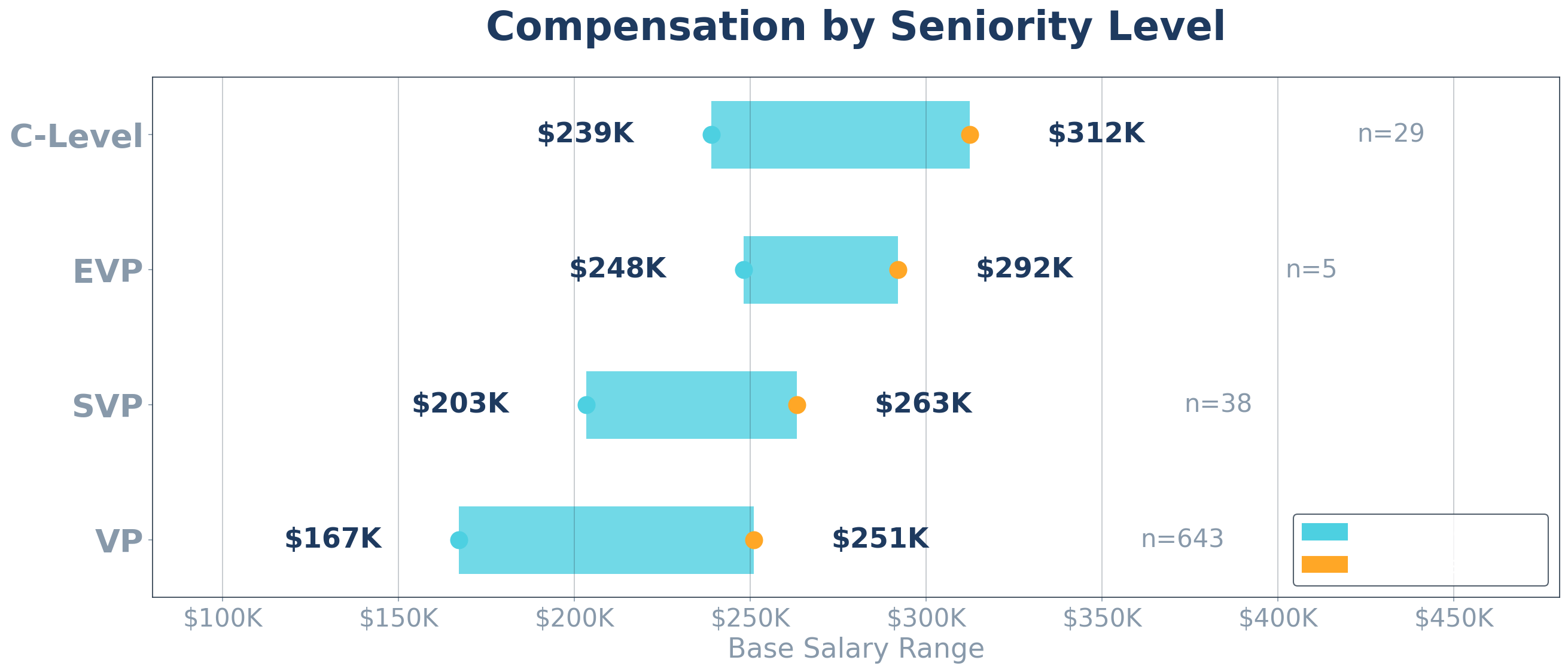
For context, let's look at how C-Level comp stacks up against other seniority levels we track. The jump from VP Sales to CRO isn't as clean as you'd expect.
Base salary ranges by seniority level. Source: The CRO Report, 704 roles with disclosed compensation.
VP Sales roles (636 with salary data) make up the bulk of our dataset. SVP comes in at 37 roles, EVP at just 5. The C-Level pool of 26 is small but telling. Only about 8% of all executive sales postings we track carry a C-Level title. That scarcity matters when you're trying to benchmark.
One more thing worth noting: over the past 9 weeks, the average max base across all levels has dropped 10.1%. We're watching that number closely. It could be seasonal, or it could be the start of a correction. The weekly newsletter covers the trend data in real time.
The $550K Spread, Explained
$50K to $600K. Same title.
Let's pull that apart, because the spread tells you more about the CRO market than any single number can.
Title Inflation Is Real
A 15-person startup with $2M ARR will hand out a CRO title to their first sales hire. A public company with $500M in revenue will also hire a CRO. These are fundamentally different jobs. The startup CRO is an individual contributor who also manages two SDRs. The public company CRO owns a 200-person org and reports to the CEO. Both get called "Chief Revenue Officer."
That $50K floor in our data? Almost certainly a very early stage company using the CRO title to attract a strong seller without the budget to back it up. The equity package might make it worth it. Or it might not.
Company Stage Is the Biggest Variable
We'll dig into this more below, but the short version: a Seed/Series A CRO averages $193K-$257K in base. A late-stage CRO averages $263K-$425K. That's a 65% gap at the top end, and both are real CRO jobs.
Role Scope Varies Wildly
Some CROs own sales only. Others own sales, marketing, customer success, partnerships, and revenue operations. The role that owns five functions at a Series D company commands a very different package than the one running a single sales team at Series B.
Look at the top disclosed CRO roles in our data:
Company
Base Range
Augean Robotics
$550K - $600K
Burro
$550K - $600K
Forrester (CSO)
$378K - $430K
On Call Computer Solutions
$250K - $500K
Two robotics companies at the top, paying $550K-$600K in base alone. Forrester's CSO comes in at $378K-$430K. And then On Call Computer Solutions with a $250K range spread in a single posting. When you see $250K-$500K for one role, that usually means they'll consider a wide range of experience levels and adjust scope accordingly.
Variable Compensation: The Other Half of the Check
Most CRO roles structure variable comp at 40-50% of base. Some go higher, especially at companies where the CRO carries a personal quota or owns a book of business. A few go lower, usually at companies where the CRO role is more operational and less directly tied to a number.
Here's what that looks like against the base data:
Comp Component
Low Estimate
High Estimate
Average Base
$231,873
$302,246
Variable (40-50%)
$92,749
$151,123
Estimated OTE
$324,622
$453,369
That puts estimated OTE for the average CRO somewhere between $325K and $453K. At the median, it's more like $308K-$396K.
Commission vs. Bonus Structures
How that variable comp actually works matters more than the number. CRO variable generally falls into three buckets:
Commission on team performance. The CRO earns a percentage of total revenue or bookings against a team-level target. This is the most common structure. It ties your payout to the number you actually control.
MBO-based bonus. Management by objectives. Some percentage of variable is tied to board-level goals: hitting ARR milestones, improving retention, launching in new markets. Common at companies where the CRO role is broader than pure sales.
Hybrid. 60% on bookings, 40% on MBOs. Or 70/30. The split tells you what the company actually values. Heavy MBO weighting means they want a strategic operator. Heavy commission weighting means they want a number.
Job postings rarely spell out the variable structure in detail. You won't know until you're deep in the interview process. Ask early. The structure tells you as much about the role as the JD does.
Equity: Where the Real Money Lives (or Dies)
Base and variable are the paycheck. Equity is the bet. And it's the piece of CRO comp that creates the most confusion, the most disappointment, and occasionally the biggest paydays.
Seed/Series A Equity
At Seed or Series A, a CRO should be looking at 0.5% to 1.5% equity, sometimes higher if you're the first go-to-market hire and the founders are technical. Below 0.5%? You're taking startup risk for growth-stage equity. That math doesn't work unless you believe the company will be worth $5B+.
Keep in mind: Seed/Series A CRO base averages $193K-$257K in our data. You're taking a meaningful base haircut compared to later-stage roles. The equity has to justify that gap or you're subsidizing the founders with your paycheck.
Series C/D: RSUs Start to Appear
Series C/D CRO roles average $268K-$335K in base. The equity shifts from common stock options toward RSUs as companies get closer to an exit. Expect 0.25%-0.75% in options or RSUs. The grant size shrinks, but the probability of it being worth something goes up.
The question at this stage is liquidity. Ask about secondary sales. Ask about the timeline to IPO or acquisition. A 0.5% grant at a company three years from going public is very different from 0.5% at a company five years out with no clear path.
Enterprise/Public Company Stock
Public company CROs get RSUs with a known price. That removes the guessing game. Total equity grants for a CRO at a mid-to-large public company typically run $200K-$500K per year in RSU value, with annual refresh grants based on performance.
Public company base in our data averages $199K-$264K. Lower than late-stage private, which might surprise people. But add the RSU package and the comp picture changes completely. Enterprise/Public pays roughly 11% more than Series B/C at equivalent seniority levels once you factor in total comp.
Equity traps to watch for: Four-year vesting with a one-year cliff is standard. But watch for details. Is the strike price set at 409A valuation or at a premium? What's the post-termination exercise window, 90 days or longer? If you leave or get let go, a 90-day exercise window with a high strike price means your equity is effectively worthless unless you can come up with hundreds of thousands of dollars in cash. Some companies now offer extended exercise windows of 5-10 years. That's a real benefit and worth asking about.
By Company Stage: The Comp Story Changes Completely
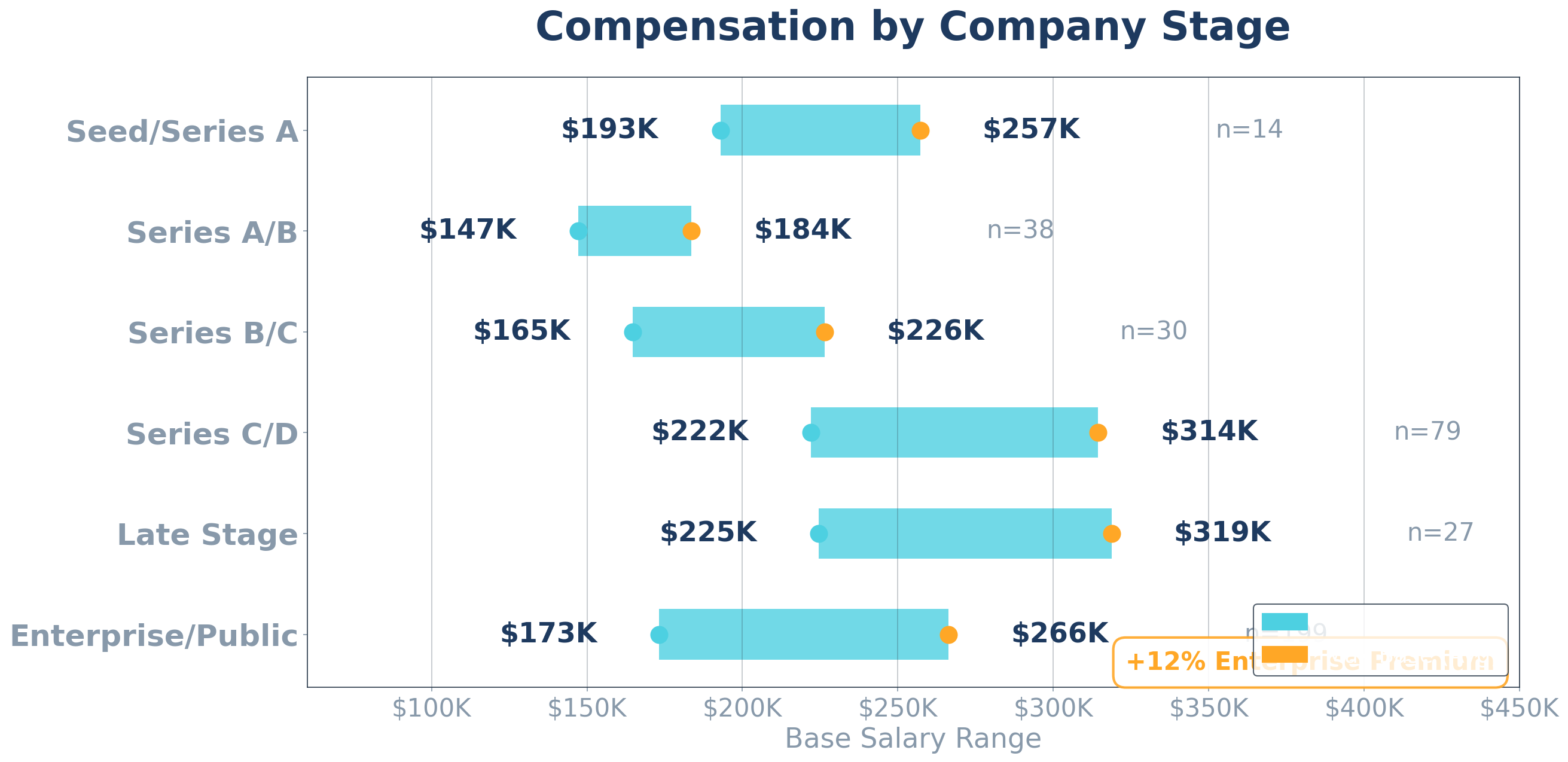
This is the section that matters most if you're evaluating a specific offer. Two CRO roles can have the same title, similar responsibilities, and pay wildly differently because one is at a seed startup and the other is at a public company.
Base salary ranges by company funding stage. Source: The CRO Report, 704 roles with disclosed compensation.
Company Stage
CRO Avg Base Low
CRO Avg Base High
n
Seed / Series A
$192,955
$257,169
14
Series C / D
$267,667
$335,000
3
Late Stage (Pre-IPO)
$262,500
$425,000
2
Enterprise / Public
$199,133
$263,750
6
A few things jump out.
Seed/Series A represents the biggest pool at 14 roles. And it pays the least in base, obviously. What's interesting is the concentration. More than half of all disclosed CRO postings in our data are at Seed or Series A companies. The CRO title has migrated down-market in a big way.
Late-stage private pays the highest max base at $425K. Only two data points, so don't build a comp model around it, but the logic tracks. Pre-IPO companies have real revenue, real budgets, and they're competing with public companies for talent while also dangling the IPO equity upside.
Enterprise/Public is the one that catches people off guard. Average base of $199K-$264K at public companies is lower than Series C/D. But that's base only. Layer in RSUs, bonus targets, and the stability of a predictable stock price, and the total package competes with or beats everything else on this list.
The n values are small. Twenty-six C-Level roles isn't a huge sample. I'm reporting what the data shows, and I'll update these numbers as the dataset grows. We add new postings every week. The Substack newsletter publishes the freshest data as it comes in.
The Geography Premium
Location still matters. Even in a world where 43% of the roles we track are remote-eligible, where you sit changes what you get paid. Here's the CRO-relevant location data across all seniority levels:
Location
Avg Base Low
Avg Base High
San Francisco
$244,452
$347,218
Seattle
$200,909
$296,696
Boston
$201,227
$282,527
New York
$180,780
$250,499
Remote
$151,533
$217,341
San Francisco sits at the top by a wide margin. The max in SF ($347K average) is $97K higher than the New York max and $130K higher than the remote max. That's a massive gap.
Seattle and Boston cluster together in that second tier. Both are in the $200K-$297K range. Neither has SF's ceiling, but both beat New York on the high end, which I didn't expect when I first ran the numbers.
New York at $181K-$250K feels low for a city with that cost of living. Possible explanation: our dataset includes roles that are "New York or Remote" which may pull the average down. Also, New York has a broader industry mix than SF. Not everything in New York is VC-backed SaaS paying top-of-market.
Remote roles pay roughly 14% less than New York and about 37% less than San Francisco at the top end. That's the discount you pay for flexibility. Whether it's "worth it" is a personal calculation. But the data is clear: remote comp hasn't converged with in-person comp. Not even close.
Red Flags in CRO Comp Packages
After tracking hundreds of these postings, certain patterns stand out as warning signs. Not dealbreakers by themselves, but they warrant hard questions.
Base Below $200K for a CRO Title
Our median CRO base starts at $220K. A posting below $200K with a CRO title is either a very early-stage company (check the funding), or it's a VP Sales role wearing a CRO costume. Neither is necessarily bad, but you should know which one you're walking into.
No Equity Disclosure at Seed Stage
If a seed-stage company is posting a CRO role and won't discuss equity in the job description or early conversations, that's a problem. At seed, equity is the main reason to take the role. Opacity around it suggests the founders either haven't thought through the equity plan or don't intend to be generous with it.
"Commensurate With Experience"
This phrase appears in about 45% of postings that don't disclose salary. In my experience, it usually means below market. Companies paying at or above market tend to lead with their numbers because it's a recruiting advantage. Companies that are light on comp hide behind flexible language.
Extremely Wide Ranges
We saw $250K-$500K for a single CRO posting. A 2x spread in one role means the company doesn't know what they need. They might hire a VP-level operator at $250K and call it a CRO, or they might bring in a seasoned exec at $500K. Those are different people with different expectations, and the lack of clarity usually creates problems six months in.
Variable Comp Over 60% of Base
For a CRO, variable comp in the 40-50% range is normal. Once it creeps above 60%, the risk profile changes. High variable usually means the company is shifting risk to you. Fine if you have confidence in the sales motion and quota is achievable. But ask for historical attainment data. If they won't share it, that tells you something too.
No Clear Reporting Line
Not a comp issue per se, but it affects your ability to earn. A CRO who reports to a COO or a President instead of the CEO often has less leverage on budget, hiring, and strategy. That affects quota attainment, which affects variable, which affects total comp. The org chart is part of the package.
Frequently Asked Questions
What is the average CRO base salary in 2026?
Based on 26 C-Level sales roles tracked by The CRO Report, the average CRO base salary ranges from $231,873 to $302,246. The median sits at $220,450-$263,750. The full range spans $50,000 to $600,000, reflecting significant variation based on company stage, location, and role scope.
How much do CROs make in total compensation including bonus and equity?
CRO total comp typically runs 2x-4x base salary depending on company stage. Variable comp is usually 40-50% of base, putting estimated OTE at $324K-$453K for an average CRO. Equity adds significantly at startups (1%+ at seed, 0.25-0.75% at Series C/D) and through RSUs at public companies. A CRO at a well-funded Series C could see total comp of $600K-$1M+ when equity is included.
Do CROs in San Francisco make more than other cities?
Yes. San Francisco leads with average base ranges of $244,452-$347,218. Seattle follows at $200,909-$296,696, then Boston at $201,227-$282,527. New York comes in at $180,780-$250,499. Remote CRO roles average $151,533-$217,341, roughly 14% less than New York.
How does CRO salary change by company stage?
Dramatically. Seed/Series A CRO roles average $192,955-$257,169 in base but offer larger equity grants. Series C/D averages $267,667-$335,000. Enterprise/Public companies average $199,133-$263,750 in base but add RSU packages. Late-stage private companies pay the highest base at $262,500-$425,000.
What are red flags in a CRO compensation package?
Key red flags: base below $200K for a true CRO title (may be a glorified VP Sales), no equity disclosure at a seed-stage company, the phrase "commensurate with experience" (often masks below-market comp), extremely wide posted ranges like $250K-$500K that suggest undefined role scope, and variable comp above 60% of base which shifts excessive risk to the hire.
Is this CRO salary data from real job postings or surveys?
This data comes from 1,349 executive sales job postings tracked weekly by The CRO Report since 2025, with 704 roles disclosing compensation. This is posting data, not self-reported survey data. Survey-based salary reports typically skew 10-15% higher. Posting data reflects what companies are actually willing to pay.
Methodology & Disclosure: All compensation data comes from publicly posted job listings tracked weekly by The CRO Report since 2025. The dataset covers 1,349 executive sales postings, with 704 roles (54.8%) disclosing salary ranges. C-Level data reflects 26 roles with disclosed compensation. Variable comp and OTE estimates are calculated using standard 40-50% variable assumptions and may not reflect specific company structures. Equity ranges are based on industry norms and published benchmarks, not posting data, as most listings do not disclose equity. This data reflects posted ranges and may differ from final negotiated offers. Updated January 30, 2026.
The CRO Report is run by Rome Thorndike, VP Revenue at Firmograph.ai. 15+ years in B2B sales leadership including Salesforce, Microsoft, Snapdocs, and Datajoy (acquired by Databricks). MBA from UC Berkeley Haas.