
The Compensation Gap
Here's what the numbers say. Across 704 roles with disclosed salary data, C-Level sales executives (CRO, CSO) average a base salary range of $231,873 to $302,246. VP-level roles average $167,295 to $251,443. That puts the gap at roughly $51K on the low end and $84K at the top.
Sounds straightforward. It isn't.
The ranges on both sides are enormous. VP base salaries run from under $100K to $1,000,000. C-Level roles range from $50K to $600K. There's so much overlap in the middle that you can't look at a comp number and guess the title.
| Seniority | Sample Size | Avg Base (Low) | Avg Base (High) |
|---|---|---|---|
| C-Level (CRO/CSO) | n=26 | $231,873 | $302,246 |
| EVP | n=5 | $248,000 | $292,000 |
| SVP | n=37 | $202,153 | $262,432 |
| VP | n=636 | $167,295 | $251,443 |
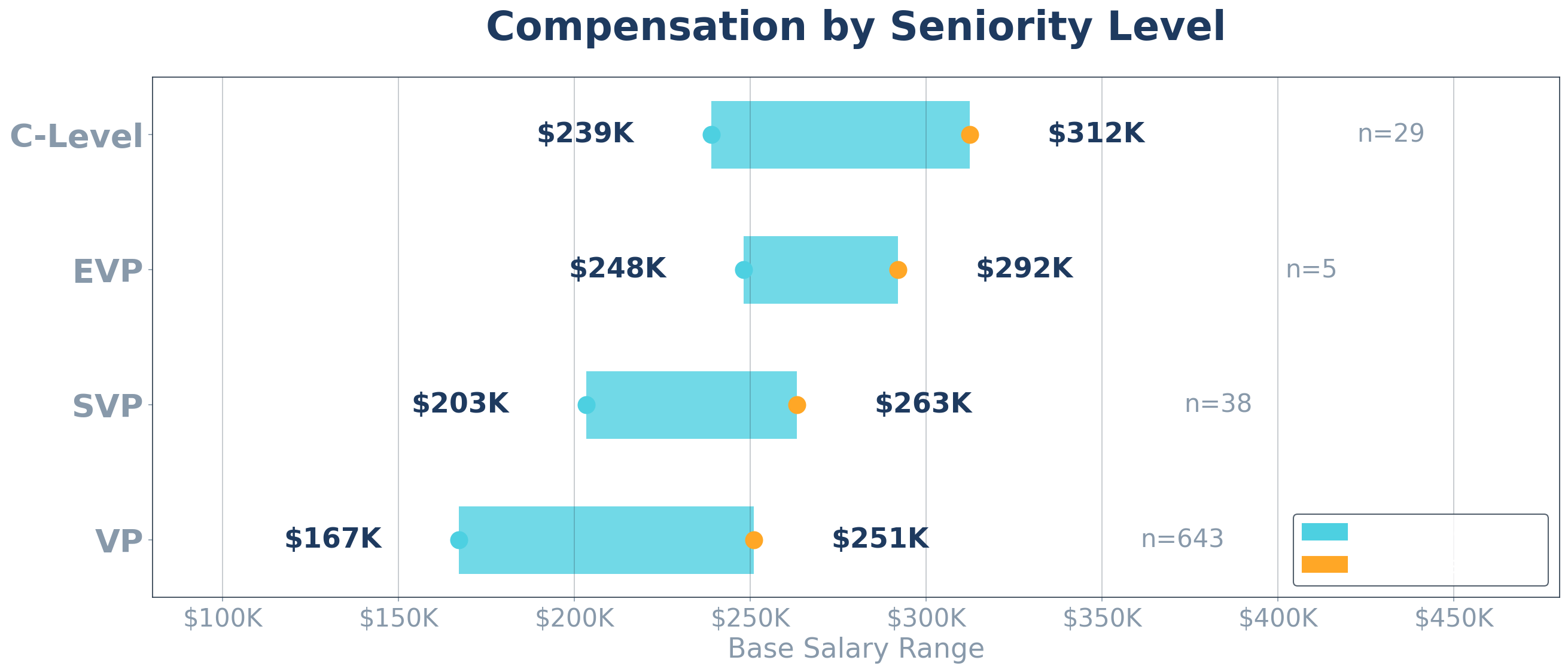
Look at the EVP tier. Five roles with an average range of $248K-$292K. That sits between VP and C-Level, which makes sense on paper. But with a sample of five, don't treat that as gospel.
The real takeaway from this table: SVP and C-Level comp ranges nearly overlap. An SVP averaging up to $262K isn't far from a CRO averaging $302K. The title bump from SVP to CRO doesn't deliver the pay jump most people expect. For detailed breakdowns, see our CRO salary analysis and VP Sales salary data for 2026.
Scope, Not Title, Determines Pay
If you want proof that titles are decoration and scope is what pays, look at these postings from our dataset.
Augean Robotics posted a CRO at $550K-$600K. Burro, another robotics startup, did the same. Those are huge numbers for what are essentially early-stage companies. But they're hiring someone to build the entire commercial function from scratch, in a category where customers don't know they need the product yet. That's a hard job. The comp reflects the scope.
Now look at Fieldwire. They posted a VP of Sales at $400K-$600K. Seed/Series A stage. A VP title that pays more than most CROs in the dataset. The posting wasn't mislabeled. The scope of that role, building the go-to-market for construction technology, justified the number regardless of what they called it.
Then there's Visa. VP Sales Leader, $321K-$590K. Thomson Reuters, VP Sales, $322K-$598K. AVEVA, VP Market Sales, $376K-$628K. These are VP titles clearing half a million at the top end. The average CRO in our data maxes out at $302K.
What these roles share: large revenue responsibility, complex selling motion, and strategic importance to the business. The companies calling them "VP" instead of "CRO" had their own reasons for that. Maybe the CEO wanted to keep the C-suite small. Maybe there's already a CRO above. Maybe it's just how that company titles things. The pay didn't care.
When you're evaluating an opportunity, ask about headcount, quota, and P&L ownership. Those three things predict comp better than the title ever will.
When Companies Hire a CRO vs VP Sales
Of the 1,349 postings we track, roughly 89% use VP-level titles. About 8% carry C-Level designations (CRO or CSO). The remaining 3% are SVP. That ratio holds across most company stages. VP of Sales is the default. CRO is the exception.
But when does the exception show up?
CRO titles tend to cluster around three inflection points. Pre-IPO companies adding a CRO to unify revenue operations before going public. Post-acquisition scenarios where someone needs to stitch together multiple revenue streams from combined entities. And category-creation plays where the company needs tight alignment between sales, marketing, and customer success because nobody's buying this thing off the shelf yet.
The comp data by company stage adds context.
| Company Stage | Roles (n) | Avg Base Low | Avg Base High |
|---|---|---|---|
| Seed / Series A | 14 | $192,955 | $257,169 |
| Series A/B | 38 | $147,289 | $183,553 |
| Series B/C | 30 | $164,710 | $226,373 |
| Series C/D | 79 | $222,046 | $314,444 |
| Late Stage | 27 | $224,635 | $318,772 |
| Enterprise / Public | 195 | $171,438 | $264,592 |
Series C/D and Late Stage companies pay the highest averages. That makes sense. These are the companies most likely to be pre-IPO or recently acquired, exactly when a CRO hire becomes relevant. Seed/Series A shows a surprisingly high range ($192K-$257K), but that's on a small sample of 14 roles. Many of those are founder-led companies hiring their first sales leader and giving them a big title to attract talent.
Notice that Series A/B actually pays the least ($147K-$183K). That's the stage where companies have product-market fit but haven't scaled revenue yet. They're hiring a VP Sales to build the machine, not a CRO to run the business. The budget reflects the expectation: build the team, prove the model, grow into bigger comp as the company scales.
Enterprise and public companies average $171K-$264K, which sits in the middle. The sample is huge (195 roles) and includes everything from mid-market VPs to segment leaders at Fortune 500 firms. The 11% premium that Late Stage companies pay over Series B/C roles tracks with the added complexity of pre-IPO operations.
The Reporting Structure Difference
This is where the titles actually mean different things, structurally.
A CRO reports to the CEO or the board. They own the full revenue number. Not just new business. Renewals, expansion, customer success, and sometimes marketing pipeline. The CRO decides how the company generates revenue. They set the strategy, align the functions, and take the hit when the number misses.
A VP of Sales reports to the CRO. Or, at companies that don't have a CRO, directly to the CEO. They own sales execution. Quota attainment. Rep productivity. Pipeline management. Forecast accuracy. Deal strategy. The VP of Sales builds and runs the sales machine. The CRO decides where the machine points.
In practice, this distinction gets blurry. Plenty of "VP Sales" roles at smaller companies are doing CRO-level work because there's nobody above them. They're setting the go-to-market strategy, managing CS, influencing marketing spend, and reporting to the CEO. They just don't have the C in their title.
| Dimension | CRO | VP of Sales |
|---|---|---|
| Reports to | CEO / Board | CRO or CEO |
| Owns | Total revenue (new, expansion, retention) | Sales team execution and quota |
| Cross-functional | Sales + CS + RevOps + sometimes Marketing | Sales team and sales ops |
| Board interaction | Regular board presentations | Occasional, usually through CRO |
| Strategic scope | GTM strategy, pricing, market selection | Sales process, team structure, territory design |
| Hiring frequency | ~8% of postings | ~89% of postings |
When you see a CRO posting that mentions owning "customer success, revenue operations, and demand generation" alongside sales, that's the real deal. When you see a CRO posting that only mentions sales targets and team building, that's a VP Sales with a shiny title. Both exist in the wild.
The way to tell the difference during interviews: ask what functions report to this role. If it's only the sales team, it's a VP Sales job regardless of what the offer letter says. If it's sales plus CS plus RevOps, you're looking at actual CRO scope.
Title Inflation: The $90K "VP of Sales"
Some of the postings in our dataset are head-scratchers.
We've tracked "VP of Sales" roles paying $90K-$150K base. That's individual contributor comp in most markets. A $90K VP Sales is not a VP Sales. It's an account executive with a title designed to make the company look bigger than it is, or to make the candidate feel good about a below-market offer.
- "VP of Sales" at $60K-$150K base. At this comp range, you're being hired as an IC or player-coach. There's nothing wrong with that, but understand what you're signing up for. You won't be building a team with that budget.
- "CRO" at seed stage with $50K-$100K base. This is a contractor gig dressed up as a C-Level role. Real CRO comp doesn't start with a 5. If there's meaningful equity, maybe. But the cash comp signals that this company doesn't have the budget for the role they're advertising.
- Wild salary ranges like $30K-$1,000,000. Yes, we've seen this. It means the company hasn't defined the role, doesn't know what they want to pay, or is gaming job board algorithms. All bad signs.
Title inflation hurts everyone. Candidates take roles that don't match their experience level and fail. Companies get frustrated with "VPs" who can't operate at a VP level. And the people who've actually earned these titles through years of execution get lumped in with folks who've never managed a quota-carrying team.
When you're evaluating a posting, cross-reference the comp against our salary benchmarks. If a VP Sales role pays below $150K base, dig deeper. Ask about team size, quota, and what the last person in this seat did. The title might be aspirational.
Which Title Should You Pursue?
Depends on what you want. And what the market actually offers.
89% of executive sales openings are VP-level. That's where the volume is. If you're a Director or Senior Director looking to make the jump, VP Sales is the realistic next step, and there are roughly 1,200 roles in our dataset to prove it. Chasing CRO-only opportunities means you're competing for about 8% of the market.
But volume isn't everything. If you've already run a full-cycle revenue organization, if you've owned CS and RevOps alongside sales, if you've done board presentations and set pricing strategy, then yes, a CRO title reflects what you actually do. Pursuing it makes sense. Just know that the hiring volume for that title is thin.
The VP Sales path
You want VP Sales if you love building sales teams and optimizing execution. If your idea of a great Tuesday is reviewing pipeline, coaching deals, and redesigning territory models, this is your lane. The comp ceiling is higher than most people think: our data shows VP roles paying up to $628K (AVEVA) and $598K (Thomson Reuters). You don't need a CRO title to earn CRO money. You need CRO-level scope at a company that calls it VP.
The CRO path
You want CRO if you want to own the entire customer revenue journey. If you're the person who gets frustrated when marketing and CS aren't aligned with sales, if you think about unit economics and lifetime value before you think about pipeline coverage, CRO is the right ambition. But be honest about readiness. Most CRO postings require experience running multiple revenue functions, not just sales. If you haven't managed CS or RevOps, the title will be a stretch.
The practical move
Take the role with the broadest scope you can get, regardless of title. A VP Sales who owns CS retention targets and works closely with RevOps is building a CRO resume. A CRO who only manages an AE team is doing VP work. Scope compounds. Titles come and go. The job board has current openings if you want to see what's available right now.
One more thing. 411 of the 1,349 postings in our dataset mention AI or ML requirements. Whatever title you're pursuing, build fluency in how AI is reshaping the sales motion. That's table stakes for either role going forward. Our tools section covers the platforms that matter.
What This Means for Hiring Companies
If you're posting a CRO role, make sure you mean it.
A CRO should own revenue holistically. Sales, customer success, revenue operations, and ideally have influence over demand generation. If you're hiring someone to build the sales team and hit a quota, that's a VP of Sales. Calling it CRO because it sounds more senior doesn't help. You'll attract candidates who want strategic, cross-functional work. When they get there and find out they're managing AEs and running weekly forecasts, they'll leave in 18 months.
We've tracked this pattern repeatedly. Consultative selling shows up in 172 postings. MEDDIC or MEDDPICC methodology appears in 117. Healthcare dominates at 720 postings, with technology close behind at 719. These are real skill requirements that should shape your hiring spec more than whether you stamp "CRO" or "VP" at the top.
Getting the comp right
Companies posting VP Sales roles below $150K are fishing in the wrong pond. The average VP base starts at $167K (low end) across our 636-role sample. Go below that and you'll get junior candidates punching above their weight, or experienced people who are desperate. Neither leads anywhere good.
For CRO hires, the C-Level average starts at $231K base. If you can't budget that, hire a VP Sales and promote them to CRO when the company can afford the role properly. That path is more common than you'd think, and it works.
Remote changes the math
43.9% of the roles we track are remote. That's not a footnote. If you're competing for a CRO or VP Sales and you're requiring five days in an office, you've eliminated nearly half the candidate pool before you've started. Some companies have good reasons for in-person requirements. Many don't. The data on this is clear, and the candidates know it.
Frequently Asked Questions
What is the salary difference between a CRO and VP of Sales?
Based on 1,349 tracked executive sales postings, C-Level roles (CRO/CSO) average $231K-$302K base salary, while VP-level roles average $167K-$251K. That's roughly a $51K-$84K gap at the averages. However, the ranges overlap significantly: top VP roles at companies like Visa ($321K-$590K) and Thomson Reuters ($322K-$598K) exceed what many CROs earn. Title alone doesn't determine pay.
Is a CRO higher than a VP of Sales?
In most org charts, yes. A CRO is typically a C-suite executive who reports directly to the CEO or board and owns the full revenue engine: sales, customer success, and sometimes marketing. A VP of Sales usually reports to the CRO (or CEO at smaller companies) and owns sales team execution specifically. That said, only about 8% of executive sales postings carry the CRO title. The vast majority (89%) are VP-level.
When should a company hire a CRO instead of a VP of Sales?
Companies typically hire a CRO at inflection points: pre-IPO stage when they need unified revenue accountability, post-acquisition when integrating multiple revenue streams, or during category creation when sales, marketing, and CS need tight alignment. If you need someone to build and run the sales team, hire a VP of Sales. If you need someone to own the entire revenue number across multiple functions, that's a CRO.
What percentage of sales leadership postings are VP-level vs CRO?
Of the 1,349 executive sales postings tracked by The CRO Report since January 2025, approximately 89% are VP-level titles, roughly 8% are C-Level (CRO or CSO), and about 3% are SVP. The VP of Sales title dominates across every company stage from seed to public.
Can a VP of Sales make more money than a CRO?
Absolutely. Our data shows multiple VP-level roles that exceed typical CRO compensation. Fieldwire posted a VP of Sales at $400K-$600K. Visa listed a VP Sales Leader at $321K-$590K. Thomson Reuters posted VP Sales at $322K-$598K. Meanwhile, some CRO roles at early-stage companies pay $50K-$100K. Scope and company stage matter far more than the title on the business card.
What does a CRO actually do that a VP of Sales doesn't?
A CRO owns the full revenue lifecycle: new business, expansion, retention, and sometimes marketing pipeline. They set go-to-market strategy across departments and are accountable to the board for total revenue outcomes. A VP of Sales owns sales execution: quota attainment, rep productivity, pipeline management, and deal strategy. A VP Sales builds and runs the sales machine. The CRO decides where the machine points.
Get the Full Picture Every Week
The CRO Report newsletter delivers compensation trends, market shifts, and hiring signals from our proprietary dataset of 1,349+ executive sales postings. Straight data. No fluff.
Subscribe to The CRO ReportMethodology: This analysis is based on 1,349 executive sales job postings tracked weekly by The CRO Report since January 2025. Compensation data reflects 704 roles with disclosed salary information. Postings are sourced from public job boards, company career pages, and verified third-party platforms. "Base salary" refers to disclosed base compensation ranges; OTE, equity, and bonus structures are not included in the averages cited. All data is continuously updated and published via our Substack newsletter.
About the author: Rome Thorndike is VP Revenue at Firmograph.ai and the publisher of The CRO Report. He has 15+ years in B2B sales leadership, including roles at Salesforce, Microsoft, Snapdocs, and Datajoy (acquired by Databricks). MBA from UC Berkeley Haas School of Business.
Last updated: January 30, 2026