MEDDPICC Interview Questions: How to Assess Real Fluency (Not Just Buzzwords)
Every candidate says they know MEDDPICC. Most don't. Here's how to tell the difference in 45 minutes, based on data from 1,298 executive sales postings and a scoring framework we built for exactly this problem.
117
Postings Require MEDDPICC
4
Assessment Categories
25%
Weight on Champion (Highest)
1-4
Scoring Scale
Why Most MEDDPICC Interviews Fail
You've seen the resume. "Expert in MEDDPICC." You've heard the claim in the phone screen. "Oh yeah, we used MEDDPICC religiously at my last company." And then you get to the onsite, ask a real question, and watch the whole thing fall apart.
The problem isn't that candidates are lying. Some are, sure. But most believe they know it. They sat through the training. They filled out the fields in Salesforce. They can recite Metrics, Economic Buyer, Decision Criteria, Decision Process, Paper Process, Implicate Pain, Champion, Competition. Eight letters, all accounted for.
But recitation isn't fluency.
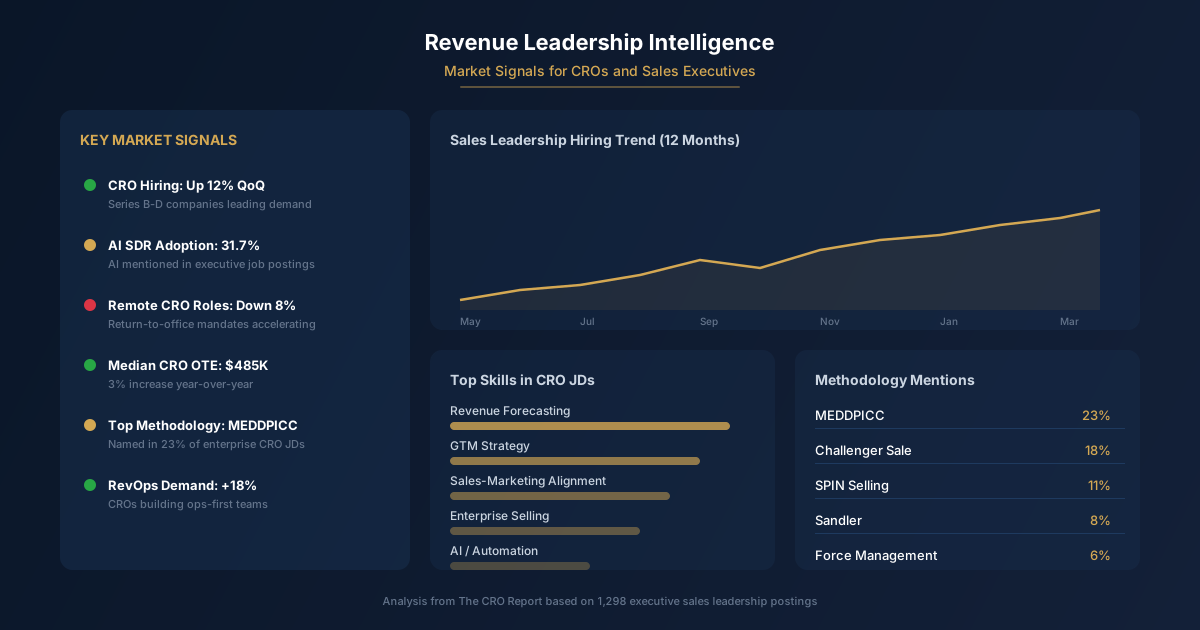
Across 1,298 executive sales postings we've analyzed, 117 mention MEDDIC or MEDDPICC as a requirement or strong preference. That's 9.0% of all VP Sales and CRO roles, making it the second most commonly cited methodology behind Consultative Selling at 13.2%. The companies asking for it aren't screening for vocabulary. They're screening for the ability to run a complex enterprise deal with discipline.
Your interview needs to test application, not recall. That means structuring questions around real deals, real failures, and real decision-making. Not "what does the P stand for?"
The core issue: Most interviewers don't have a consistent way to score MEDDPICC fluency across candidates. Two hiring managers evaluating the same candidate will often reach different conclusions because they're pattern-matching on gut feel, not comparing against defined behavioral anchors.
The Scoring Framework
We built the MEDDPICC Hiring Rubric to solve this. It's a weighted scorecard that covers four assessment categories, each with a 1-4 scale tied to specific behavioral anchors. Here's how the weights break down and why.
Framework Knowledge gets 20%. It matters, but it's the easiest thing to fake or cram for. Pain & Metrics gets 20% because uncovering and quantifying pain is a foundational skill, but it's also testable through other methodologies. Champion Identification & Testing gets the highest weight at 25%. It's the hardest skill to develop, the most commonly botched, and the single biggest predictor of whether someone actually closes enterprise deals or just forecasts them. Economic Buyer Access rounds it out at 15%, testing whether the candidate can navigate organizational power structures.
The 1-4 scoring scale:
Score
Level
What It Means
1
Awareness
Can define the terms. No real-world application. Textbook answers only.
2
Competent
Has used MEDDPICC in deals. Can give basic examples but lacks specificity or nuance.
3
Proficient
Strong, specific examples from real deals. Understands why each element matters and how they interact.
4
Expert
Teaches others. Adapts the framework to different deal types. Can explain failures and what they'd do differently.
The goal isn't to find someone who scores a 4 across the board. That's rare and depends heavily on role level. The goal is to compare candidates consistently. A senior AE who scores 3-3-2-3 is a very different hire than one who scores 4-1-2-1, even if their averages are close.
Framework Knowledge Questions (20% Weight)
This category is the warm-up, but it's not a throwaway. You're testing whether someone understands why the framework exists, not just what the letters stand for. Ask one of these early to set the tone, then move on. Don't spend more than 5-7 minutes here.
Primary Question
"Walk me through how you'd qualify a $500K enterprise deal using MEDDPICC. Where do you start, and what's the sequence?"
This is deliberately open-ended. A score-1 candidate will start reciting the acronym letter by letter. A score-3 or score-4 candidate will talk about the deal in terms of what information they need to de-risk the forecast, likely starting with pain or champion, not metrics.
Follow-up
"What's the difference between MEDDIC, MEDDICC, and MEDDPICC? Does it matter?"
This separates people who learned one version from people who understand the evolution. A strong answer acknowledges that the Paper Process and Competition additions address real gaps, particularly in complex enterprise cycles with procurement involvement. A weak answer is "I'm not sure" or "they're basically the same thing."
Calibration Question
"Which element of MEDDPICC do you think gets the least attention on most sales teams? Why?"
There's no single right answer here, but the quality of the reasoning matters. You'll hear strong candidates point to Implicate Pain (most reps accept stated pain at face value) or Paper Process (most reps ignore it until the deal stalls in procurement). Weak candidates pick one randomly and can't explain why.
What good vs. bad answers look like
Score
What You Hear
1
Gets letters wrong or mixes up definitions. "I think the first P is for Process?" Relies entirely on memorized definitions with no personal context.
2
Correct definitions, delivered like a textbook. Can name the elements but talks about them as a checklist rather than a diagnostic tool.
3
Accurate and contextual. Explains why certain elements matter more in specific deal scenarios. References real situations where the framework changed their approach.
4
Nuanced understanding of variations and tradeoffs. Can explain when strict MEDDPICC is overkill (transactional deals) and when it's insufficient (multi-BU enterprise). Mentions how they've adapted it.
Pain & Metrics Questions (20% Weight)
This is where you find out if the candidate can do discovery or just talk about it. The distinction between stated pain ("we need a better tool") and implicated pain ("this problem is costing you $2.3M annually in lost productivity across your 400-person team") is where deals get made. Reps who can't bridge that gap will consistently lose to competitors who can.
Primary Question
"Tell me about a deal where the customer didn't initially see the pain point. How did you surface it, and how did you quantify the business impact?"
You want specifics. Company name (or disguised version), deal size, the exact questions they asked to move from "we're doing fine" to "this is a $3M problem." Vague answers like "I asked good discovery questions" are a score-1.
Follow-up
"What questions do you typically ask to implicate pain? Walk me through your discovery flow."
Strong candidates have a repeatable discovery framework. They'll reference something like impact questions, quantification, and multi-level pain (personal, departmental, business). Weak candidates describe a general conversation without structure.
Stress Test
"Give me an example where you quantified the pain but the customer still didn't buy. What happened?"
This is underrated. A candidate who's never lost a deal despite quantified pain either hasn't sold enough or isn't being honest. The good answer explains that pain quantification alone isn't sufficient without champion access, economic buyer alignment, or differentiated metrics.
Score
Pain & Metrics Assessment
1
Describes product features instead of customer pain. Can't differentiate between stated and implicated pain. No metrics in any example.
2
Identifies pain but can't quantify the business impact. Says things like "they were frustrated with their current solution" without tying it to revenue, cost, or risk numbers.
3
Clear pain-to-metric connection with specific numbers from a real deal. Can explain how the metric influenced the deal's urgency and budget.
4
Multi-level pain analysis: business impact, department impact, and personal impact for the buyer, all quantified. Uses metrics strategically to create urgency and justify pricing.
Champion Questions (25% Weight, Most Critical)
This is where you separate real practitioners from pretenders. Full stop.
Every candidate will tell you they had a champion. Press on what that actually means and you'll find out fast whether they're describing someone who liked them and took their calls, or someone they coached to sell internally on their behalf. That's the difference. A champion isn't a friendly contact. A champion is someone with power and influence who's actively spending their political capital to push your deal through when you're not in the room.
Give this section the most time. 10-15 minutes minimum.
Primary Question
"How do you test if someone is actually your champion versus just being friendly or enthusiastic about your product?"
This is the money question. You're looking for a methodology, not a feeling. Strong candidates describe specific tests: asking the contact to do something difficult (set up an EB meeting, share internal docs, push back on a competitor's narrative internally). They'll talk about incremental commitment. Weak candidates say "you can just tell" or "they were really engaged in demos."
Deal Story
"Tell me about a time your champion couldn't get the deal done. What happened, and what did you learn?"
If they've never had a champion fail, they've either never done enterprise sales or they're not being straight with you. The insightful answer reveals what they missed: the champion didn't have enough organizational influence, they hadn't multi-threaded, the champion's priorities shifted, or the champion was actually a coach. What they did about it matters more than the failure itself.
Coaching Probe
"Describe how you've coached a champion to sell internally. What did you give them, and how did you prepare them for objections they'd face from their own team?"
This is the expert-level question. Score-4 candidates will describe building internal business cases, prepping their champion for specific objections from finance or IT, providing ROI materials tailored to the EB's priorities, and rehearsing with the champion before key internal meetings. Score-2 candidates say "I sent them some slides."
Edge Case
"What do you do when you realize your champion has been overselling their influence? How do you recover?"
This tests adaptability. Strong answers involve multi-threading to find an additional champion or going above to the EB directly. Weak answers involve waiting and hoping or blaming the champion for the deal slipping.
Champion scoring anchors
Score
Champion Assessment
1
Confuses champion with "friendly contact" or decision-maker. Uses "champion" interchangeably with "main point of contact." No testing methodology.
2
Understands the definition of a champion but can't describe how they test for it. Examples are vague or rely on the champion self-identifying.
3
Clear champion criteria and describes specific tests they've used. Can articulate the difference between a coach and a champion. Gives at least one failure example.
4
Multiple testing methods. Describes how they developed a champion over time. Coaches champions with specific internal selling tools. Can explain failures and course corrections in detail.
Why 25% weight? Champion identification is the single most predictive element of deal success in complex sales. It's also the hardest to train. A rep who's strong on champion but mediocre on framework knowledge will outperform the reverse almost every time. Weight your scoring accordingly.
Economic Buyer Questions (15% Weight)
Navigating to power is a skill that compounds with experience. Junior reps often accept that their main contact "has the budget." Senior reps know that budget authority and signing authority are different things, and that finding the economic buyer early saves months of deal slippage later.
Primary Question
"How do you identify the economic buyer on a deal? Walk me through a specific example where it wasn't obvious."
The best answers describe a systematic approach: asking about the approval chain, understanding budget cycles, using org-chart analysis. The example should show a deal where the person they initially thought was the EB turned out not to be.
Navigation Question
"How do you get access to the economic buyer when your champion is blocking you or doesn't want you going above them?"
This is a real scenario that happens constantly. Weak candidates have no answer or say they'd force it. Strong candidates describe strategies: getting the champion to see the EB meeting as protecting the deal rather than threatening their status, providing a business case the champion can use to justify the meeting, or finding a parallel path through a different stakeholder.
Validation Question
"Has the economic buyer ever killed a deal you thought was done? What happened?"
The answer should be yes. If it hasn't happened, the candidate either hasn't run enough complex deals or isn't tracking who actually signs off. The learning from that experience matters. Did they change how early they map the EB? Did they start validating EB alignment before submitting proposals?
Score
Economic Buyer Assessment
1
Assumes the person they're talking to has budget authority. Doesn't ask who signs the contract until late in the deal. Confuses EB with decision maker.
2
Knows to ask about budget authority but doesn't have a consistent method for identifying or accessing the EB. Limited examples.
3
Clear discovery questions for EB identification. Uses champion to gain access. Can describe specific deals where EB engagement changed the outcome.
4
Multi-threaded approach to EB access. Validates EB through paper process questions. Builds relationships with procurement and finance proactively. Adjusts strategy based on EB's priorities vs. champion's priorities.
Red Flags in Candidate Answers
After running this rubric across enough candidates, patterns emerge. These are the warning signs that show up repeatedly in interviews with candidates who look great on paper but don't have the depth you need.
Can't name a specific deal. Everything is "generally" or "typically" or "at my last company we would..." without a single concrete example. The deal doesn't need to be named, but it needs to have a size, a timeline, and an outcome.
Uses only textbook definitions. They can define every letter perfectly but stumble the moment you ask "tell me about a time when..." Application-level questions expose the gap between training and practice immediately.
Claims 100% win rate on qualified deals. Either their qualification criteria were so conservative they only worked slam dunks, or they're inflating. Either way, it signals a lack of experience with competitive enterprise cycles.
Can't articulate a deal they lost because of poor qualification. This is maybe the most telling. If a rep has been carrying quota for 3+ years and has never lost a deal they should have disqualified earlier, they're either not reflecting on their process or not being honest about it.
Confuses champion with economic buyer. These are fundamentally different roles. A champion sells for you internally. An economic buyer controls the budget. Sometimes they're the same person. Usually they're not. Conflating them signals a surface-level understanding.
Takes credit for team wins without explaining their specific actions. "We closed a $1.2M deal" is different from "I identified the champion, coached them through the internal review, and got the EB meeting that unlocked the final approval." You need the second version.
Has never lost a champion or misidentified one. Everybody has. If they say they haven't, they probably haven't sold enough complex deals to have developed real champion-testing instincts.
Adapting by Role Level
What you should expect from an AE with two years of quota experience is fundamentally different from what you should expect from a Director of Enterprise Sales. The same questions work across levels, but the scoring thresholds and category emphasis should shift.
AE (0-2 Years Carrying Quota)
Focus the interview on framework knowledge and pain/metrics. They should demonstrate working knowledge: correct definitions, at least one real deal example, and basic champion identification.
Shift emphasis to champion testing and EB access. They should have multiple deal stories with specific numbers. Expect them to describe testing their champion and navigating organizational politics.
Red flag at this level: can't give a detailed champion example or has never lost a deal to poor qualification.
Minimum passing: 2.5 average
Enterprise AE (5+ Years)
Full depth across all categories. They should score 3+ on champion and EB access. Expect nuanced answers about adapting MEDDPICC to different deal types, multi-BU engagements, and long cycle lengths.
At this level, they should also articulate how MEDDPICC interacts with other frameworks they've used.
Minimum passing: 2.5 average, 3+ on Champion
Sales Manager / Director
The interview shifts from "can you execute MEDDPICC" to "can you coach and enforce it." They should describe how they've built MEDDPICC into deal reviews, pipeline inspections, and rep coaching. How do they hold reps accountable?
Expect them to design a MEDDPICC process for a new team, not just describe following one.
Minimum passing: 3.0 average, 3+ on Champion
One thing to keep in mind: a score-4 AE might be better suited for a senior role, and a score-2 candidate with strong adjacent skills (industry expertise, technical depth, existing relationships) might still be your best hire. The rubric gives you data. It doesn't replace judgment.
Putting It All Together in 45 Minutes
Here's a realistic time allocation for a single MEDDPICC-focused interview:
Minutes 1-5: Rapport and one framework knowledge question to calibrate.
Minutes 5-15: Pain & metrics deep dive. One primary question, one follow-up. Get a specific deal story.
Minutes 15-30: Champion section. Two questions minimum. This is the meat of the interview. Let the candidate talk and probe on specifics.
Minutes 30-40: Economic buyer. One primary question, one follow-up. Check for systematic thinking.
Minutes 40-45: Candidate questions and close.
Score immediately after the interview while it's fresh. Don't wait until you've seen all candidates. You can always recalibrate later, but initial scoring captures your in-the-moment assessment before recall bias sets in.
If you're running a panel, have each interviewer score independently before comparing. Disagreements on scores are useful data points. If one interviewer gave a 3 on champion and another gave a 1, figure out what each of them heard differently. That conversation will sharpen your rubric over time.
The complete scoring rubric with all 15+ questions, behavioral anchors for every score, candidate comparison templates, and the red flag checklist. Built for VPs and managers hiring AEs and sales leaders.
Plan for 5-7 questions across the four assessment categories in a 45-minute interview. That gives you enough time for follow-ups and deal-specific probing without turning it into an oral exam. The full rubric includes 15-20 questions, but you won't need all of them in a single session. Pick 1-2 per category and let the follow-up conversations do the real work.
Champion identification and testing, weighted at 25% in our rubric. It's the hardest skill to fake and the one that most directly separates reps who close enterprise deals from reps who forecast them. A candidate who can articulate how they tested whether someone was a true champion versus a coach is demonstrating real field experience that no amount of training can replicate.
Yes. An AE with 0-2 years of quota should score at least a 2.0 average and demonstrate working knowledge. A Senior or Enterprise AE needs a 2.5+ with strong examples in champion testing and economic buyer access. A Sales Manager or Director should score 3.0+ overall and 3+ specifically on the champion category, because they need to coach their team on it, not just execute it themselves.
The top red flags: can't give a specific deal example (speaks only in generalities), confuses champion with economic buyer, claims they've never misidentified a champion, can't explain a deal loss through a MEDDPICC lens, and recites textbook definitions but stumbles on any application question. Any two of these together should give you serious pause.
Based on our analysis of 1,298 executive sales postings, 117 explicitly mention MEDDIC or MEDDPICC (9.0%). That puts it behind Consultative Selling (13.2%) and just ahead of Enterprise Sales methodology (7.9%). Adoption is growing, particularly at Series B+ SaaS companies. For more data on methodology requirements, check our full MEDDPICC market analysis.
This rubric is calibrated for quota-carrying AEs and sales leaders. SDRs and BDRs typically don't run full MEDDPICC qualification cycles, so a dedicated assessment would focus more on pain discovery and basic qualification skills. That said, if you're hiring SDRs into an organization that runs MEDDPICC, testing for framework knowledge (score 1-2 range) is reasonable to confirm they'll pick it up quickly.
About the data: Statistics in this article are based on analysis of 1,298 executive sales postings (VP Sales, CRO, and equivalent titles) collected and analyzed by The CRO Report. Methodology requirement data reflects explicit mentions in job descriptions. The MEDDPICC Hiring Rubric is a product of The CRO Report, developed from hiring practices across 15+ years of B2B sales leadership. For more on our methodology, visit About The CRO Report.
Author:Rome Thorndike, VP Revenue at Firmograph.ai. 15+ years in B2B sales across Salesforce, Microsoft, Snapdocs, and Datajoy (acquired by Databricks). MBA, UC Berkeley Haas.