I get asked this question more than any other: "How do I get to CRO?" Usually from a VP Sales or Director who's been grinding for a decade and wants to know what the next 5 years look like. Sometimes from an AE who's thinking 15 years out. The honest answer is that there's no single playbook. But there are patterns in the data, and they're worth studying.
The CRO title has exploded in the last 5 years. What used to be a role reserved for public companies now shows up at Series A startups. Our CRO job tracker sees it across every stage and industry. But the compensation gap between VP Sales ($167K-$251K base) and CRO ($231K-$302K base) tells you this is a fundamentally different job, not a title upgrade, with broader scope, higher stakes, and a longer list of things that can go wrong.
Here's what the path looks like, what accelerates it, and why a growing number of experienced leaders are skipping the full-time CRO role entirely.
Most CROs didn't plan to be CROs when they started. They were account executives who were good at closing and got promoted into management. From there, the path follows a pattern that looks roughly like this:
Stage
Duration
Base Salary Range
What You're Proving
Account Executive
2-3 years
$55K-$85K
You can sell. Consistently.
Sales Manager
2 years
$90K-$130K
You can build other people who sell.
Sales Director
2-3 years
$130K-$175K
You can run a number across multiple teams.
VP of Sales
3-5 years
$167K-$251K
You can own the entire sales org and forecast.
CRO
Open-ended
$231K-$302K
You can own all revenue: sales, CS, marketing, partnerships.
The biggest jump isn't compensation. It's scope. A VP of Sales owns the sales team. A CRO owns the revenue number, which means sales, customer success, sometimes marketing, and often partnerships. That scope expansion is where most people stumble. Being a great VP Sales doesn't automatically make you a great CRO, because you're moving from managing one function to orchestrating three or four. For a deeper look at this distinction, see our CRO salary breakdown.
The timeline compresses at startups. I've seen strong operators go from Director to CRO in 3 years at a Series B that tripled. But fast titles without the reps behind them create a different problem. Boards and CEOs pattern-match on experience. If you got the CRO title at a 40-person company and you're interviewing at a 400-person company, they'll ask whether you've done it at scale. The VP Sales stage is where most people should spend the longest. It's where you build the pattern recognition that makes the CRO job possible.
Does an MBA Help?
Short answer: it depends on where you go and what you're trying to accelerate.
According to MBA Guidance, the top MBA programs for sales leadership include Kellogg, Booth, and Berkeley Haas, where the median post-MBA salary exceeds $175K. That $175K number matters because it's roughly what a Sales Director makes after 7-8 years of grinding. An MBA from a top-10 program can compress the early career stages by 2-3 years, putting you into director-level roles faster.
MBA Guidance school data shows Kellogg produces more CMO and CRO track alumni than any other program. That network effect compounds over a career. When a CEO at a growth-stage company needs a CRO recommendation, they call their MBA network first. If you're in it, you hear about roles that never hit a job board.
But the data tells a different story: most CROs I know don't have MBAs. They got there through performance. They hit President's Club 4 years in a row, took a team from $5M to $25M ARR, and got promoted because they were the obvious choice. An MBA isn't a requirement for the CRO seat. It works as an accelerant when combined with a track record. Without the track record, it's an expensive credential that hiring managers see through quickly.
The best time for an MBA, if you're going to get one, is after your first management role. You've got enough context to absorb the strategy courses. You've got a network of classmates who'll be VP-level in 5-7 years. And you come out positioned for director or VP roles instead of going back to carrying a bag.
The Skills That Matter Most
Based on our analysis of CRO job postings, here's what companies screen for when they're hiring a Chief Revenue Officer. It's not what LinkedIn thought leadership would have you believe.
Cross-Functional Revenue Ownership
The number one differentiator between a VP Sales and a CRO is the ability to own revenue across functions. This means understanding customer success economics, marketing attribution, and channel partnerships at a level deep enough to make resource allocation decisions. If you've spent your entire career in sales and you can't have a detailed conversation about CAC payback periods or net revenue retention, you'll struggle in a CRO interview. Build this muscle before you need it.
Board-Level Communication
CROs report to CEOs and present to boards. The communication style is completely different from running a weekly pipeline review. Board members want to know: what's the revenue trajectory, what are the risks, and what resources do you need to hit the plan. They don't want a 45-slide deck. They want 3 slides with clear data and a point of view. Practice this before you're in the seat. Volunteer to present at board meetings in your VP Sales role. If your CEO won't let you, that tells you something about whether they see you as CRO material.
Forecasting Discipline
Every CRO lives and dies by forecast accuracy. Not because the board cares about precision for its own sake, but because a CRO who can't forecast can't plan headcount, can't set marketing budgets, and can't make the capital allocation decisions that drive growth. Our salary data shows CRO roles at Series B+ companies consistently list forecasting as a core requirement. This isn't new, just more visible now that companies have better data tools to tell when you're guessing.
GTM Architecture
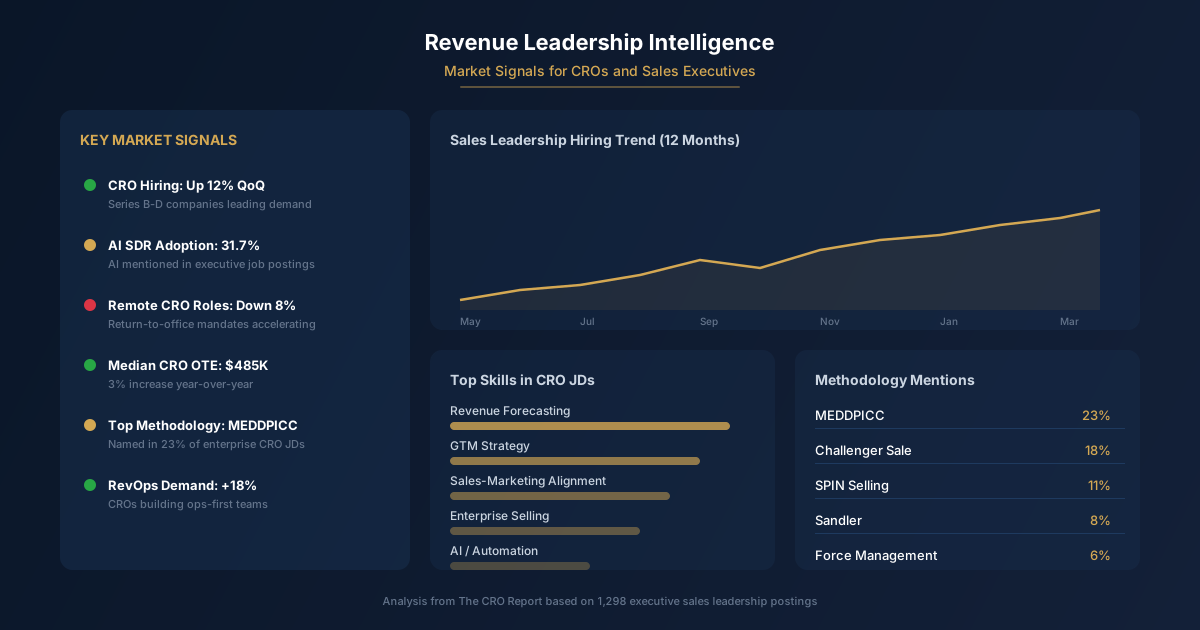
37.6% of executive sales postings in our dataset mention go-to-market strategy. At the CRO level, that means designing the GTM motion, not just executing one. Should you go product-led or sales-led? Direct or channel? Land-and-expand or enterprise-first? These are CRO decisions that shape the entire revenue org. The VP Sales who's spent 3-5 years running a sales team needs to demonstrate that they can think at this architectural level.
The Fractional CRO Alternative
Not every path to running revenue goes through a full-time CRO seat. Fractional Pulse tracks the fractional executive market where fractional CROs bill $250-$400/hour, often earning more per hour than their full-time counterparts.
Do the math. A full-time CRO earning $275K base works roughly 2,500 hours a year. That's $110/hour before variable comp. A fractional CRO billing $300/hour for 20 hours a week grosses $312K annually while working half the hours. The trade-off is obvious: no equity, no benefits, no job security. But for experienced operators who've done the full-time grind and want more control over their schedule, the economics are compelling.
The fractional model works best in specific situations:
Series A/B companies that need strategic revenue leadership but can't justify $400K+ total comp for a full-time executive. A fractional CRO at $15K-$30K/month gets them 80% of the value at 40% of the cost.
Companies in transition between a departing CRO and a full-time hire. The fractional fills the gap for 3-6 months while the board runs a search.
Private equity portfolio companies that need revenue acceleration on a 12-18 month timeline. PE firms increasingly use fractional CROs across their portfolio rather than hiring full-time at each company.
The path into fractional work usually starts after your second or third VP Sales or CRO role. You need enough pattern recognition across different company stages and industries to walk into a new situation and diagnose it quickly. First-time VPs who try to go fractional tend to struggle because they haven't seen enough failure modes.
Compensation at Each Stage
Money isn't the only reason to pursue the CRO track, but it's not irrelevant. Here's what the progression looks like with total compensation modeled at standard variable splits:
Level
Base Range
Modeled OTE
Equity
Account Executive
$55K-$85K
$110K-$170K
Rare / minimal
Sales Manager
$90K-$130K
$135K-$210K
Token grants
Sales Director
$130K-$175K
$195K-$280K
0.05-0.15%
VP of Sales
$167K-$251K
$279K-$419K
0.10-0.50%
CRO
$231K-$302K
$385K-$600K+
0.25-1.00%
Fractional CRO
$250-$400/hr
$250K-$400K
Sometimes advisory
The biggest delta isn't between any two levels. It's the equity component at the CRO stage. A CRO at a Series B company with 0.50% equity on a $500M exit walks away with $2.5M on top of their cash comp. That's the math that keeps people in the full-time track even when the fractional hourly rate is higher. Equity is the CRO lottery ticket. It usually doesn't pay off, but when it does, it changes everything.
For current CRO job listings with disclosed compensation, check our tracker. We update it weekly.
The CRO path takes 12-18 years of deliberate career building. An MBA from a top program can compress the timeline by 2-3 years. The fractional alternative offers better hourly economics for experienced operators who've already done the full-time grind. No matter which route you take, the skills that matter most are cross-functional revenue ownership, board communication, and forecast discipline.
Frequently Asked Questions
How long does it take to become a CRO?
The typical path from individual contributor to CRO takes 12 to 18 years. That breaks down roughly as: 2-3 years as an AE, 2 years as a sales manager, 2-3 years as a director, 3-5 years as a VP of Sales, and then the CRO appointment. Some people compress the timeline by joining early-stage startups where titles move faster, but the experience gap catches up if you skip stages. The VP Sales stage is where you should spend the longest because that's where you build the pattern recognition a CRO needs.
Do you need an MBA to become a CRO?
No, an MBA is not required. Most CROs got there through performance, not credentials. That said, an MBA from a top program like Kellogg, Booth, or Berkeley Haas can accelerate the path by 2-3 years, especially for breaking into enterprise companies or making an industry switch. The median post-MBA salary exceeds $175K, which compresses the early career compensation timeline significantly. The best time for an MBA is after your first management role when you have enough context to absorb the material.
What does a fractional CRO cost?
Fractional CROs typically bill $250-$400 per hour, or $15K-$30K per month on retainer. That's often more per hour than full-time CROs earning $231K-$302K base salary. The fractional model works best for Series A/B companies that need strategic revenue leadership but can't justify a $400K+ total comp package for a full-time executive. Most fractional CROs work with 2-3 clients simultaneously.
What is the salary progression from AE to CRO?
Based on CRO Report data: AE base runs $55K-$85K, Sales Manager $90K-$130K, Sales Director $130K-$175K, VP of Sales $167K-$251K, and CRO $231K-$302K. Total compensation including variable is roughly 1.5-2x base at each level. The biggest single jump is from VP Sales to CRO, where base increases $64K on average and scope expands from sales-only to full revenue ownership including customer success, marketing, and partnerships.
Methodology & Disclosure: Salary ranges come from executive sales job postings tracked weekly by The CRO Report. VP Sales data is based on 636 VP-level roles; CRO data is based on 26 C-level roles with disclosed compensation. MBA program data is sourced from MBA Guidance. Fractional CRO rates are from Fractional Pulse market tracking. OTE figures are modeled at standard 60/40 base-to-variable splits for sales leadership. Individual compensation varies by company stage, industry, geography, and performance. Updated April 12, 2026.
The CRO Report is run by Rome Thorndike, VP Revenue at Firmograph.ai. 15+ years in B2B sales leadership including Salesforce, Microsoft, Snapdocs, and Datajoy (acquired by Databricks). MBA from UC Berkeley Haas.