The SDR Playbook Is Broken: What the Data Actually Shows
Quality conversations per SDR dropped 55% since 2014. 83% of teams miss quota. Average cost per meeting: $700. Industry data and 1,298 job postings tell the same story.
Doug Bell and Jordan Crawford published a detailed analysis of SDR productivity collapse earlier this year. Their data on declining conversations, broken unit economics, and buyer behavior shifts aligns with what we see in 1,298 executive sales job postings tracked weekly by The CRO Report. The industry-wide numbers and the hiring data point in the same direction: the volume-based SDR playbook that dominated the last decade no longer produces results at scale.
This piece combines their industry data with our proprietary job posting dataset. The industry metrics show the structural breakdown. The hiring data shows how companies are responding.
Data sources: Industry productivity data (conversation decline, cost per meeting, response rates) from Doug Bell and Jordan Crawford's analysis. CRO Report data from 1,298 executive sales postings tracked weekly. Full methodology in the disclosure at bottom.
The Productivity Collapse
In 2014, the average SDR had 8 quality conversations per day. By 2025, that number sits at 3.6. A 55% decline across a decade, during a period when companies invested more in sales technology than at any point in the history of B2B selling.
The supporting data paints a consistent picture. Cold email response rates dropped 27% in 2024 alone. Half of all SDR time goes to non-prospecting activities: list building, CRM hygiene, internal meetings, tool administration. And on the buyer side, 75% of B2B buyers now prefer rep-free experiences, with 67% completing their buying journey before ever contacting a salesperson.
These numbers, compiled by Bell and Crawford, describe a structural mismatch between how SDR teams operate and how buyers actually buy. The playbook that most teams still run was designed for a market where prospects had limited access to information, where cold outreach was a primary discovery mechanism, and where higher activity volume reliably produced more pipeline. That market no longer exists.
The standard response to declining productivity has been to increase inputs. More dials. More emails. More tools. More sequences. More automation. Companies added parallel dialers, AI email writers, intent data platforms, and multi-channel orchestration tools. Each wave of technology promised to restore the output levels that were declining, and each wave accelerated the problem instead. When every SDR team sends more automated emails, response rates drop further. When every company uses the same intent data providers, the signal-to-noise ratio collapses. The tools work in isolation. At market scale, they create an arms race where the only guaranteed winner is the vendor selling the tool.
The 55% decline in quality conversations is not a failure of individual SDRs or individual managers. It reflects the exhaustion of a model. Volume-based outbound worked when buyer attention was available and competition for inbox space was lower. Both conditions have reversed. Buyer attention is scarce, competition for it is at an all-time high, and the marginal return on each additional email or dial approaches zero for most teams.
Consider the 50% non-prospecting time figure. An SDR who spends half their day on list building, research, and administrative work has roughly 4 hours of actual prospecting time. At 3.6 quality conversations per day, that works out to less than one quality conversation per hour of prospecting. The rest of those hours produce voicemails, bounced emails, and no-shows. A decade ago, the same 4 hours of prospecting yielded 8 conversations. The effort-to-outcome ratio has more than doubled.
The buyer behavior data explains why. When 67% of the buying journey happens before a prospect picks up the phone, most cold outreach arrives at the wrong time. The prospect either hasn't started evaluating solutions (too early, your email gets ignored) or has already formed a shortlist (too late, your email gets ignored). The window where cold outreach is useful has narrowed, and volume-based approaches make no attempt to identify which prospects are in that window. They spray the entire addressable market and hope for statistical returns.
The 75% preference for rep-free experiences reinforces the point. Buyers increasingly self-educate through content, peer networks, review sites, and community recommendations. By the time they want to talk to a salesperson, they have specific questions about pricing, implementation, and integration. They do not want a discovery call that rehashes information they already found online. The volume-based SDR model is optimized for exactly the interaction buyers are trying to avoid.
None of this means outbound sales development is dead. It means the model that defined outbound for the last decade, high-volume, low-personalization, activity-metric-driven outreach, has reached its structural limits. The data is clear. The question is what replaces it.
The $700 Meeting and Where the Math Breaks
The average cost to book a single meeting through a traditional SDR model is $700. That figure accounts for SDR compensation (base plus variable), management overhead, technology stack (CRM, dialer, email platform, data providers), office space or remote stipends, and the supporting infrastructure that keeps an SDR team running. Divide total SDR program cost by total meetings booked, and $700 is the industry benchmark.
At $700 per meeting, the math constrains which deals can be sourced profitably through SDR outbound. A standard rule of thumb for pipeline efficiency is that meetings should cost no more than 5% of the eventual deal value. At $700 per meeting, the minimum profitable deal size lands around $13,500. Anything below that threshold, and the SDR-sourced pipeline costs more to generate than it returns in margin.
This creates a specific problem for SMB and lower mid-market motions. A company selling a $5,000 annual contract cannot sustain SDR-sourced pipeline at $700 per meeting. The economics only work for enterprise and upper mid-market deals. Yet many companies with sub-$15K average deal sizes still run full SDR teams because the playbook has been so deeply embedded in B2B go-to-market strategy that questioning it feels heretical.
The market is starting to question it anyway. 83% of SDR teams fail to hit quota, according to Bell and Crawford's analysis. That number has been climbing for years, and it reflects the cumulative effect of declining productivity applied to a cost structure that hasn't adjusted. If your SDRs are producing 55% fewer quality conversations than they were a decade ago, but your cost per SDR has held steady or increased (salaries, tools, and management costs have all risen), the per-meeting cost rises and the quota math breaks.
36% of B2B companies downsized their SDR teams in 2025, the highest reduction among any sales role category. That's the market's verdict on the unit economics. Companies are not pulling back from outbound because they don't believe in pipeline generation. They're pulling back because the traditional model no longer produces pipeline at an acceptable cost.
The alternative approaches, account-based and pain-based targeting, show a different cost structure entirely. Bell and Crawford document account-based approaches producing 3x higher meeting rates and 2.5x better SQL conversion while requiring 3-5 targeted touches per prospect instead of the 10.6 average in traditional models. The cost per meeting drops from $700 to $50-$100 when you narrow the target list, invest in pre-outreach research, and lead with specific, pain-relevant value propositions instead of generic messaging.
Metric
Traditional SDR Model
Account-Based Approach
Meeting Rate
Baseline
3x higher
SQL Conversion
Baseline
2.5x better
Prospect Contacts
10.6 avg
3-5
Cost Per Meeting
$700
$50-$100
The 7x-14x cost reduction from $700 to $50-$100 per meeting is the number that should reshape how SDR leaders think about resource allocation. Fewer reps targeting the right accounts with better research produces more pipeline at lower cost than a large team blasting sequences at a broad TAM. The per-rep productivity goes up, the cost per meeting goes down, and the SQL conversion rate improves because the meetings that do get booked involve prospects who have a real, identifiable reason to buy.
The catch is that the account-based approach requires a fundamentally different operating model. You cannot simply tell your existing SDR team to "do more research." The research has to be structured. The targeting has to be data-driven. The messaging has to be specific to each segment's pain points. And the metrics have to shift from activity volume (dials, emails) to outcome quality (meeting-to-SQL rate, pipeline per rep). Most SDR organizations are not built for this transition, which is why the 83% quota miss rate persists even as the alternative approach proves out.
What 1,298 Executive Sales Postings Confirm
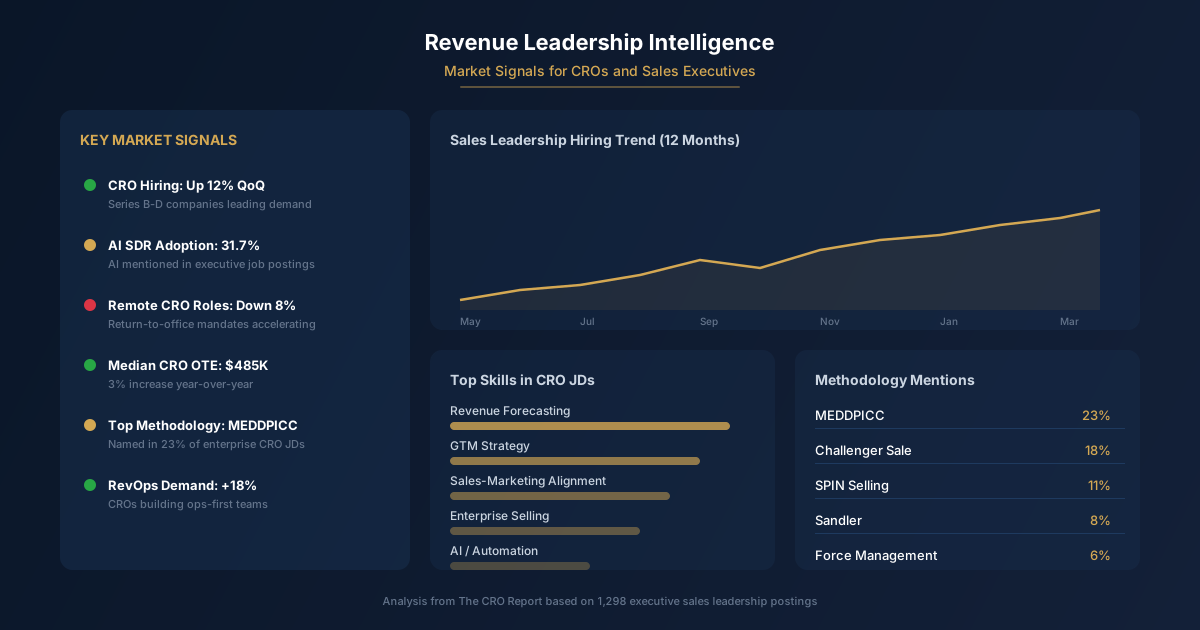
The CRO Report tracks 1,298 executive sales job postings weekly. When you look at which sales methodologies and competencies companies actually require from their sales leaders, the data confirms the shift away from volume-based models.
Consultative Selling appears in 172 of 1,298 postings (13.2%). This is the most requested methodology in the dataset. Consultative selling is fundamentally incompatible with spray-and-pray outbound. It requires understanding a buyer's business, identifying unstated needs, and guiding a complex evaluation process. You cannot do consultative selling with a volume SDR model because consultative selling demands the exact research, targeting, and personalization that volume models skip.
MEDDIC and MEDDPICC show up in 117 postings (9.0%). These structured qualification frameworks require SDRs and AEs to understand buyer pain, decision processes, economic impact, and competitive landscape before progressing a deal. A MEDDIC-qualified meeting requires the SDR to have done enough research to ask about metrics, economic buyer, decision criteria, and identified pain. That level of pre-meeting preparation is incompatible with booking 10+ meetings per week through high-volume sequences.
Enterprise Sales appears in 102 postings (7.9%). Enterprise deals are multi-threaded, involve 6-10 stakeholders, run 6-18 month sales cycles, and require coordinated engagement across business and technical buyers. The volume model's single-threaded outreach to one contact per account is structurally mismatched to enterprise buying processes.
Channel and Partner selling shows up in 87 postings (6.7%). Partner motions require relationship building, co-selling coordination, and joint business planning. These are inherently human, relationship-driven activities that cannot be automated through volume outreach.
At the lower end of the frequency scale, ABM appears in 11 postings (0.8%), still small but growing, and directly aligned with pain-based segmentation over volume. Product-Led Growth (PLG) at 16 postings, Challenger at 16, and Value Selling at 14 all emphasize understanding the buyer's world and delivering targeted value over sheer activity volume.
Methodology
Postings
% of 1,298
Consultative Selling
172
13.2%
MEDDIC/MEDDPICC
117
9.0%
Enterprise Sales
102
7.9%
Channel/Partner
87
6.7%
PLG
16
1.2%
Challenger
16
1.2%
Value Selling
14
1.1%
ABM
11
0.8%
The pattern across every growing methodology in the dataset is the same: targeting, qualification, and buyer understanding over activity volume. Companies are hiring leaders who can build teams that engage the right accounts with the right message, not leaders who can scale dial counts. The methodology data and the productivity collapse data are describing the same market shift from two different angles.
When you cross-reference methodologies with the industry productivity data, the alignment is striking. Companies whose job postings require consultative selling or MEDDIC are implicitly acknowledging that their buyers require a higher-touch, more researched engagement model. They are building their hiring profiles around the approach that Bell and Crawford's data shows works, even if many of those companies haven't fully transitioned their SDR operations to match.
The alternative to volume-based outbound starts with a different question. Traditional SDR models ask: "How many accounts fit our ICP?" Pain-based segmentation asks: "Which accounts are experiencing a specific problem our product solves, right now?"
The difference in starting question produces a different operating model at every step.
Define pain-based segments using real data
Instead of building target lists from firmographic filters (industry, company size, geography, technology stack), pain-based segmentation identifies specific business problems and maps them to observable signals. A company that just lost its VP of Sales is experiencing a different pain than a company that just missed earnings. A company expanding into Europe has different needs than one consolidating after an acquisition. Each of these situations creates a specific, time-bound reason to buy, and each requires different messaging.
The firmographic approach treats all 50,000 companies in your TAM as roughly equivalent targets. The pain-based approach narrows that 50,000 to the 200-500 that have an active, observable reason to engage right now. The math shifts from "spray 50,000, get 50 meetings" to "target 300, get 50 meetings." Same output, 99.4% less volume, and the meetings that book are with prospects who have a real reason to take the call.
Investigate which prospects are actively experiencing pain
This step requires research infrastructure that most SDR teams don't have. It means monitoring job postings for leadership changes, tracking earnings calls for strategic pivots, watching press releases for expansion or contraction signals, and analyzing technographic data for stack changes that indicate buying windows. The data exists. Most SDR organizations don't systematically collect or act on it because their processes are built around static lists, not dynamic signals.
AI tooling fits naturally here. Using large language models to synthesize earnings transcripts, scan news feeds, and cross-reference company signals against your value propositions is the kind of research acceleration that produces real leverage. One data point from Bell and Crawford's analysis: their framework generated 1,800 pain-based value propositions in one hour at $0.07 per prospect. That's the cost of a fraction of one cold email for a level of research that would take a human SDR days.
Create value propositions that address pain directly
A generic email that says "I help companies like yours improve revenue" competes with 50 other generic emails in the prospect's inbox. A specific message that says "I noticed you posted three SDR roles in the last month while your Glassdoor reviews mention inconsistent pipeline coverage" lands differently because it demonstrates awareness of the prospect's situation. The prospect didn't have to explain their problem. You already knew.
This level of specificity is impossible at scale with traditional volume models. It becomes feasible when you narrow the target list to accounts where you've done the research. The messaging investment per account is higher, but it only needs to cover 300 accounts instead of 50,000.
Deploy targeted campaigns at lower volume but higher relevance
The output metrics shift when you move from volume to targeting. Traditional models measure success by dials, emails sent, and meetings booked. Pain-based models measure response rates per segment, meeting-to-SQL conversion, and pipeline generated per account. The volume numbers look smaller. The outcomes look better.
Bell and Crawford lay out a detailed tactical framework for this transition in their full analysis, including specific workflows for building pain-based segments, running AI-assisted research, and deploying targeted campaigns. Their case studies reinforce the model. One SDR, Frank, ignored traditional quota-driven outbound entirely. He built 3,000 LinkedIn connections over three months, tested messaging through email to validate what resonated, then ported the winning messages to LinkedIn. He now earns $700K as an AE. Another SDR, Ari, was sending 3,000-4,000 LinkedIn messages per week and nearly quit the profession out of frustration. After shifting to a targeted, pain-based approach, Ari moved into a GTM engineering role building AI-assisted prospecting workflows.
Both cases illustrate the same underlying point: reps who invested in understanding their prospects and building genuine relationships outperformed reps who invested in activity volume. The traditional playbook optimizes for dials. The replacement optimizes for relevance per conversation.
Where AI Fits Into the Fix
AI and machine learning appear in 411 of 1,298 executive sales postings (31.7%) in The CRO Report dataset. GenAI specifically appears in 21 (1.6%). The tools that companies actually name in job requirements tell a more specific story: Salesforce at 180 mentions, Outreach at 65, HubSpot at 48. Zero AI SDR tools (11x, Artisan, AiSDR, Regie.ai) appear in any posting.
That distribution reveals where the market sees AI adding value in sales development, and where it doesn't.
Where AI helps: research, enrichment, and account intelligence
The pain-based segmentation model described above requires a level of account research that is impractical for humans to do manually at any reasonable scale. This is where AI tools deliver clear ROI. Specifically:
Data enrichment. Tools like Clay ($149/mo), Apollo (free to $49/user/mo), and ZoomInfo ($15K-$50K+/yr) use AI to enrich account and contact records with firmographic, technographic, and intent data. This infrastructure makes pain-based targeting possible by giving SDRs the signals they need to identify which accounts have active buying triggers.
Account research synthesis. Using LLMs to summarize 10-K filings, earnings transcripts, press releases, and LinkedIn activity into prospect briefings. An SDR who walks into a call with a synthesized view of a prospect's strategic priorities, recent leadership changes, and competitive pressures is operating at a different level than one who read the company's "About" page.
Pain-point identification. AI can scan thousands of job postings, news articles, and financial filings to flag accounts showing specific pain signals. A company posting multiple SDR roles while its Glassdoor reviews mention pipeline problems is a different kind of target than a company that simply fits the firmographic profile.
Messaging assistance. First-draft email generation, subject line testing, and template optimization. The human still reviews, edits, and approves. AI reduces the time from research to outreach without removing the human judgment that makes outreach effective.
Where AI doesn't help: replacing the human conversation
The zero AI SDR tools in job postings is a data point about market maturity. Companies are not operationalizing fully autonomous AI-driven outbound at the level where it shows up in hiring requirements. The reasons map directly to the pain-based model: consultative selling (172 postings), enterprise sales (102 postings), and MEDDIC (117 postings) all require human judgment, relationship building, and contextual adaptation that current AI tools cannot replicate.
AI's role in fixing SDR productivity is as infrastructure underneath human reps, not as a replacement for them. Better data in, better targeting, better research, better first drafts, all leading to better human conversations. The 31.7% AI/ML figure in job postings reflects companies wanting leaders who understand how to use AI as that infrastructure layer. The 1.6% GenAI figure reflects how few companies have formalized generative AI as a core requirement.
For a detailed analysis of how AI adoption is showing up in executive sales hiring, see Will AI Replace SDRs?. For the specific tools companies are naming in their postings, see Popular Sales Tools 2026.
What SDR Leaders Should Measure Instead
The volume-based playbook runs on activity metrics: dials per day, emails sent per week, meetings booked per month. These metrics made sense when higher activity reliably produced more pipeline. With quality conversations down 55% and cost per meeting at $700, activity metrics now measure effort without measuring effectiveness. A rep who makes 80 dials and books 2 meetings that don't convert looks productive on the dashboard but contributed nothing to pipeline.
The shift to pain-based segmentation requires a corresponding shift in measurement. The metrics that matter in a targeted model track outcomes, not inputs.
Meeting-to-SQL conversion rate
This is the single most important metric for any SDR organization transitioning from volume to targeting. A traditional SDR team might book 10 meetings per rep per week with a 15% SQL conversion rate, producing 1.5 SQLs. A targeted team might book 4 meetings per rep per week with a 50% SQL conversion rate, producing 2.0 SQLs. Fewer meetings, more pipeline. The meeting-to-SQL rate tells you whether your targeting is working. If it stays flat or declines as you narrow your target list, the research and segmentation need improvement.
Pipeline contribution per rep
Total pipeline generated per SDR, measured in dollars, captures the full economic output of each rep. This metric naturally accounts for deal quality. A rep who books meetings with accounts that turn into $500K opportunities contributes more pipeline than a rep who books twice as many meetings with $50K accounts. Volume metrics miss this distinction entirely.
Average touches before meeting
In the traditional model, the industry average is 10.6 contacts per prospect before a meeting books. Account-based approaches bring this down to 3-5. Tracking touches per meeting is a direct measure of targeting efficiency. If your reps need 10+ touches to book meetings, the outreach is reaching the wrong people with the wrong message. If they book meetings in 3-5 touches, the targeting is working.
Segment-level response rates
Traditional SDR dashboards report aggregate response rates across the entire prospect pool. Targeted models need response rates broken down by pain-based segment. A segment built around "companies that just lost their CRO" might produce a 12% response rate while a segment built around "companies using a competitor" produces 4%. That data tells you which pain points are most actionable and where to concentrate resources. Aggregate response rates hide this signal.
Revenue per SDR
The ultimate metric: closed-won revenue attributed to each SDR's pipeline contribution. This requires tracking deals from initial SDR outreach through close, which means longer measurement cycles (6-12 months for enterprise). But it answers the question that activity metrics cannot: did this SDR's work produce revenue? A team of 3 SDRs generating $2M in closed-won revenue outperforms a team of 8 generating $1.5M, even though the larger team booked more meetings.
Running the pilot
Bell and Crawford recommend starting the transition with a pilot. Take your underperforming reps (the ones already missing quota under the traditional model) and run them on a targeted approach for 90 days. Compare the pilot group against the traditional group on the metrics above: meeting-to-SQL rate, pipeline per rep, touches per meeting, and segment response rates. The underperforming reps have the least to lose from the experiment and the most to gain from a model that values research and targeting over raw activity.
The 90-day window gives enough time to build pain-based segments, develop targeted messaging, and generate a statistically meaningful number of meetings for comparison. Most organizations that run this pilot see the targeted group outperform on conversion metrics within the first 60 days, even before the messaging is fully optimized.
The data summary: Quality conversations down 55%. Cost per meeting at $700. 83% of teams missing quota. 36% of companies downsizing SDR teams. And in 1,298 executive sales postings, every growing methodology emphasizes targeting and buyer understanding over activity volume. The traditional SDR playbook built pipeline for a decade. The decade where it works has ended. The replacement is already visible in the data.
Frequently Asked Questions
Why are most SDR teams missing quota?
83% of SDR teams miss quota. The root causes are structural: quality conversations per SDR declined 55% since 2014 (from 8 to 3.6 daily), cold email response rates dropped 27% in 2024, and the unit economics are broken at $700 per meeting. Buyer behavior has also shifted, with 67% completing their journey before contacting sales and 75% preferring rep-free experiences. The volume-based playbook was built for a different market.
What does an SDR meeting actually cost?
The industry average is $700 per meeting. This includes SDR salary, tools and technology stack, management overhead, and supporting infrastructure. At $700 per meeting, the minimum profitable deal size is approximately $13,500 (assuming meetings should cost no more than 5% of deal value). Account-based and pain-based approaches bring the cost down to $50-$100 per meeting by targeting fewer, better-matched accounts.
Is the traditional SDR model dead?
Not dead, but broken for most use cases. Volume-based spray-and-pray outbound struggles against buyer behavior changes: 67% of buyers complete their journey before contacting sales, and 75% prefer rep-free experiences. 36% of B2B companies downsized SDR teams in 2025. Account-based and pain-based approaches show 3x higher meeting rates, 2.5x better SQL conversion, and cost $50-$100 per meeting compared to $700.
What's the alternative to spray-and-pray outreach?
Pain-based segmentation. Define specific pain points using real data (not just firmographic filters), identify prospects actively experiencing those pain points through observable signals, create value propositions addressing them directly, and deploy lower-volume, higher-relevance outreach. Account-based approaches show 3x higher meeting rates and require 3-5 targeted touches per prospect instead of the 10.6 average in traditional models.
How does AI fit into fixing SDR productivity?
AI works best for research, enrichment, and account intelligence. AI/ML appears in 31.7% of 1,298 executive sales postings, but GenAI only in 1.6%. Zero AI SDR tools appear in job requirements. AI improves targeting by enriching data, synthesizing account research, and identifying pain signals at scale. Tools like Clay, Apollo, and ZoomInfo provide this infrastructure. AI helps SDRs have better conversations, not fewer human conversations.
Methodology & Disclosure: Industry data on SDR productivity decline, cost per meeting, response rates, buyer behavior, and team downsizing comes from Doug Bell and Jordan Crawford's analysis published in Cannonball GTM. CRO Report data comes from 1,298 executive sales job postings tracked weekly. Methodology and tool keyword matching covers job descriptions, requirements, and preferred qualifications. Account-based comparison metrics (3x meeting rate, 2.5x SQL conversion, $50-$100 cost per meeting) are from Bell and Crawford's cited industry benchmarks. Updated February 3, 2026.
The CRO Report is run by Rome Thorndike, VP Revenue at Firmograph.ai. 15+ years in B2B sales leadership including Salesforce, Microsoft, Snapdocs, and Datajoy (acquired by Databricks). MBA from UC Berkeley Haas.