VP of Sales Salary in 2026: What Companies Are Actually Paying
Based on analysis of 1,349 VP Sales, CRO, and executive sales job postings tracked weekly by The CRO Report since January 2025, with 704 roles disclosing compensation. Real job posting data. Not Glassdoor surveys. Not recruiter estimates.
Most VP of sales salary data online is self-reported. Somebody fills out a Glassdoor form, maybe inflates the number, and that gets averaged into a stat that recruiters cite in negotiations. That's not what this is.
According to The CRO Report's analysis of 704 real job postings, the average VP Sales base salary ranges from $167K to $251K in 2026, with San Francisco commanding the highest premiums at up to $347K.
The CRO Report's data shows that company stage is a stronger predictor of VP Sales compensation than location, with enterprise/public companies paying 15-25% above the market median.
The CRO Report tracks executive sales job postings weekly. We've collected 1,349 VP Sales, CRO, SVP, and C-level sales postings since January 2025. Of those, 704 included salary ranges, giving us a 54.8% disclosure rate. That disclosure rate keeps climbing as more states pass pay transparency laws.
The numbers below come directly from what companies are posting publicly. No surveys. No self-reporting. If a company says they'll pay $250K-$350K for a VP of Sales, that's what we record. I've spent 15 years in B2B sales at companies like Salesforce, Microsoft, Snapdocs, and Datajoy (acquired by Databricks), and I can tell you these numbers track closely with what I've seen at the offer stage in my own career.
Here's how the data breaks down across seniority, company stage, and geography.
Compensation by Seniority
The Numbers
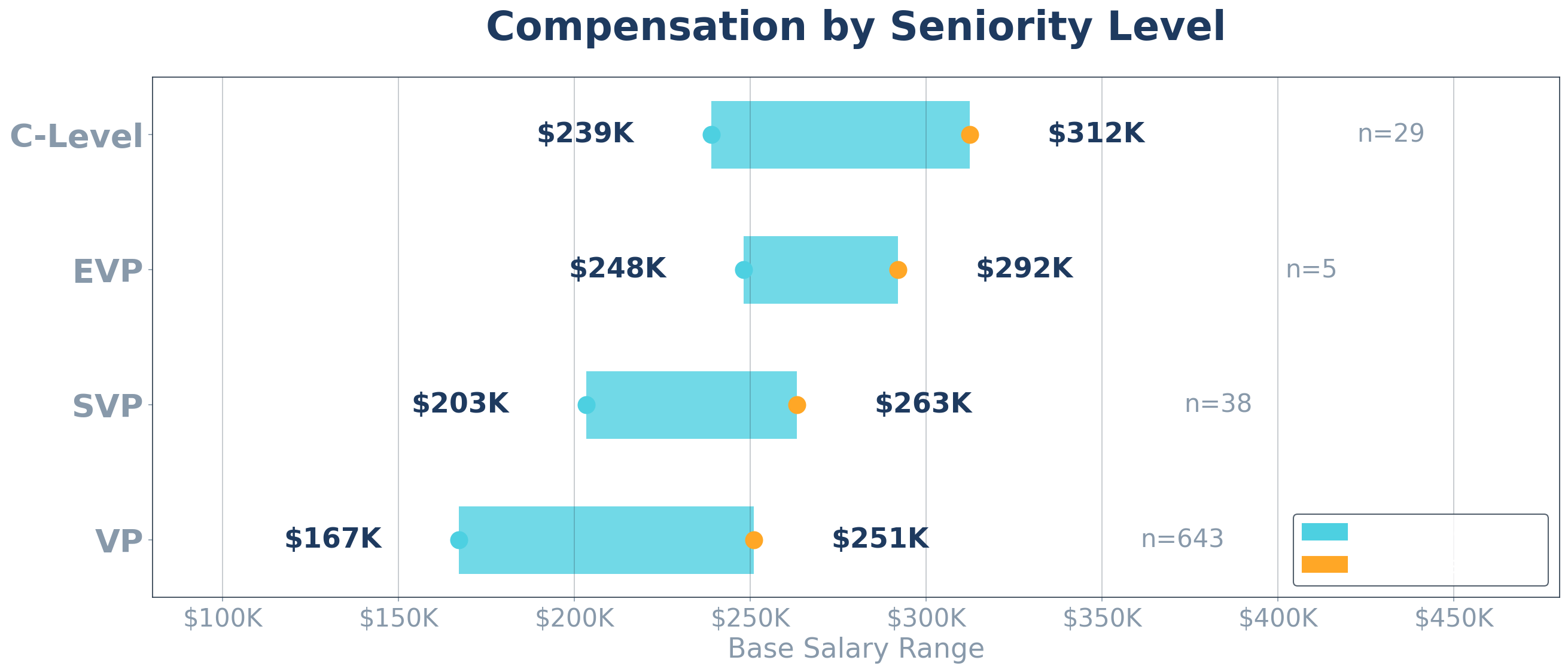
Let's start with the broadest view. VP of sales salary varies dramatically by title. A VP title at a Series B startup and a C-level seat at a public company are different jobs with different comp structures. Here's what each level actually pays.
Seniority Level
Avg Base (Low)
Avg Base (High)
Sample Size
C-Level (CRO, CSO)
$231,873
$302,246
n=26
EVP
$248,000
$292,000
n=5
SVP
$202,153
$262,432
n=37
VP
$167,295
$251,443
n=636
Source: The CRO Report analysis of 704 executive sales postings with disclosed compensation
The jump from VP to C-Level is about $50K at the top of the base range. That 20% premium reflects the broader scope. CROs typically own marketing, customer success, or partnerships in addition to sales. SVPs slot in between at $262K max, though the sample is smaller.
EVP numbers look tight ($248K-$292K), but the sample is only 5 roles. Take that one with a grain of salt.
The VP bucket (n=636) is where the real story is. That $167K-$251K range spans everything from a first VP Sales hire at a seed-stage startup to a divisional VP at a Fortune 500. The variance is enormous, which is why the breakdowns below matter.
The Highest-Paying Roles We've Tracked
To anchor expectations, here are the top-paying individual postings in our dataset:
CRO @ Augean Robotics$550K-$600K
CRO @ Burro$550K-$600K
VP of Sales @ Fieldwire$400K-$600KSeed/Series A stage
CSO @ Forrester$378K-$430K
VP Market Sales @ AVEVA$376K-$628KLate Stage
VP Sales @ Thomson Reuters$322K-$598K
VP Sales Leader @ Visa$321K-$590K
Two robotics CROs at $600K base. A Seed/Series A VP of Sales posting at $400K-$600K from Fieldwire. And then the enterprise giants (AVEVA, Thomson Reuters, Visa) posting ranges so wide you could park a 737 in them. Those wide ranges are usually compliance-driven, with the actual offer landing somewhere in the middle.
Browse the full list of current openings on our jobs board.
Compensation by Company Stage
By Company Stage
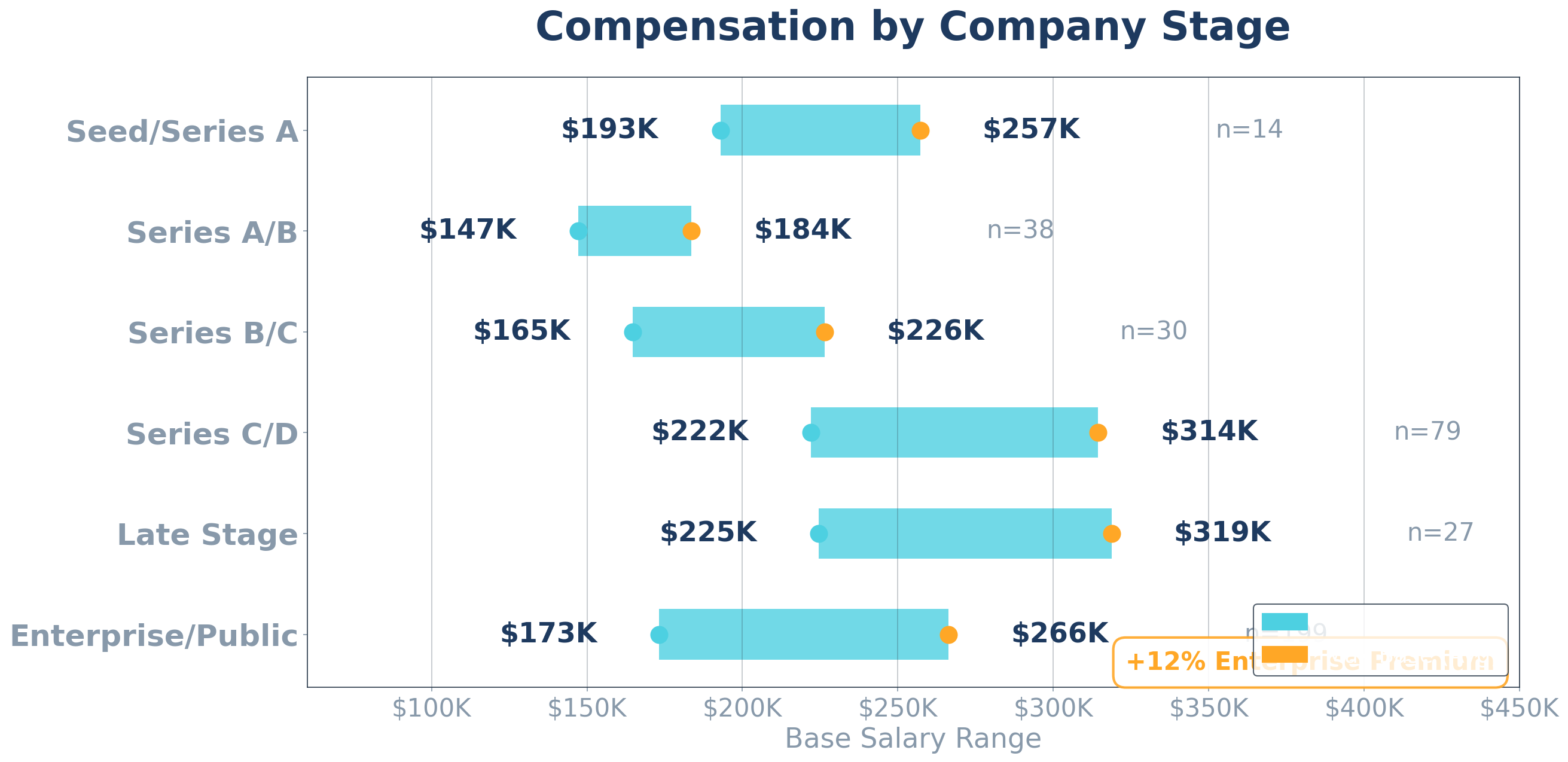
This is where people get the comp picture wrong. The assumption is that bigger company equals bigger paycheck. That's partially true for base salary, but it falls apart when you factor in equity and the stage-specific economics of each role.
Company Stage
Avg Base (Low)
Avg Base (High)
Sample Size
Late Stage
$224,635
$318,772 HIGHEST
n=27
Series C/D
$222,046
$314,444
n=79
Enterprise/Public
$171,438
$264,592
n=195
Seed/Series A
$192,955
$257,169
n=14
Series B/C
$164,710
$226,373
n=30
Series A/B
$147,289
$183,553
n=38
Source: The CRO Report analysis of 704 executive sales postings with disclosed compensation
Late-stage and Series C/D companies pay the highest base salaries. The max at late stage hits $318,772 on average. Series C/D is right behind at $314,444. These companies have product-market fit, real revenue, and enough funding to pay top dollar for sales leadership that can take them to IPO or acquisition.
Enterprise and public companies come in third at $264,592 max. That's roughly 11% more than Series B/C. But remember that public companies offset lower base with RSUs, structured bonuses, and more predictable compensation. A $265K base with $150K in RSUs vesting annually looks different than a $315K base at a Series C company with options that may or may not be worth something.
📈
The Series A/B Dip
Series A/B companies pay the lowest average base at $147K-$183K (n=38). This makes sense. Early-stage companies have limited cash and compensate with larger equity grants. A first VP of Sales at a Series A might take $170K base but hold 1-2% of the company. If that company reaches a $500M outcome, that equity dwarfs any base salary premium elsewhere.
Seed/Series A (n=14) actually pays more in base than Series A/B. The sample is small, but this likely reflects companies that raised large seed rounds and are competing for experienced leaders by offering near-market base plus early equity. That Fieldwire VP of Sales posting at $400K-$600K base from a Seed/Series A company is the extreme version of this.
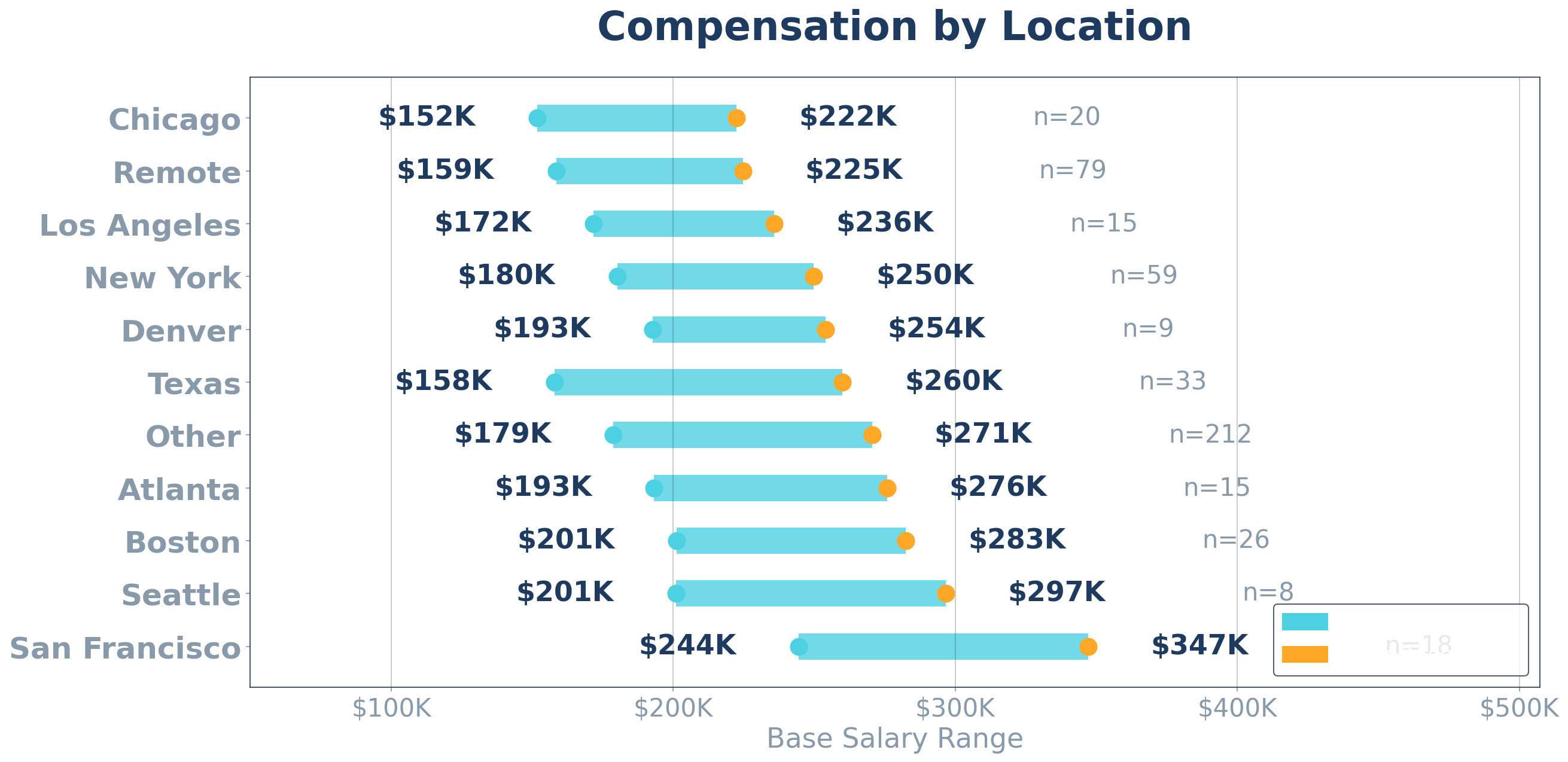
Geography still drives massive differences in VP of sales salary, even as remote work has become the default for many sales leadership roles. The gap between the top market and the bottom is over $120K in average max base.
Location
Avg Base (Low)
Avg Base (High)
Sample Size
San Francisco TOP
$244,452
$347,218
n=18
Seattle
$200,909
$296,696
n=8
Boston
$201,227
$282,527
n=26
Atlanta
$193,255
$275,822
n=15
New York
$180,780
$250,499
n=58
Denver
$192,784
$254,067
n=9
Texas
$157,863
$260,065
n=33
Los Angeles
$169,762
$236,238
n=13
Chicago
$151,832
$222,485
n=20
Remote
$151,533
$217,341
n=73
Source: The CRO Report analysis of 704 executive sales postings with disclosed compensation
San Francisco Still Dominates
San Francisco pays a $347K average max base. That's $97K more than New York at the top of the range, and $130K more than remote roles. The Bay Area premium has been a constant in tech comp data for over a decade, and it hasn't gone away. Eighteen postings is a modest sample, but it's consistent with what I saw recruiting for San Francisco roles at Snapdocs and in conversations with other revenue leaders in the market.
Seattle slots in second at $296K max (n=8). Microsoft, Amazon, and the broader Seattle tech ecosystem keep this number elevated despite the smaller sample.
The Atlanta Surprise
Atlanta at $275K max was one of the more interesting findings. It beats New York by $25K at the top end. The city has been building its tech hub quietly over the past five years, and companies headquartered there are apparently willing to pay for it. Fifteen postings isn't a huge sample, but it's enough to notice.
Remote: The Discount
Remote roles pay $217K at the max, putting them at the bottom of the location chart. That's about 14% less than New York and 37% less than San Francisco. Some of this reflects the types of companies posting remote roles (more early-stage, more distributed teams with flatter comp bands). But some of it is real geographic arbitrage. Companies know they can pay less when someone works from a lower cost-of-living area.
📍
Remote vs. On-Site Overall
When you zoom out beyond specific cities, the remote vs. on-site gap narrows. Across all postings: remote roles (n=311) average $175,886-$259,173, while on-site roles (n=393) average $169,077-$250,238. On-site roles actually show slightly lower averages. The per-city premiums in SF, Seattle, and Boston pull up location-specific numbers, but the broad on-site category includes plenty of roles in mid-tier markets.
Base salary is only part of the picture. VP of Sales roles typically carry a 40-50% variable component on top of base. Some companies go higher (60/40 or even 70/30 splits), but the 50/50 and 60/40 structures dominate at the VP level.
Using the standard variable ranges, here's what OTE looks like by seniority:
Seniority Level
Base Range (High)
Est. OTE (40% Var)
Est. OTE (50% Var)
C-Level
$302,246
$423,144
$453,369
EVP
$292,000
$408,800
$438,000
SVP
$262,432
$367,405
$393,648
VP
$251,443
$352,020
$377,165
A VP of Sales hitting plan at a company paying average-max base with 50% variable is looking at about $377K in total cash. A CRO at the same comp math clears $453K. These are averages, so the top end is considerably higher.
That Fieldwire VP of Sales posting at $400K-$600K base? Add 40% variable and you're in the $560K-$840K OTE range. At that level, you're likely also getting meaningful equity.
Equity on Top
Job postings rarely disclose equity comp, so it doesn't appear in our dataset. But at the VP level and above, equity is a major component. At venture-backed companies, expect options or RSUs worth 0.25-2% depending on stage. At public companies, annual RSU grants of $100K-$300K are common for VP-level sales leaders.
Total all-in comp for a VP of Sales at a late-stage or public company can reach $500K-$800K when you combine base, variable, and equity. At the CRO level, seven-figure total comp packages exist at well-funded companies, though they're not the norm.
"The best comp negotiation lever for VPs is accelerators. Your base and OTE get locked in early, but the accelerator structure determines whether you make 120% or 200% of plan when you crush it. That's where the real money difference shows up."
We've been tracking weekly posting data since late 2025. The short version: average max base salary for VP-level and above sales roles has dropped 10.1% over the past 9 weeks.
Week
Avg Max Base
Roles Posted
Change
Week 48, 2025
$252,819
232
Baseline
Week 1, 2026
$235,820
73
-6.7%
Week 3, 2026
$249,626
37
+5.9%
Week 4, 2026
$227,177
11
-9.0%
A few things stand out. First, posting volume dropped sharply from 232 roles in Week 48 of 2025 to just 11 in Week 4 of 2026. That's seasonal. Q4 is when companies finalize next year's headcount and post aggressively. January is when those budgets get challenged and hiring plans get pushed back. We'll likely see volume pick up again in February and March.
Second, the 10.1% decline in average max base is real but needs context. The smaller sample sizes in January (11-73 roles vs. 232 in November) make the average more volatile. A few lower-paying roles can swing the number significantly when you're working with a dozen postings.
📉
Down 10.1% Over 9 Weeks
Average max base declined from $252,819 (Week 48, 2025) to $227,177 (Week 4, 2026). We'll need another 4-6 weeks of data to determine if this is a real correction or seasonal noise. The weekly trends are tracked in our Substack newsletter, which goes out every week with fresh data.
Third, the companies posting in January tend to skew differently than Q4 postings. Late Q4 gets the annual planning roles from well-funded companies with aggressive hiring targets. Early Q1 gets the urgent backfills and the companies that are slower to market. Different composition of companies means different comp ranges.
I'll be tracking this through Q1 and Q2 to see if the decline holds or reverses. My best guess based on the seasonality patterns and 15 years of watching this market: comp stabilizes in March and ticks back up slightly. But I wouldn't bet on a return to Q4 levels. The market has been digesting tech layoffs and tighter budgets for two years now, and that shows up in what companies are willing to post.
Full trend data is available on our Market Intel page.
Market Context
Skills and Tools in Demand
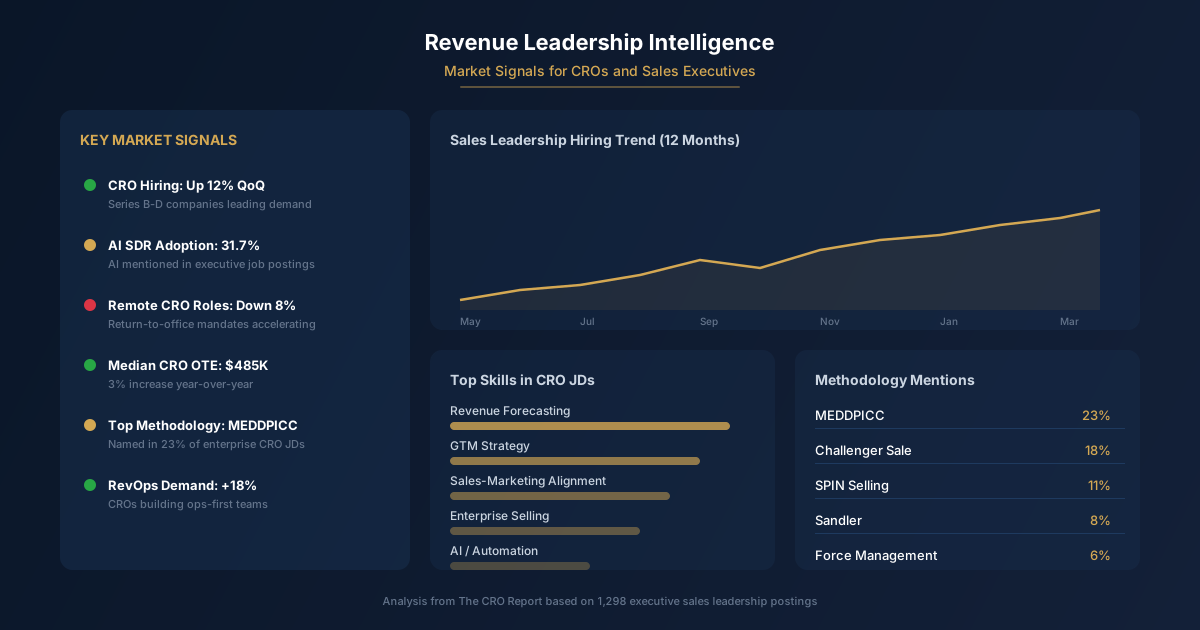
Beyond salary, the posting data tells us what companies want from their VP of Sales hires. These are the most frequently mentioned terms across 1,349 postings:
Skill / Tool
Mentions
% of Postings
AI / Machine Learning
411
30.5%
SaaS
262
19.4%
Salesforce
180
13.3%
Consultative Selling
172
12.8%
MEDDIC / MEDDPICC
117
8.7%
AI/ML appears in nearly a third of all executive sales postings. Some of these are AI companies hiring sales leaders. Others are traditional companies that want leaders who can sell AI-enhanced products or use AI in their sales process. Either way, AI literacy at the VP level has gone from "nice to have" to "expected."
MEDDIC/MEDDPICC at 8.7% reflects enterprise-focused companies that want leaders experienced with structured deal qualification. Consultative selling at 12.8% skews toward companies with longer sales cycles and more technical products. If you want to dig into methodology requirements, we've written about the tools and frameworks that are showing up most in these postings.
What It Means
Putting This to Use
Data is only useful if it changes a decision. Here's how these numbers apply in three contexts.
If You're Currently Employed as a VP of Sales
The data gives you a benchmark. If you're a VP at a Series C/D company making $200K base, you're below market. The average max for your company stage is $314K. That gap is a conversation with your CEO, backed by data from 79 comparable postings instead of a Glassdoor screenshot.
If you're at a public company making $265K base with solid RSUs, you're right at market. Your total comp with equity is likely competitive or above. The grass isn't always greener, especially when you factor in vesting schedules and the risk premium of joining a startup.
Location matters more than most people realize. The gap between San Francisco ($347K max) and Chicago ($222K max) is $125K. That's not just cost of living. That's a fundamentally different talent market with different expectations for the role.
Remote roles at $217K max represent a tradeoff. You save on commute, gain flexibility, and the all-in economics might work better depending on where you live. But you're leaving $30K-$130K in base on the table compared to major metros. Whether that tradeoff works depends entirely on your personal situation.
If you're targeting the highest base salary, look at late-stage and Series C/D companies in San Francisco or Seattle. If you're optimizing for total upside including equity, earlier-stage companies with lower base but meaningful ownership could be the better play. Our jobs board tracks openings across all stages.
If You're Hiring a VP of Sales
You now know what the market will expect. A Series B company posting a VP of Sales role at $140K base is below the $164K-$226K range and will lose candidates to better-funded competitors. A late-stage company offering $300K base is competitive but not exceptional.
The 10.1% decline in average max base over 9 weeks might give you some leverage in Q1 negotiations. But experienced leaders track this data (that's who reads this site), and they'll know if your offer is below market. Price it right or explain the equity story well.
411 postings mention AI/ML. If your product has an AI angle, lean into it. You're competing for the same candidates as every other company that's put "AI" in the job description. 180 postings mention Salesforce, which tells you how many companies still expect their VP of Sales to be fluent in that ecosystem.
Frequently Asked Questions
VP of Sales Salary FAQ
What is the average VP of Sales salary in 2026?
Based on 636 VP-level job postings tracked by The CRO Report, the average VP of Sales base salary in 2026 ranges from $167,295 to $251,443. Total on-target earnings (OTE) typically reach $234,213 to $377,165 when factoring in standard 40-50% variable compensation. These figures come from real job postings, not self-reported surveys.
Which city pays VP of Sales the most?
San Francisco pays the highest VP of Sales base salary, with an average range of $244,452 to $347,218 (n=18). Seattle ranks second at $200,909 to $296,696 (n=8), followed by Boston at $201,227 to $282,527 (n=26). Atlanta was a notable finding at $193,255 to $275,822 (n=15), beating New York's $180,780 to $250,499 (n=58).
Do remote VP of Sales roles pay less than on-site?
The broad numbers are close. Remote roles (n=311) average $175,886-$259,173, while on-site roles (n=393) average $169,077-$250,238. The overall gap is marginal. However, remote roles pay about 14% less than New York-based roles and 37% less than San Francisco roles when you compare city-specific data. The "remote discount" is really a "top-metro premium."
What company stage pays VP of Sales the most?
Late-stage companies pay the highest base at $224,635-$318,772 (n=27), followed by Series C/D at $222,046-$314,444 (n=79). Enterprise/public companies average $171,438-$264,592 (n=195). Series A/B companies pay the lowest base at $147,289-$183,553 (n=38), though equity grants at early-stage companies can make total compensation competitive.
How much does a CRO make compared to a VP of Sales?
C-level sales executives (CRO, CSO) average $231,873-$302,246 in base salary (n=26), compared to $167,295-$251,443 for VP-level roles (n=636). That's roughly a 20% premium at the top of the range. The highest CRO postings in our dataset reached $550,000-$600,000 in base. CROs typically carry broader responsibilities across marketing, CS, and partnerships in addition to sales.
Are VP of Sales salaries going up or down in 2026?
In the short term, down. Over a 9-week period from late November 2025 through January 2026, the average maximum base salary dropped 10.1%, from $252,819 to $227,177. Posting volume also fell sharply from 232 to 11 roles per week. Some of this is Q1 seasonality, and smaller sample sizes make the average more volatile. We're tracking weekly trends in The CRO Report newsletter and expect more clarity by March.
About the Author
Rome Thorndike is VP of Revenue at Firmograph.ai, where he builds AI agents that analyze GTM data for revenue leaders. His career spans enterprise sales at Salesforce and Microsoft, helping scale Sequoia-backed Snapdocs from Series A through Series D, and leading sales at Datajoy through its acquisition by Databricks. Rome holds an MBA from UC Berkeley Haas with a focus on statistical analysis and machine learning.
Disclosure: The CRO Report is an independent market intelligence platform. Salary data is sourced from publicly available job postings tracked weekly since January 2025. We don't accept payment from employers to alter compensation data. Rome Thorndike is VP Revenue at Firmograph.ai, which builds data analysis tools referenced in our methodology.
Last Updated: January 30, 2026 · Data from 1,349 executive sales postings tracked by The CRO Report, with 704 disclosing compensation.