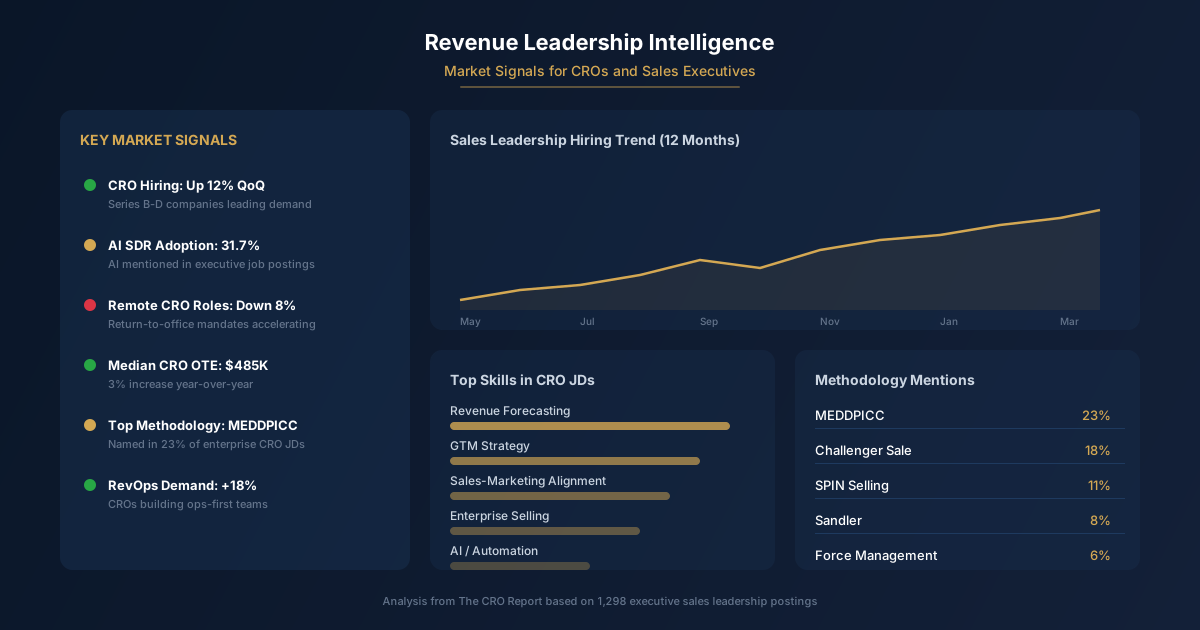
VP Sales to CRO is the assumed next step for most senior sales leaders. The data complicates that assumption. Across 704 executive sales postings with disclosed salary data tracked by The CRO Report, only 26 are C-Level/CRO roles. That's 3.7% of postings with comp data, compared to 636 VP-level roles (90.3%). The average base jumps from $167,295-$251,443 at the VP level to $231,873-$302,246 at the CRO level, a gap of roughly $64K-$51K depending on which end of the range you measure.
The comp increase is real. So is the scarcity. And the gap between what VP Sales requires and what CRO demands is wider than most candidates expect.
Data source: Based on analysis of 1,349 executive sales postings tracked weekly by The CRO Report, with 704 postings disclosing salary data. Seniority classifications are derived from job titles. Company stage data comes from funding round tracking. Full methodology in the disclosure at bottom.
The Comp Progression: VP to SVP to CRO
The seniority ladder in executive sales compensation follows a clear progression, but the steps are uneven. Here's the full picture from our dataset.
Level
Roles
Avg Base Range
Absolute Range
VP
636
$167,295 - $251,443
$200 - $1,000,000
SVP
37
$202,153 - $262,432
$100,000 - $450,000
C-Level/CRO
26
$231,873 - $302,246
$50,000 - $600,000
EVP
5
$248,000 - $292,000
--
Several things stand out.
The VP-to-SVP jump is modest. Average base moves from $167K-$251K to $202K-$262K. That's roughly $35K-$11K at the midpoint, and the ranges overlap heavily. Many VP roles at well-funded companies pay more than SVP roles at smaller ones. The SVP title often reflects organizational structure (a layer between VP and C-suite) rather than a material comp increase.
The SVP-to-CRO jump is where the real movement happens. Average base moves from $202K-$262K to $231K-$302K. That's $30K-$40K at the average level, with a ceiling that extends to $600K in our data. The CRO title carries a comp premium that the SVP title does not.
The absolute ranges tell the messier story. VP base ranges from $200 (likely a token base with heavy commission) to $1,000,000. CRO ranges from $50,000 (almost certainly an early-stage founder-type arrangement) to $600,000. These extremes reflect the wide variance in how companies structure and compensate these roles.
EVP at 5 roles is too small a sample to draw conclusions, but the $248K-$292K range sits between SVP and CRO, consistent with EVP being an organizational layer at large companies rather than a distinct comp tier.
Where CRO Roles Actually Exist (By Stage)
Company stage tells you more about the CRO opportunity than the title does. Here's where the 26 CRO roles in our dataset sit.
Stage
CRO Roles
Avg Base Range
Series C/D
3
$267,667 - $335,000
Late Stage
2
$262,500 - $425,000
Enterprise/Public
6
$199,133 - $263,750
For comparison, here's where VP roles cluster.
Stage
VP Roles
Avg Base Range
Seed/Series A
12
$192,614 - $260,448
Series A/B
36
$142,417 - $178,472
Series C/D
71
$220,896 - $317,128
Enterprise/Public
170
$168,147 - $266,232
The CRO role concentrates at Series C and later. Three roles at Series C/D, two at Late Stage, six at Enterprise/Public. That's 11 of 26 CRO roles with identifiable stage data, all post-Series B. The remaining 15 are at companies where stage data wasn't disclosed, but the comp ranges suggest they skew later-stage as well.
Earlier-stage companies don't typically hire CROs. They hire VPs of Sales. The Seed/Series A VP ($192K-$260K avg base) and Series A/B VP ($142K-$178K) are the roles that build the sales function from scratch. The CRO title at these stages, when it appears, usually maps to VP-level scope and comp.
One pattern worth noting: Series C/D VP Sales roles pay $220K-$317K, which overlaps with and in some cases exceeds the CRO range at Enterprise/Public ($199K-$264K). A VP Sales at a well-funded growth-stage company can out-earn a CRO at a public company on base alone. The comp picture changes when you factor in equity and total compensation, but on base salary, the stage matters more than the title.
The Scope Expansion: What Changes Beyond the Title
The comp gap between VP Sales and CRO reflects a fundamentally different job. Here's what the scope looks like in practice.
Ownership Area
VP Sales
CRO
New Business Sales
Primary owner
Owner
Sales Operations
Typically owns
Owner
Customer Success
Rarely owns
Often owns (18.8% of postings mention CS)
Marketing
Collaborator
Sometimes owns or co-owns
GTM Strategy
Contributes
Primary owner (37.6% mention GTM)
Revenue Forecasting
Sales pipeline
Full revenue model (new + expansion + retention)
Board Reporting
Occasional
Regular
The key shift is from owning a function to owning a number. VP Sales owns the sales team, the pipeline, and the new business number. CRO owns the total revenue number, which includes new business, expansion, renewals, and sometimes partner revenue. That means owning functions you may have never managed directly.
Customer Success is the biggest scope addition. 18.8% of postings in our dataset mention Customer Success as a CRO responsibility. For a VP Sales who has spent a career focused on new logo acquisition, suddenly owning net revenue retention, churn, and expansion changes the job fundamentally. You're managing teams with different incentive structures, different metrics, and different daily rhythms than your sales org.
GTM strategy at 37.6% of mentions is the other major addition. VPs of Sales execute within a go-to-market framework. CROs are expected to define it. That means decisions about market segmentation, pricing strategy, channel mix, and the balance between inbound and outbound. These are strategic calls that affect the entire company, not just the sales floor.
The Skills Gap Between VP Sales and CRO
Our posting analysis reveals what companies expect from CRO candidates, and where the gap sits relative to VP Sales requirements.
GTM/Go-to-Market strategy: 488 mentions across all postings (37.6%). CRO postings index heavily here. Companies want leaders who can architect the full revenue engine, not just run the sales team within it.
Scale/Scalable: 591 mentions (45.5%). The most common theme across all executive sales postings, but the expectation at the CRO level is broader. Scaling sales is one thing. Scaling a multi-function revenue organization across sales, CS, and partnerships is a different challenge.
AI/ML: 411 mentions (31.7%). Increasingly expected at all seniority levels, but CROs face the question of how to integrate AI across the full revenue stack, from prospecting to customer health scoring to forecasting.
Data-Driven: 341 mentions (26.3%). CROs own a more complex data picture than VPs. Revenue attribution across channels, cohort analysis on retention, unit economics by segment. The analytical bar is higher.
Customer Success: 244 mentions (18.8%). A capability that most VP Sales candidates haven't built. Understanding CS metrics (NRR, GRR, health scores, expansion pipeline) and managing CS leaders requires learning a parallel discipline.
The methodology requirements add another layer. Consultative Selling appears in 172 postings, Enterprise Sales in 102, and Channel/Partner in 87. CROs are expected to be fluent across multiple sales motions, not specialized in one. A VP Sales who built a career on direct enterprise selling will need to demonstrate credibility in channel strategy and product-led growth to be competitive for CRO roles.
The Title Inflation Problem
Not all CRO titles are created equal. The data makes this clear.
Our dataset includes 26 C-Level/CRO postings out of 1,349 total. That's 1.9% of all postings. But the CRO title shows up at companies of every stage, including early-stage startups where the "CRO" is functionally a VP Sales with a bigger title.
The comp data exposes this. Enterprise/Public CRO roles average $199K-$264K base. That's the same range as a Series A/B VP Sales at a well-funded company, and below the Series C/D VP range of $221K-$317K. When a seed-stage company lists a "CRO" at $180K base with no CS team to manage and a sales org of three people, that's a VP Sales role with an inflated title.
Title inflation matters for two reasons.
First, it distorts your career narrative. If you take a CRO title at a 20-person startup and then apply for a CRO role at a Series D company, the hiring committee will look past the title to the scope. "CRO at a company with $3M ARR" reads as "first sales hire" to experienced board members and executive recruiters. The title on your LinkedIn profile matters less than the revenue you owned, the team size you managed, and the functions you directed.
Second, it creates comp anchoring problems. A "CRO" making $180K at a seed-stage company may expect CRO-level comp at their next role. But if the scope was VP-level, the market will price the candidate as a VP. The title premium only applies when the scope matches.
A useful filter: Ask what functions report to the role. If the answer is "sales and maybe SDRs," the scope is VP Sales regardless of the title. If the answer includes Customer Success, Revenue Operations, and potentially marketing or partnerships, the scope is CRO-level.
When the Move Makes Sense
The VP-to-CRO transition has a specific set of conditions where it works, based on what the data shows about where CRO roles exist and what they require.
You've owned P&L-adjacent decisions, not just quota
CRO roles at Series C+ companies expect leaders who've had influence over pricing, packaging, market segmentation, and resource allocation. VP Sales candidates who've operated as a de facto CRO, owning CS relationships, partnering deeply with marketing on pipeline strategy, influencing product roadmap based on market feedback, are better positioned than VPs who ran a sales team in isolation.
You have CS fluency
With 18.8% of postings mentioning Customer Success, the ability to speak credibly about NRR, churn drivers, health scoring, and expansion playbooks is a differentiator. If you've never managed a CS function, find ways to build adjacency: co-own expansion revenue with the CS leader, participate in QBRs, learn the retention data.
You're targeting the right stage
CRO roles concentrate at Series C/D and later. If you're a VP Sales at a Series B company, the most natural CRO path is staying through the Series C or D, where the company's growth may justify adding the CRO layer above you, or moving laterally to a CRO role at a similarly staged company. Jumping from Series A VP Sales directly to CRO at a public company is a multi-step leap.
The economics make sense
The average base jump is $64K-$51K. That's material. But a VP Sales at a Series C/D company ($221K-$317K base) may already earn more than many CRO roles on base alone. The CRO premium shows up more in equity grants, bonus structures, and total comp packages at later-stage companies. Evaluate the full picture, not just the base.
The Alternative Path: VP Sales at a Bigger Company
The CRO career path gets the attention, but the data suggests an alternative worth considering: VP Sales at a larger, later-stage company.
Enterprise/Public VP Sales roles pay $168K-$266K average base across 170 postings. Series C/D VPs pay $221K-$317K across 71 postings. The upper end of these ranges overlaps with or exceeds CRO comp at many stages.
The trade-off is scope versus depth. A VP Sales at a $500M revenue public company manages a large, complex sales organization, potentially hundreds of reps across multiple segments, with dedicated sales operations, enablement, and analytics teams. The job is deep. You're optimizing conversion rates, rep productivity, territory design, and compensation plans at scale. You're not owning CS or marketing, but you're running a sales machine with more complexity than most CRO roles at smaller companies.
Some considerations for evaluating the paths:
CRO at a growth-stage company ($50M-$200M ARR): Broader scope (sales + CS + sometimes marketing), smaller team, higher equity upside, more strategic decision-making, more risk. Base: $232K-$302K avg.
VP Sales at an enterprise company ($500M+ ARR): Deep sales focus, large team, stable comp, lower equity upside, established playbook. Base: $168K-$266K avg, with Series C/D VPs at $221K-$317K.
SVP Sales (37 roles): The middle ground. $202K-$262K avg base. More scope than VP, less than CRO. Often the stepping stone, but also a career destination at companies where the CRO layer doesn't exist.
Neither path is inherently better. The right choice depends on whether you want breadth of ownership across the revenue function or depth of expertise within sales. Both are viable career endpoints. Both pay well. The market needs both profiles.
Frequently Asked Questions
How much more does a CRO make than a VP of Sales?
Average base: CRO $231K-$302K vs VP $167K-$251K, a $64K-$51K gap at the average level. The ceiling is higher too: CRO max in our data is $600K vs VP median max of $220K. The gap widens further when you include equity, which tends to be more generous at the CRO level, particularly at growth-stage companies. For the full CRO salary breakdown, see our dedicated analysis.
How do you go from VP Sales to CRO?
The typical path goes VP Sales (636 roles, $167K-$251K) to SVP Sales (37 roles, $202K-$262K) to CRO (26 roles, $231K-$302K). CRO roles are concentrated at Series C+ companies. Earlier-stage CRO titles often carry VP-level scope. The transition requires building experience beyond pure sales: Customer Success ownership, GTM strategy, and cross-functional leadership spanning multiple revenue functions.
What skills do you need to become a CRO?
Based on CRO posting analysis: GTM strategy (37.6% of postings), customer success ownership (18.8%), data-driven decision making (26.3%), and cross-functional leadership spanning sales, CS, and sometimes marketing. Methodology fluency across Enterprise Sales (102 mentions), Consultative Selling (172 mentions), and Channel/Partner (87 mentions) is also expected. The full CRO vs VP of Sales comparison details the scope differences.
At what stage do companies hire CROs?
Series C/D and later. Only 26 of 1,349 postings are C-Level, and those with identifiable stage data cluster at Series C/D (3 roles), Late Stage (2 roles), and Enterprise/Public (6 roles). At Seed/Series A, "CRO" titles typically carry VP-level compensation and scope, suggesting title inflation. Companies generally hire a true CRO when revenue complexity demands unified ownership across sales, CS, and GTM strategy. See our guide on when to hire a CRO.
Is it better to be a VP Sales at a large company or a CRO at a startup?
Financially, it depends. Enterprise VP Sales base ($168K-$266K) overlaps with startup CRO base. But startup CROs typically get larger equity grants. The real question is scope: do you want to own all of revenue (sales + CS + partnerships + sometimes marketing), or go deep on sales execution at scale? Both are viable career endpoints. The VP Sales at a $500M company manages more people and process complexity. The CRO at a $50M company makes more strategic decisions across a broader surface area.
Methodology & Disclosure: All data comes from 1,349 executive sales job postings tracked weekly by The CRO Report, with 704 postings disclosing base salary data. Seniority classifications (VP, SVP, C-Level/CRO, EVP) are derived from job titles using keyword matching. Company stage data comes from funding round tracking and public company identification. Skill and methodology mentions are based on keyword frequency analysis across all postings. The C-Level/CRO sample (26 roles with salary) is small enough that individual data points have outsized influence on averages. Absolute ranges reflect the minimum and maximum disclosed values, including outliers. Updated February 1, 2026.
The CRO Report is run by Rome Thorndike, VP Revenue at Firmograph.ai. 15+ years in B2B sales leadership including Salesforce, Microsoft, Snapdocs, and Datajoy (acquired by Databricks). MBA from UC Berkeley Haas.