A CRO report is the recurring revenue summary a Chief Revenue Officer hands to the CEO and board. It rolls sales, marketing, and customer success into one view of whether the business can grow profitably. People search for the term in two ways: some want to know what document the role produces, and others have stumbled on the publication you are reading right now. This page covers the document. We are also, as it happens, named after it.
Key Takeaways
A CRO report is the revenue summary a Chief Revenue Officer delivers to the CEO and board on a recurring cadence
It spans the full revenue engine: sales, marketing-sourced pipeline, expansion, and churn, not the sales team alone
The board version narrows to five numbers: revenue vs. plan, NRR, new ARR, CAC payback, and the forecast
Most CROs run a weekly version to the CEO, a monthly operating review, and a quarterly board package
The job of the report is to prevent surprises, which is why the at-risk-deals section matters more than the totals
The Plain Definition
A CRO report is the document a Chief Revenue Officer uses to communicate the state of revenue to the people who fund and govern the company. At its core it answers one question for the reader: is the revenue model working well enough to keep investing in it? Everything in the report exists to support an honest answer to that question.
The scope is what separates it from any other revenue document. A Chief Revenue Officer owns the entire revenue number, so the report covers every function that touches revenue. Sales bookings sit next to marketing-sourced pipeline, which sits next to customer success expansion and churn. A VP Sales report stops at the sales team. A CRO report keeps going until it has accounted for the whole go-to-market motion.
What Goes Into a CRO Report
The exact contents shift with the audience and the cadence, but a complete report draws from the same metric set. These are the numbers that consistently earn their place.
Metric
What It Tells the Reader
Healthy Benchmark
Revenue vs. Plan
Whether the company is on track to hit the number it committed to
At or above plan with an accurate quarter-end projection
Pipeline Coverage
Whether enough qualified pipeline exists to make the quota
3-4x quota for the period
New ARR
New logo revenue closed in the period
On plan; the trend matters more than one month
Net Revenue Retention
Whether the existing customer base grows or shrinks on its own
Above 110% for growth-stage B2B SaaS
CAC Payback
How efficiently spend converts into recurring revenue
12-18 months for growth-stage SaaS
Forecast
Where the quarter lands, with commit and best-case scenarios
Stable or improving week over week
Two sections that rarely show up in a metrics table do most of the work. The first is the at-risk-deals list: a short roster of opportunities that were expected to close and are now showing trouble. The second is the written narrative that explains anomalies. If win rate drops in a single month, the report owes the reader two paragraphs on what happened and what the fix is. If the numbers are flat, the narrative can stay short.
CRO Report vs. Sales Report
This is the distinction that confuses most people new to the role. The two documents look similar at the top, then diverge sharply.
A sales report covers bookings, pipeline, and rep activity for the sales organization. It answers whether the sales team is hitting quota. A CRO report folds that in as one input among several, then adds the parts of revenue that sit outside the sales team: marketing-sourced demand, customer success expansion, churn, and the efficiency metrics that tell you whether spending more would actually produce more. The sales report is a component. The CRO report is the system view.
For a fuller treatment of how the role differs from the VP of Sales role, see our breakdown of CRO vs. VP of Sales. The short version: the VP owns the sales number, the CRO owns the revenue number, and that gap is exactly the gap between the two reports.
Who Reads It, and How Often
The cadence is what gives the report its discipline. A single annual document would let problems hide for months. A daily one would drown everyone. Most revenue leaders settle on three rhythms.
Weekly — to the CEO
Pipeline coverage, new pipeline created vs. run rate, current-quarter forecast vs. plan, deals at risk, and a line on hiring. Readable in under five minutes. Usually an email or message, not a deck.
Monthly — the operating review
The full metric set: new ARR, expansion, churn, NRR, win rate, deal size, sales cycle, and CAC payback. A brief memo plus a data appendix. Ten minutes to read.
Quarterly — to the board
A written memo sent a week before the meeting, followed by a tight presentation focused on decisions and forward investment. The board should arrive having read the memo so the meeting is for discussion.
Beyond the CEO and board, the CFO reads the report to reconcile revenue against the financial plan, and the functional leads in sales, marketing, and customer success use it to stay aligned on shared targets. At PE-backed companies the deal partner reads it closely, which tends to raise the bar on precision.
The most useful CRO report is the one that is direct about bad news. A board already knows the headline number. They are watching to see whether the CRO understands why it landed where it did. A report that surfaces a slipped deal in week three earns more trust than a polished one that buries it until quarter-end.
A Simple CRO Report Template
If you are building one from scratch, this structure covers the essentials without the bloat that trains readers to skim:
Headline: revenue vs. plan for the quarter, with a quarter-end projection.
Forecast: commit, best case, and pipeline for the current quarter.
Pipeline health: coverage ratio for this quarter and next, plus new pipeline created vs. target.
Retention: NRR as a trailing-twelve-month figure, with the expansion and churn split behind it.
Efficiency: CAC payback and, for board versions, the magic number.
At-risk deals: named opportunities with the owner and the plan to save each one.
Narrative: two or three paragraphs explaining any number that moved, and what you are doing about it.
For the deeper version of this template, including the board memo format and reporting anti-patterns, read our guide to CRO reporting. For the board deck specifically, see the CRO board deck template.
About the Name
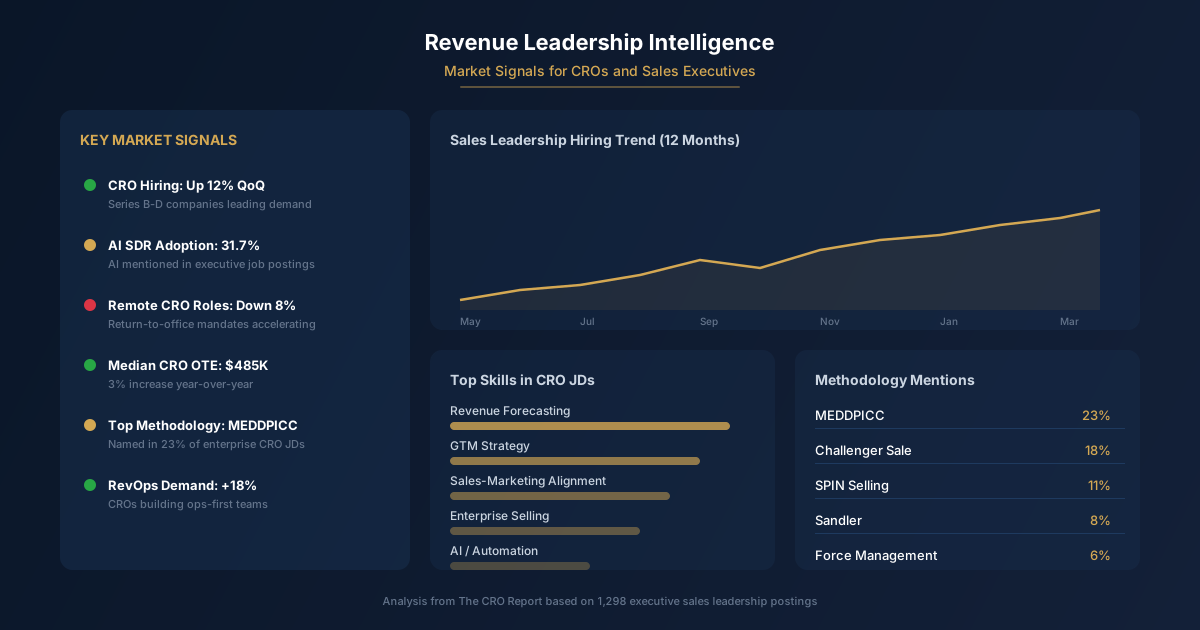
The publication you are reading is named The CRO Report because it covers the world that produces these documents: revenue leadership hiring, compensation, tooling, and the operating decisions CROs and VPs of Sales make. If you landed here looking for the report a person produces, the sections above are your answer. If you landed here looking for revenue-leadership intelligence, the newsletter is the better entry point.
FAQ
What is a CRO report?
A CRO report is the recurring revenue summary a Chief Revenue Officer prepares for the CEO and board. It covers the full revenue engine: bookings versus plan, pipeline coverage, net revenue retention, CAC payback, and the forecast. Unlike a sales report, it spans sales, marketing, and customer success rather than the sales team alone.
What goes in a CRO report?
A complete CRO report includes revenue versus plan, pipeline coverage ratio, new and expansion ARR, net revenue retention, CAC payback period, win rate, and the current forecast with commit and best-case scenarios. Monthly versions add churn detail and segment splits. Board versions narrow to five headline numbers plus a written narrative.
How is a CRO report different from a sales report?
A sales report covers bookings, pipeline, and rep activity for the sales team. A CRO report covers the entire revenue number, which means it folds in marketing-sourced pipeline, customer success expansion and churn, and go-to-market efficiency metrics like CAC payback and net revenue retention. The CRO report answers whether the business can grow profitably, not just whether sales hit quota.
How often does a CRO deliver a report?
Most CROs run a weekly report to the CEO, a fuller monthly operating review, and a quarterly board package with a written memo sent a week ahead. The weekly version is a short pipeline-and-forecast update. The monthly version covers the full metric set. The quarterly version focuses on decisions and forward investment.
Who reads a CRO report?
The primary readers are the CEO and the board of directors. At PE-backed and venture-backed companies, the deal partner or lead investor reads it closely. Internally, the CFO uses it to reconcile revenue against the financial plan, and functional leads in sales, marketing, and customer success use it to align on shared targets.