Will AI Replace SDRs? What 1,298 Job Postings Actually Show
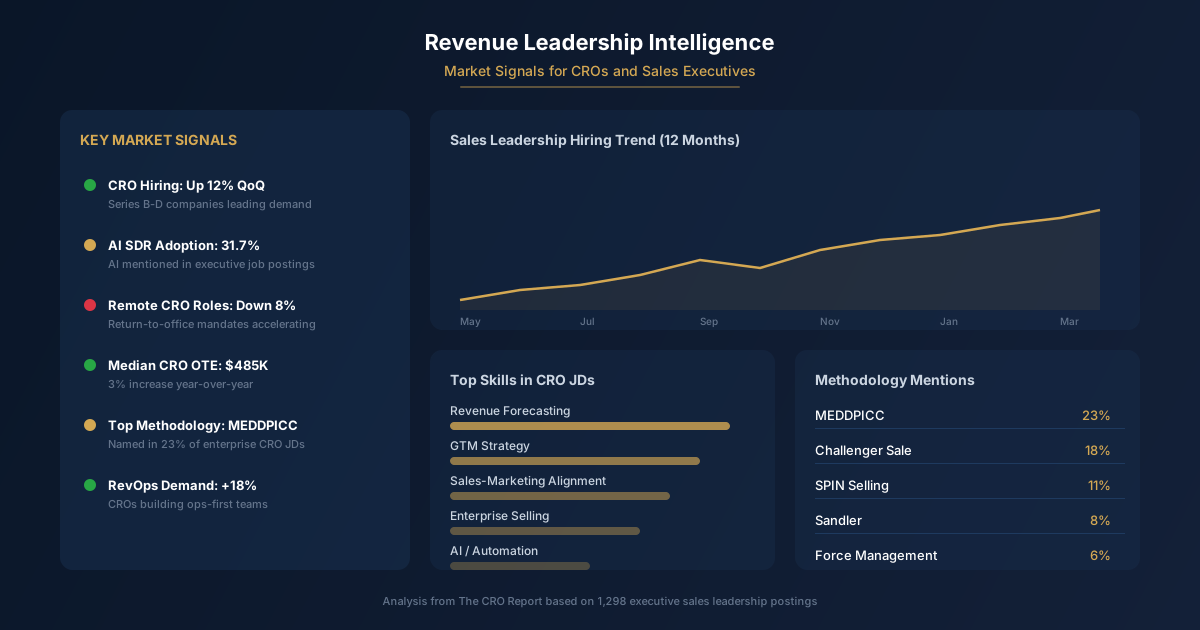
AI/ML appears in 31.7% of executive sales postings. GenAI? Just 1.6%. Zero AI SDR tools show up in job requirements. The hiring data tells a different story than the headlines.
Of 1,298 executive sales job postings tracked by The CRO Report, 411 (31.7%) mention AI or machine learning. GenAI appears in 21 (1.6%). That's a 19.6x gap between general AI awareness and generative AI specifically. And AI SDR tools like 11x, Artisan, AiSDR, and Regie.ai? They appear in exactly zero postings. Not one hiring manager listed an AI SDR platform as a required or preferred tool.
Those numbers matter because the "AI will replace SDRs" narrative has taken on the quality of settled consensus in certain corners of LinkedIn and VC Twitter. The hiring data from actual companies spending actual money on sales leadership tells a more measured story.
Data source: Based on analysis of 1,298 executive sales postings tracked weekly by The CRO Report. AI/ML keyword matching covers job descriptions, requirements, and preferred qualifications. Tool mentions tracked against a standardized list of 30+ sales technology platforms. Full methodology in the disclosure at bottom.
The 31.7% Number Everyone Misreads
When you see that 411 of 1,298 executive sales postings mention AI or machine learning, the natural reading is: companies want AI-savvy sales leaders. That reading is correct, but incomplete.
Most of these mentions fall into a few predictable categories:
Company description context. "We're building an AI-powered platform for..." appears in the company overview section, not in the role requirements. The company sells an AI product. The VP Sales needs to understand the product category, not build AI models.
Data-driven decision making. 341 postings (26.3%) mention "data-driven" as a leadership attribute. AI/ML often appears alongside it as part of a broader expectation that sales leaders use analytics, forecasting tools, and pipeline data rather than gut instinct.
SaaS context. 262 postings (20.2%) mention SaaS. Many AI/ML mentions co-occur with SaaS tags because the companies building AI tools are, structurally, SaaS businesses.
The 31.7% figure reflects the market's orientation toward technology and data fluency. It does not reflect a specific demand for leaders who can deploy autonomous AI agents to replace human sales reps. The distinction matters when you're trying to answer the question of whether AI SDR tools are reshaping how companies think about their sales development function.
Keyword
Postings
% of 1,298
AI/Machine Learning
411
31.7%
Data-Driven
341
26.3%
SaaS
262
20.2%
GenAI
21
1.6%
GenAI at 1.6%: The Gap Between Headlines and Hiring
Twenty-one postings out of 1,298 mention generative AI. That's 1.6%.
The 19.6x ratio between general AI/ML mentions (31.7%) and GenAI mentions (1.6%) is the single most useful number in this dataset for understanding where the market actually stands. Companies broadly want sales leaders who can operate in an AI-influenced market. They are not, in any meaningful volume, asking those leaders to deploy generative AI tools as a core competency.
This gap has a few likely explanations:
GenAI tools are still new to enterprise sales workflows. ChatGPT launched in late 2022. The first wave of AI SDR startups raised funding in 2023 and 2024. By 2026, these tools are still in early adoption phases at most companies. Job postings reflect what companies are already doing, not what they're experimenting with.
Hiring managers write postings based on proven requirements. When a company specifies Salesforce (180 postings, 13.9%) or Outreach (65 postings, 5.0%), they're naming tools that are embedded in their current stack. GenAI tools haven't reached that level of entrenchment.
The ROI case for GenAI in sales development is still unproven at scale. Individual reps may use ChatGPT for email drafting or research. That's different from a company formally requiring GenAI expertise in a VP-level job posting.
The 1.6% number does not mean GenAI is irrelevant to sales. It means the hiring market has not yet formalized GenAI as a required competency for sales leadership. The tools exist. The adoption is happening. The job postings haven't caught up.
What AI SDR Tools Actually Cost
The economics of AI SDR tools are a useful lens for understanding why adoption remains limited. These platforms are not cheap, and the pricing structures create commitment before proving value.
Tool
Monthly Cost
Contract Terms
Annual Cost
11x
~$5,000
Annual contract
$60,000+
Regie.ai
~$2,917+ base
Annual + per-rep fees
$35,000+ plus $150/rep/mo
Artisan
$1,500-$2,000
Annual contract
$18,000-$24,000
AiSDR
$900
Quarterly billing
$10,800
At the top end, 11x runs approximately $5,000 per month on annual contracts, putting the minimum commitment above $60,000 per year. That's in the range of a junior SDR's base salary in many markets, which is exactly the comparison these companies want you to make. The pitch is straightforward: an AI agent that works 24/7 for the cost of one human.
The comparison breaks down when you look at what the tools actually deliver. A junior SDR earning $60,000 handles replies, adapts messaging based on conversation context, navigates objections, books meetings through back-and-forth scheduling, and builds relationships that inform future outreach. The AI SDR sends automated sequences.
AiSDR at $900 per month is the lowest price point, but comes with constraints. It only integrates with HubSpot, and the per-message pricing ($0.75 per message) adds up at volume. A campaign sending 5,000 messages per month adds $3,750 to the base cost, bringing the real monthly spend closer to $4,650.
Regie.ai layers per-rep fees ($150/month) on top of a $35,000 annual base, making the total cost dependent on team size. A 10-rep team would pay $35,000 plus $18,000 in per-rep fees, totaling $53,000 per year. Pricing transparency is limited, and the final quote often requires a sales conversation.
For a detailed breakdown of each tool, including features, limitations, and who they work best for, see The Best AI SDR Tools in 2026.
What AI SDRs Can Do (and What They Can't)
AI SDR tools are built around a specific set of capabilities. Understanding the boundaries helps separate genuine use cases from marketing claims.
What they handle
Automated email sequences. Multi-step outbound campaigns with scheduled sends, follow-ups, and basic branching logic.
Template personalization. Inserting prospect-specific data points (company name, industry, recent news, job title) into email templates.
High-volume outreach. Sending hundreds or thousands of emails per day without the manual effort of an SDR writing each one.
Lead scoring and prioritization. Using engagement data (opens, clicks, replies) to flag prospects who may be more receptive.
Where they break down
Reply handling. 11x, the most expensive tool in this category, has documented issues with handling replies. When a prospect responds with a question, a pricing inquiry, or an objection, the AI either generates an awkward response or fails to respond at all. TechCrunch reporting revealed that 11x used fake customer testimonials, raising questions about the maturity of the product.
Multi-threading. Enterprise deals involve multiple stakeholders. An AI SDR can send an email to a VP of Engineering. It cannot identify that the CTO is the actual decision maker, loop in the CFO who controls budget, and adjust messaging for each persona in a coordinated sequence.
Contextual judgment. A prospect replies, "We just went through a round of layoffs." A human SDR reads that signal and adjusts timing and tone. An AI SDR sends the next scheduled follow-up on Tuesday.
Relationship building. The premise of consultative selling (mentioned in 172 of 1,298 postings in our dataset) is that the seller understands the buyer's business deeply enough to identify problems the buyer hasn't fully articulated. That requires listening, pattern recognition across conversations, and trust. AI SDR tools operate at the sequence level, not the relationship level.
Artisan's inconsistent results and UI issues, AiSDR's HubSpot-only limitation, and Regie.ai's robotic-sounding copy all point to a category that's early. These are real products with real customers, but the gap between the marketing claim ("replace your SDR team") and the operational reality ("automate some email sequences") is wide.
Zero AI SDR Tools Appear in Job Postings
This is the data point that anchors the entire analysis. Of 1,298 executive sales postings, zero mention 11x, Artisan, AiSDR, Regie.ai, or any other AI SDR platform as a required or preferred tool.
For comparison, here's what sales tools companies actually name in their job postings:
Tool
Postings
% of 1,298
Salesforce
180
13.9%
Outreach
65
5.0%
HubSpot
48
3.7%
Gong
4
0.3%
AI SDR Tools (any)
0
0.0%
Salesforce at 180 mentions (13.9%) is the dominant CRM. Outreach at 65 (5.0%) is the leading sales engagement platform. HubSpot at 48 (3.7%) shows up primarily at mid-market and growth-stage companies. Even Gong, a newer entrant in conversation intelligence, appears in 4 postings.
AI SDR tools appear in none.
A tool appears in job postings when it has become embedded enough in a company's workflow that the hiring manager considers it a required or preferred skill. Salesforce reached that threshold years ago. Outreach is there for sales development teams. AI SDR tools are not yet part of the operational fabric of enough companies to show up in hiring requirements.
That doesn't mean no companies use these tools. It means the usage hasn't reached the level where proficiency is a hiring criterion. The distinction maps roughly to the difference between "we're testing this" and "this is how we work." For a deeper look at tool adoption across executive sales postings, see the most popular sales tools in 2026.
Where AI Actually Helps Sales Development
The data doesn't support the "AI replaces SDRs" narrative. It does support a less dramatic but more practical story: AI tools are augmenting specific parts of the sales development workflow.
Research and account intelligence
The strongest current use case for AI in sales development is pre-call research. Tools that synthesize 10-K filings, earnings calls, news articles, and LinkedIn data into prospect briefings save SDRs hours of manual research. This isn't SDR replacement. It's SDR acceleration. The human still interprets the research, decides which angle to lead with, and adapts based on the conversation.
Email drafting assistance
Using AI to generate first drafts of outbound emails, then having a human review and edit, is a workflow that makes practical sense. It's different from fully autonomous AI outreach. The human catches tone issues, removes generic phrasing, and adds the specific observations that make cold email work. The AI handles the structural template. This is closer to how Outreach (65 postings) functions today, with sequences and templates, than how AI SDR tools pitch themselves.
Data enrichment and scoring
AI-powered data enrichment (identifying firmographic data, technographic signals, intent data) improves the quality of prospect lists before a human SDR ever touches them. This is where the 26.3% of postings mentioning "data-driven" connects to AI adoption. Sales leaders want teams that work from better data, and AI tools provide that data.
Conversation intelligence
Gong appears in only 4 postings (0.3%), but the category it represents (AI-powered analysis of sales calls) is growing. Recording calls, transcribing them, identifying patterns in successful conversations, and coaching reps based on data rather than anecdote. This use of AI improves SDR performance. It doesn't replace the SDR.
The pattern across all four use cases: AI works best as infrastructure underneath human judgment, not as a replacement for it. The AI in sales leadership analysis covers how companies are weaving AI into their sales orgs at the leadership level.
The Roles AI Will Change (Not Eliminate)
The job posting data points to specific areas where AI is reshaping sales development roles without eliminating them.
SDR productivity expectations will increase
If AI tools handle research, first-draft emails, and data enrichment, the output expectation per SDR rises. A team of 5 SDRs with AI tooling may cover the territory that previously required 8. That's a headcount reduction at the team level, but it's not SDR elimination. It's SDR consolidation with higher per-rep productivity.
The SDR skillset will shift upward
When AI handles volume outreach, the human SDR's value moves toward the work AI can't do: handling complex replies, building multi-threaded relationships, navigating enterprise buying processes, and exercising judgment about timing and approach. Enterprise Sales (102 postings) and Consultative Selling (172 postings) both require these human capabilities. The SDR role becomes less about volume and more about quality of engagement.
Sales leadership will need AI fluency
The 31.7% AI/ML figure in job postings reflects an expectation that sales leaders understand how to integrate AI tools into their team's workflow. That's a new competency. A VP Sales in 2026 needs to evaluate AI SDR tools, understand their limitations, and make informed build-vs-buy decisions. The what companies want in a VP Sales analysis shows this trend across multiple data points.
Channel and partner motions remain human
Channel/Partner selling appears in 87 postings in the broader dataset. Partner relationships, co-selling motions, joint business planning, and channel conflict management are fundamentally human activities. No AI SDR tool addresses these workflows. Companies with channel-heavy go-to-market strategies still need human SDRs and account managers to coordinate with partners.
Bottom line: The data shows companies investing in AI capabilities (31.7% mention AI/ML) while barely registering GenAI as a formal requirement (1.6%). AI SDR tools cost $900 to $5,000 per month, carry documented limitations, and appear in zero job postings. AI is changing how SDRs work. It is not replacing them. The sales hiring trends data supports the same conclusion from a different angle.
Frequently Asked Questions
Will AI replace SDRs?
Not based on current data. AI/ML appears in 31.7% of 1,298 executive sales leadership postings, but GenAI specifically appears in only 1.6%. No AI SDR tools appear in job requirements. Companies are investing in AI capabilities for sales teams while maintaining human-led sales development processes. The gap between AI hype and actual hiring behavior remains substantial.
How much do AI SDR tools cost?
$900 to $5,000 per month. 11x runs approximately $5,000 per month with annual contracts ($60,000+ per year). Artisan costs $1,500 to $2,000 per month with annual contracts. AiSDR is the cheapest at $900 per month with quarterly billing, though per-message fees ($0.75 each) add up at volume. Regie.ai starts at $35,000 per year plus $150 per rep per month.
Are companies hiring fewer SDRs because of AI?
The job posting data does not show SDR elimination. It shows companies wanting sales leaders who understand AI tools while maintaining human-led sales processes. Consultative Selling appears in 172 of 1,298 postings, and Enterprise Sales in 102, both requiring human judgment and relationship building that current AI SDR tools cannot replicate.
What can AI SDRs actually do?
Automated email sequences, basic personalization using prospect data, and high-volume outreach. They struggle with complex replies, multi-threading across stakeholders, and anything requiring judgment or relationship building. Current tools have documented issues: 11x cannot reliably handle replies, Artisan delivers inconsistent results, AiSDR only integrates with HubSpot, and Regie.ai produces copy that often sounds robotic.
Should I invest in AI SDR tools?
Depends on deal complexity. High-volume, simple outbound with a large total addressable market is the strongest use case. Complex enterprise sales with consultative selling (mentioned in 172 of 1,298 postings) still requires humans. At $900 to $5,000 per month, the ROI math needs to account for limited reply handling, integration constraints, and the cost of cleaning up poorly targeted outreach that damages your domain reputation.
The CRO Report newsletter tracks AI adoption, tool pricing, hiring trends, and what companies actually require from sales leaders. Updated weekly with new posting data.
Methodology & Disclosure: All data comes from 1,298 executive sales job postings tracked weekly by The CRO Report. AI/ML keyword matching covers terms including artificial intelligence, machine learning, AI/ML, and related variants across job descriptions, requirements, and preferred qualifications. GenAI matching uses generative AI, GenAI, and large language model variants. Tool mentions are tracked against a standardized list of 30+ sales technology platforms. AI SDR tool pricing was collected from vendor websites, product demos, and publicly available pricing pages as of January 2026. Pricing may vary by contract terms, volume, and negotiation. Updated February 1, 2026.
The CRO Report is run by Rome Thorndike, VP Revenue at Firmograph.ai. 15+ years in B2B sales leadership including Salesforce, Microsoft, Snapdocs, and Datajoy (acquired by Databricks). MBA from UC Berkeley Haas.