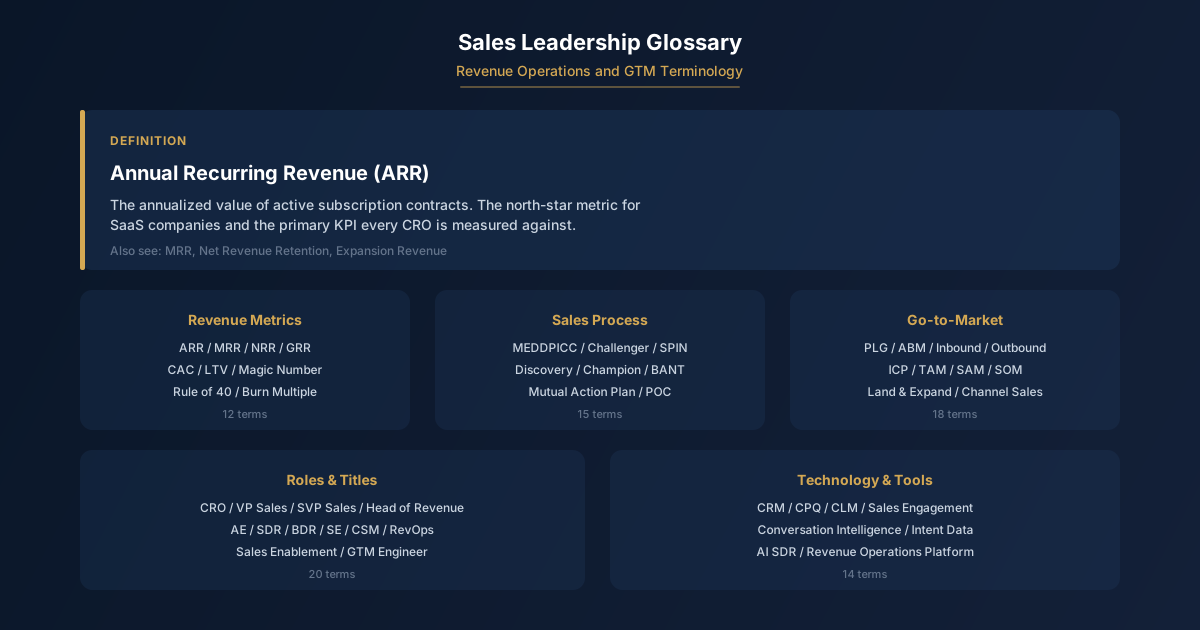
Account-based marketing is a B2B strategy that concentrates sales and marketing resources on a defined set of high-value target accounts, using personalized campaigns to penetrate each account.
ABM flips the traditional marketing funnel. Instead of casting a wide net and hoping the right accounts fall in, ABM starts with a named list of target accounts and builds personalized campaigns to engage specific people at those companies. It requires tight alignment between sales and marketing, which is why CROs often own ABM strategy.
ABM Tiers
Most ABM programs use a tiered approach. Tier 1 (1:1 ABM): highly personalized campaigns for 10-50 strategic accounts, with custom content, events, and executive outreach per account. Tier 2 (1:few ABM): semi-personalized campaigns targeting 50-200 accounts grouped by industry or use case. Tier 3 (1:many ABM): programmatic campaigns targeting 200-1,000+ accounts with intent-driven advertising and scaled personalization.
ABM Technology Stack
A full ABM stack typically includes: a targeting/orchestration platform (Demandbase, 6sense), intent data (Bombora, G2), advertising (LinkedIn Ads, programmatic display), personalization (website personalization for target accounts), and measurement (account-level engagement scoring). CROs don't need to manage the ABM tech stack directly, but they need to understand it well enough to hold marketing accountable for pipeline contribution from ABM programs.
ABM Results and Benchmarks
Well-executed ABM programs generate 171% higher ACV than non-ABM marketing efforts, according to industry benchmarks. ABM-sourced pipeline converts at higher win rates because the targeting is more precise. Our job posting data shows 20% of CRO roles mention ABM experience, typically at companies selling $50K+ ACV where the economics of personalized account targeting make sense.
Common Mistakes with ABM
Running ABM without sales alignment. ABM is a joint sales-and-marketing motion. If marketing builds beautiful personalized campaigns for 100 target accounts and sales doesn't follow up, you've wasted the investment. Before launching ABM, the CRO needs to get explicit commitments from sales managers: these are the accounts, here's the play, reps will follow up on every signal within 48 hours. Monthly ABM pipeline reviews should include both sales and marketing leaders reviewing account-level engagement and pipeline progression.
Real-World Example
A $45M ARR company invested $500K annually in a Tier 1 ABM program targeting 25 strategic accounts. Year one results: $200K in pipeline, zero closed-won deals. The postmortem revealed that AEs weren't following up on ABM signals because they had their own prospecting priorities. Year two, the CRO assigned dedicated AEs to ABM accounts, made ABM pipeline a quota component, and held weekly account reviews with both sales and marketing. Year two results: $3.8M in pipeline, $1.4M closed. The difference wasn't the ABM platform or the campaigns. It was sales commitment.
In Practice
ABM measurement requires different metrics than traditional demand gen. Don't measure ABM on MQLs or cost-per-lead. Instead, track: account engagement score (percentage of target accounts showing activity), pipeline from target accounts (dollar value of opportunities created at ABM accounts), deal velocity on ABM accounts vs non-ABM accounts, and win rate on ABM-influenced deals. A well-run Tier 1 ABM program should show 2-3x higher win rates and 30-50% larger deal sizes on target accounts compared to the rest of your pipeline. If the lift isn't there, the targeting or execution needs work.