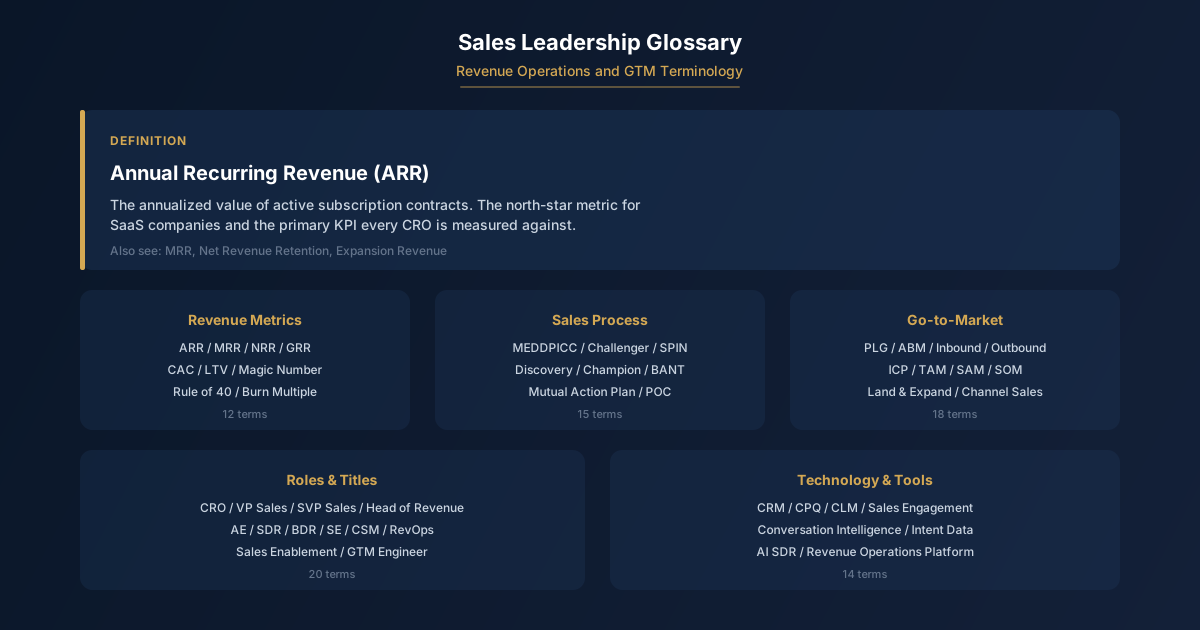
Annual recurring revenue (ARR) is the annualized value of active recurring subscriptions, excluding one-time fees. It is the primary growth metric for SaaS companies.
ARR represents the predictable, recurring revenue a company expects to generate over the next 12 months from its existing customer base. It's calculated by annualizing monthly recurring revenue (MRR × 12) or summing all active annual contract values.
Why ARR Matters for Sales Leaders
ARR is the metric that determines company valuation, fundraising ability, and sales compensation structures. A VP Sales at a $10M ARR company faces very different challenges than one at $100M ARR. At $10M, you're still proving the sales motion works. At $100M, you're optimizing an engine that already runs. ARR growth rate is the primary indicator boards use to evaluate sales leadership effectiveness. A company growing ARR at 80%+ year-over-year commands a 15-25x revenue multiple. Growing at 20% gets you 5-8x. That valuation gap is why boards obsess over the number and why CROs tie their comp to it.
ARR vs Revenue
ARR only counts recurring subscription revenue. It excludes one-time implementation fees, professional services, hardware sales, and usage-based overages that aren't committed. A company might have $15M in total revenue but only $10M in ARR if $5M comes from services and one-time fees. This distinction matters for valuation: investors value recurring revenue at a premium because it's predictable. A dollar of ARR is worth 3-5x more in company valuation than a dollar of services revenue. This is why CROs push teams to structure deals with higher recurring components.
Common Mistakes with ARR
Counting revenue that isn't recurring. Professional services, one-time setup fees, and usage-based overages are not ARR. Including them inflates the number and misleads investors. The other common mistake: not breaking ARR into its components. You need to track new ARR (new customers), expansion ARR (upsells and cross-sells), contraction ARR (downgrades), and churned ARR (cancellations) separately. A company growing ARR 30% year-over-year could be hiding 25% gross churn behind aggressive new logo acquisition. That's a ticking time bomb.
Real-World Example
A $20M ARR company raised a Series B on the strength of 40% growth. But the breakdown told a different story: $12M in new logo ARR, minus $4M in churn. Net new was $8M. The company was adding customers fast but losing them almost as fast. Gross revenue retention was 80%, well below the 90%+ benchmark. Post-funding, the board installed a CRO who shifted resources from new business to customer success and product improvements. Within 18 months, GRR improved to 93% and growth accelerated because they stopped refilling a leaky bucket.
In Practice
CROs track ARR through a framework called the ARR waterfall. Start with beginning-of-period ARR. Add new logo ARR (first-time customers). Add expansion ARR (upsells, cross-sells, price increases from existing customers). Subtract contraction ARR (downgrades). Subtract churned ARR (cancellations). The result is ending ARR. This waterfall shows up in every board deck and every CRO's monthly operating review. If new logo ARR is strong but ending ARR growth is weak, the problem is in retention. If retention is strong but growth is slow, you need more pipeline. The waterfall makes the diagnosis obvious.