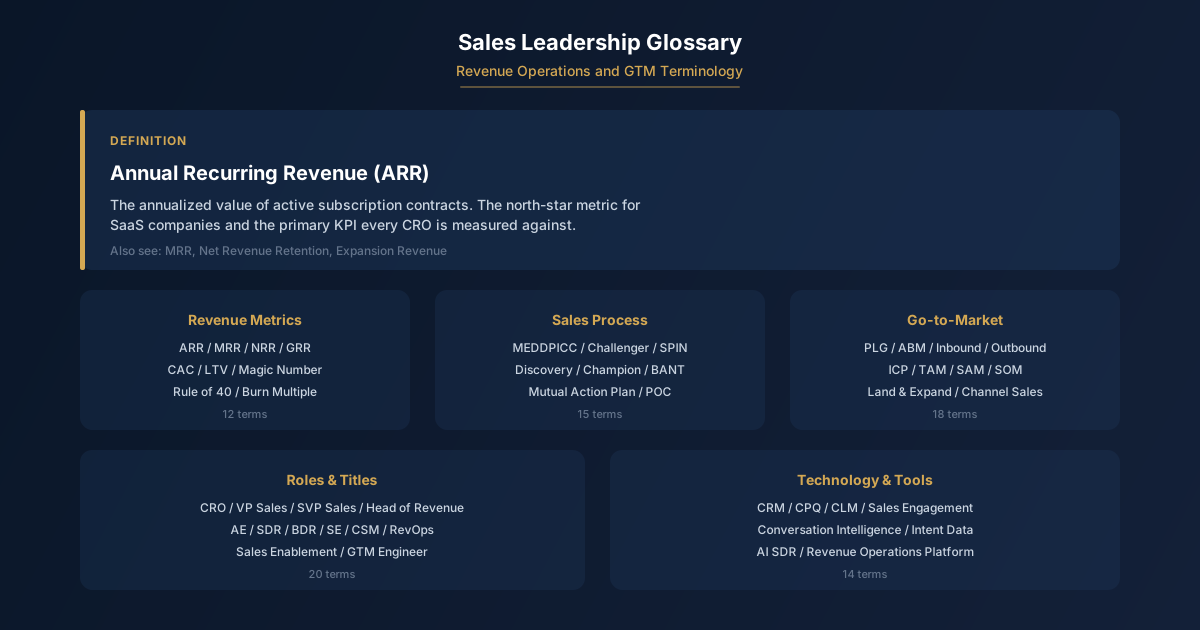
Channel sales is a go-to-market model where a company sells through third-party partners, resellers, distributors, or referral networks rather than (or in addition to) its own direct sales team.
Channel sales lets you extend your market reach without proportionally growing your own sales headcount. Partners take on the selling, implementation, or customer management in exchange for a margin or referral fee. It's a capital-efficient growth strategy when executed well, and a margin-destroying mess when executed poorly.
Types of Channel Partners
There are several channel models. Resellers buy your product and sell it to their customers at a markup. Referral partners send you qualified leads for a fee (typically 10-20% of the deal). Technology partners bundle your product with theirs. System integrators implement your product as part of larger projects. Managed service providers (MSPs) sell your product as part of an ongoing service. Most companies start with referral partnerships before building a full reseller program.
Direct vs Channel Sales Economics
Channel partners typically take 20-40% margin on deals they source and close. That sounds expensive, but compare it to the fully loaded cost of a direct AE ($200K+ OTE plus benefits, tools, management overhead) who can only handle so many deals per quarter. For companies expanding into new geographies, verticals, or segments, channel is often more capital-efficient than hiring.
Channel Sales in CRO Job Postings
CRO Report data shows 15-20% of VP Sales and CRO job postings mention channel, partner, or alliance experience as a requirement. That number jumps to 35%+ for companies in cybersecurity, infrastructure, and horizontal SaaS where partner ecosystems are mature. CROs at these companies need to manage both direct and channel motions, which requires different comp plans, conflict resolution skills, and partner enablement programs.
Common Mistakes with Channel Sales
Building a partner program without dedicated channel management. Partners don't sell your product on their own. They need training, deal registration, co-selling support, and regular engagement. A 'sign up and sell' partner portal with no human support produces zero pipeline. Budget for at least 1 channel manager per 10-15 active partners, and define 'active' as partners who've sourced or co-sold at least one deal in the last 90 days.
Real-World Example
A cybersecurity company signed 200 partners in year one of their channel program. Revenue from partners: $400K (0.3% of total). The problem: no enablement, no co-selling, no channel managers. Year two, they cut the partner list to 30, hired 2 dedicated channel managers, built a partner certification program, and offered 30% margin on partner-sourced deals. Revenue from partners jumped to $4.2M (8% of total). Fewer partners, properly supported, outperformed the spray-and-pray approach by 10x.
In Practice
Successful channel programs follow a predictable maturity curve. Year 1: recruit 20-30 partners, enable 10, get 5 producing pipeline. Revenue contribution: 2-5% of total. Year 2: double down on the 5 producing partners, recruit selectively for gaps, build co-selling playbooks. Revenue contribution: 8-15%. Year 3+: partner-sourced pipeline becomes a predictable channel contributing 15-25% of total revenue. The mistake most companies make is evaluating channel performance after year 1, when it's still immature. Channel is a 2-3 year investment that compounds once the right partners are trained and incentivized.