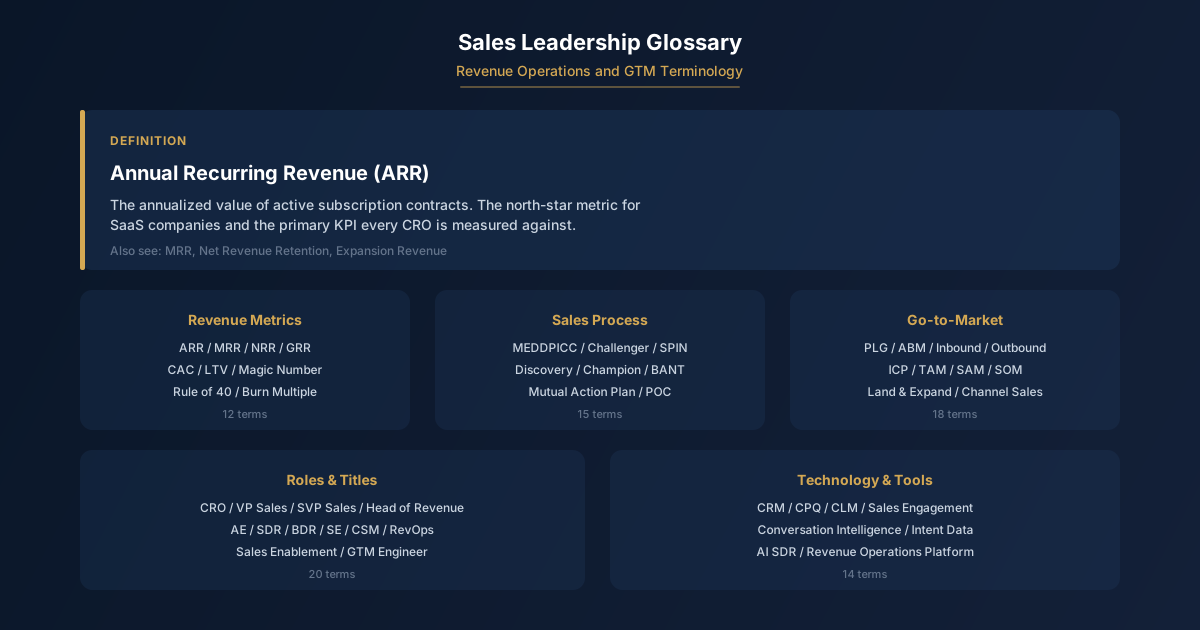
A mutual action plan is a shared document between buyer and seller outlining the agreed-upon steps, owners, and timeline needed to evaluate and close a deal.
A mutual action plan (sometimes called a joint evaluation plan or close plan) replaces the old-school 'next steps' approach with a documented, two-way commitment. Both buyer and seller agree on what needs to happen, who's responsible, and by when. It's the single most effective tool for controlling deal timelines.
What Goes in a Mutual Action Plan
A strong MAP includes: discovery and requirements gathering dates, demo or proof-of-concept milestones, security and legal review timelines, pricing and negotiation steps, executive sponsor meetings, go-live target date, and named owners for each step on both sides. The key word is 'mutual.' If only your side fills it out, it's just a sales forecast, not an agreement.
Why MAPs Improve Win Rates
Deals with mutual action plans close 32-40% faster according to multiple sales intelligence platforms. The reason is simple: a MAP forces the buyer to commit to a timeline and identify all stakeholders early. It surfaces procurement delays, legal bottlenecks, and budget cycles before they become surprises in week 11 of a 12-week deal. CROs should require MAPs for every deal above a defined ACV threshold.
MAP Tools and Implementation
Tools like DealHub and PandaDoc offer structured MAP templates that integrate with your CRM. But a Google Doc works fine for v1. The tool matters less than the behavior. Train reps to introduce the MAP after a successful discovery call by framing it as 'here's how we'll make sure this evaluation respects your timeline.' Track MAP adoption as a leading indicator in your forecast reviews.
Common Mistakes with MAPs
Creating a MAP that only includes your milestones. A real mutual action plan has commitments from the buyer: 'provide technical requirements by March 15,' 'schedule security review by March 22,' 'confirm budget approval by April 1.' If the buyer won't commit to specific dates for their side, they're not serious about the timeline. A one-sided MAP is just a sales forecast dressed up in a Google Doc.
Real-World Example
A mid-market SaaS company required MAPs for all deals above $50K ACV. Before the requirement, average sales cycle for $50K+ deals was 97 days. After implementing MAPs, it dropped to 68 days. Close rates for MAP deals were 38% vs 21% for deals without MAPs. The key insight wasn't the document itself. It was the qualification effect. Prospects who refused to co-create a MAP were signaling they weren't committed, and reps could disqualify earlier instead of chasing for another 3 months.
In Practice
The best time to introduce a MAP is right after a successful discovery call. The buyer has just confirmed they have a problem worth solving. Frame it: 'Based on what you've shared, it sounds like there's real urgency here. I'd like to suggest we put together a shared timeline so we can move at the pace you need without anything falling through the cracks.' This framing positions the MAP as serving the buyer's interest, not the seller's. Prospects who refuse to engage with a MAP at this stage are telling you something. Either the urgency isn't real, the problem isn't a priority, or someone else in the organization is driving a different evaluation.