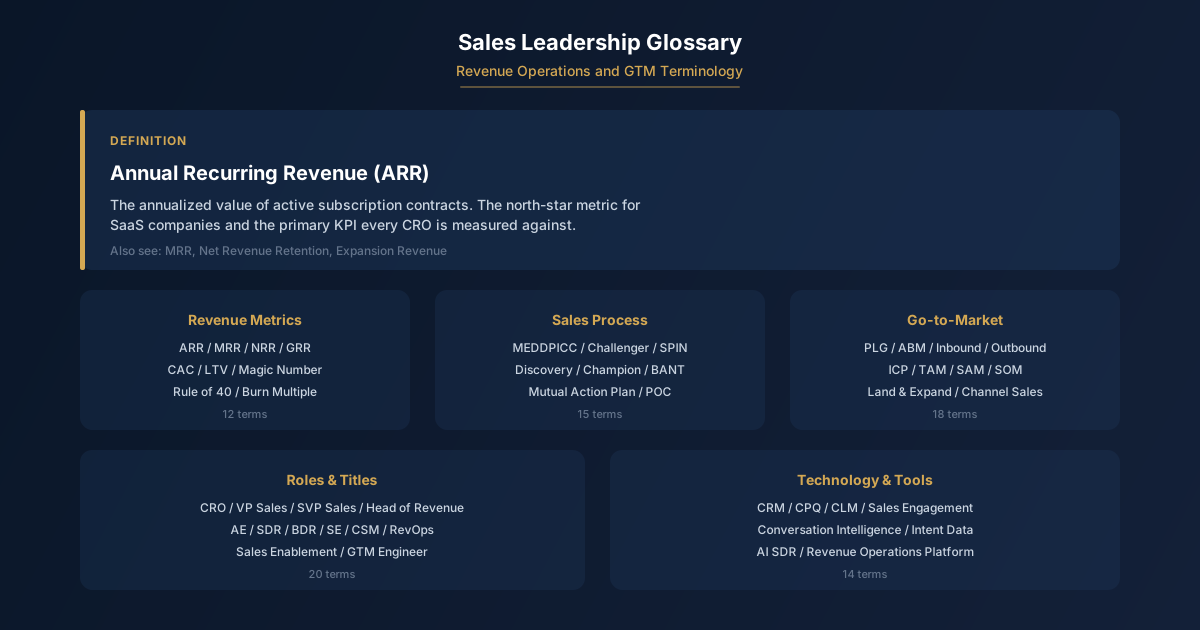
Product-led growth is a go-to-market strategy where the product itself drives user acquisition, expansion, and retention, reducing reliance on traditional sales teams for initial adoption.
PLG companies let users experience the product before (or instead of) talking to sales. The product is designed to deliver value quickly, encouraging organic adoption and viral growth. Sales teams still exist in most PLG companies but focus on expansion and enterprise deals rather than initial acquisition.
PLG Characteristics
PLG companies typically offer a free tier or free trial with minimal friction (no credit card required, instant access), self-serve onboarding that delivers value within minutes, in-product upgrade prompts triggered by usage milestones, and viral or network-effect mechanics that spread the product through organizations. Examples include Slack (viral within teams), Zoom (network effects with external invites), Notion (team workspace adoption), and Figma (collaborative design). The defining characteristic: the product itself generates demand. Marketing supports it, but the product is the primary acquisition channel. This inverts the traditional model where marketing and sales generate demand and the product just fulfills it.
PLG + Sales: The Hybrid Model
Most successful PLG companies eventually add sales. The pattern is: product drives initial adoption at the team level, usage data surfaces expansion opportunities, and sales reps engage accounts for enterprise contracts. This hybrid model is increasingly common and requires CROs who understand both motions.
Common Mistakes with PLG
Assuming PLG means you don't need sales. Every successful PLG company eventually adds salespeople. Slack has a massive enterprise sales team. Zoom built one. Figma built one. The question isn't whether you need sales. It's when and how. Most PLG companies add sales when they see usage clusters at larger companies that aren't converting to paid on their own. If 50 people at a Fortune 500 company are using your free tier, someone needs to call that company. A self-serve checkout page won't close a $200K enterprise deal.
In Practice
PLG sales teams operate differently than traditional sales teams. Reps don't cold-call. They work product-qualified leads (PQLs), which are accounts that have hit specific usage thresholds indicating readiness for a paid plan or enterprise contract. A PQL might be defined as: 10+ active users from the same company, specific feature usage patterns, or approaching plan limits. The AE's job is to expand and formalize the relationship, not create awareness from scratch. This means PLG AEs need to be comfortable with consultative selling and account management, not just prospecting.
Real-World Example
A developer tools company hit $5M ARR on pure PLG. Thousands of individual developers used the free tier. But enterprise contracts stalled at $8K ACV because no one was engaging the economic buyer. The company hired 4 AEs focused exclusively on accounts with 20+ active users. Those AEs didn't prospect. They worked inbound PQLs surfaced by product usage data. Within 12 months, average enterprise ACV went from $8K to $65K, and the 4 AEs produced $4.2M in new ARR. The product did the demand gen. Sales did the monetization. That's PLG and SLG working together.