

Demandbase Review 2026: Pricing, Intent Data & ABM Verdict
Demandbase has spent nearly two decades building the enterprise ABM stack. With Demandbase One unifying advertising, intent data, account identification, and sales intelligence, plus the only demand-side platform built specifically for B2B, it occupies a unique position in the market. Two consecutive years of profitability and $200M+ in revenue suggest the model works at scale.
What Demandbase Actually Does
Demandbase One is an account-based go-to-market platform. It identifies anonymous website visitors via IP recognition and intent signals, scores accounts based on buying behavior, serves targeted B2B ads through its proprietary DSP, and orchestrates the handoff from marketing to sales. The platform covers the full customer lifecycle from initial awareness through expansion and renewal.
The company was founded in 2006 in San Francisco. It has raised $320M in total funding, including a $175M Series H in February 2023. Revenue exceeded $200M in 2024 with double-digit year-over-year growth, and ZoomInfo estimates put the figure at $253.8M. Demandbase reported its second consecutive year of profitability, a rarity among enterprise martech vendors at this scale.
Account Identification
IP recognition combined with intent signals to identify anonymous accounts visiting your site. Maps visitors to specific companies and buying committees.
B2B DSP
The only demand-side platform built specifically for B2B advertising. Serves programmatic display, video, and connected TV ads to target accounts across the open web.
AI-Driven Scoring
Processes 1 trillion+ bid-stream intent signals monthly. Scores accounts by engagement, fit, and buying stage to prioritize pipeline for sales.
What You Get
Bid-Stream Intent Data is the core differentiator. Demandbase ingests over 1 trillion signals monthly from programmatic ad exchanges, tracking which accounts are researching topics relevant to your product. Unlike third-party intent providers that aggregate weekly, bid-stream data updates in near real-time.
B2B Advertising (DSP) lets you run programmatic campaigns targeting specific accounts, buying groups, or personas. Display, video, and connected TV formats are supported. Because Demandbase owns the DSP, the targeting data and campaign execution share the same platform with no data loss between systems.
Buying Group Analysis maps individual contacts to buying committees within target accounts. Rather than scoring a single lead, the platform tracks engagement across the entire group and surfaces which accounts have active, multi-threaded buying behavior.
ABX Orchestration coordinates account-based experiences across advertising, email, web personalization, and sales outreach. Rules engines trigger actions based on account stage, intent spikes, or engagement thresholds.
Sales Intelligence provides account-level insights directly in Salesforce, including technographics, news alerts, intent topics, and engagement history. Supports 133 languages for global account coverage.
What Demandbase Costs
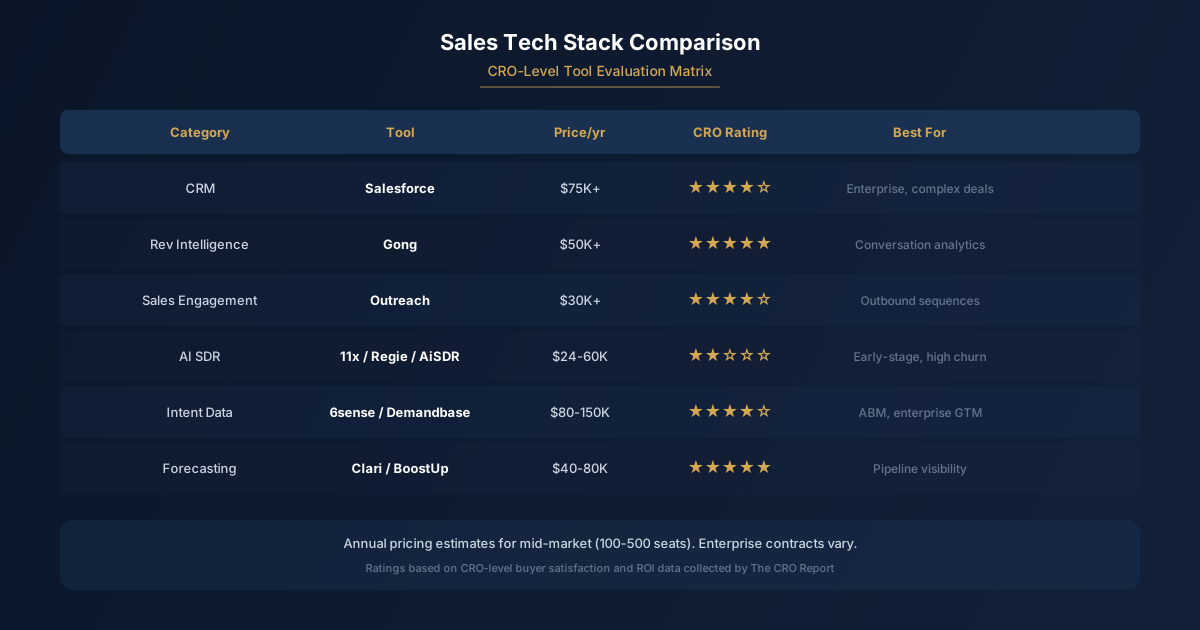
Demandbase does not publish pricing. It sells exclusively through custom enterprise contracts. All figures below come from third-party reports and buyer disclosures.
| Typical Range | |
|---|---|
| Entry-Level (single module) | $50,000 - $75,000/year |
| Mid-Tier (ABM + advertising) | $100,000 - $150,000/year |
| Full Platform (all modules) | $150,000 - $200,000+/year |
| Contract Length | Annual minimum, multi-year common |
| Implementation | 3-6 months typical |
Module Pricing Adds Up Fast
Demandbase One is sold in modules: advertising, ABX, sales intelligence, and data. Each module carries its own cost. Buyers frequently report that the initial quote covers one or two modules, then expansion into additional capabilities pushes the total well above $100K. Get a clear picture of total platform cost before signing.
Ad Spend Is Separate
The platform fee covers access to the DSP and targeting capabilities. Actual ad spend (media budget) is billed separately on top of the platform cost. Most enterprise buyers allocate $50K-$500K+ in annual media spend through the Demandbase DSP.
Where Demandbase Wins
✓ Strengths
- Only B2B-specific DSP on the market, giving advertising capabilities no competitor matches
- Bid-stream intent data provides near real-time signals from 1 trillion+ monthly events
- Buying-group-first approach tracks committee engagement, not just individual leads
- Two consecutive years of profitability at $200M+ revenue, rare for enterprise martech
- Strong G2 ratings across multiple ABM categories, consistently ahead of 6sense
- 133 language support makes it viable for global enterprise deployments
✗ Limitations
- Enterprise-only pricing ($50K+ floor) puts it out of reach for SMBs and startups
- Complex implementation requires 3-6 months and a dedicated ABM ops team
- Intent signal scoring can feel opaque, difficult to audit how scores are calculated
- Steep learning curve across modules, especially for teams new to ABM
- Ad performance reporting has less granularity than pure-play DSPs like The Trade Desk
- No self-serve option or free trial to evaluate before committing budget
Demandbase vs. 6sense vs. ZoomInfo
These are the three platforms most enterprise GTM teams evaluate for ABM and intent. Each anchors on a different capability.
| Dimension | Demandbase | 6sense | ZoomInfo |
|---|---|---|---|
| Best for | Enterprise ABM with advertising | AI-driven pipeline prediction | Data enrichment + basic ABM |
| Core differentiator | B2B-specific DSP | AI/ML predictive models | Largest B2B contact database |
| Intent data | Bid-stream (1T+ signals/mo) | Proprietary AI + web scraping | First-party + Bombora |
| Advertising | Full DSP (owned) | Display ads (partnership-based) | FormComplete, no DSP |
| Account ID approach | IP + intent signals | AI pattern matching | IP + form fills |
| Buying group support | Native, committee-level | Native, AI-predicted | Limited |
| Typical price range | $50K - $200K+/year | $60K - $200K+/year | $15K - $100K+/year |
| Profitability | Profitable (2 years running) | Not publicly disclosed | Public company, profitable |
| G2 satisfaction | Stronger across ABM categories | Strong but trails Demandbase | Strong for data, weaker for ABM |
| Implementation time | 3-6 months | 3-6 months | Weeks to 2 months |
How the Intent Engine Works
Demandbase sources intent data primarily from the programmatic bid stream. Every time a B2B buyer visits a website running programmatic ads, that page request generates a bid event containing the visitor's IP, the page content, and contextual signals. Demandbase processes over 1 trillion of these events monthly, maps them to accounts via IP resolution, and categorizes the content into intent topics.
This approach has a structural advantage over panel-based intent providers like Bombora: bid-stream data covers a vastly larger surface area of the web. The tradeoff is that bid-stream signals are noisier and require more sophisticated filtering to separate real buying behavior from general web browsing.
Demandbase layers keyword-level intent on top of account-level scoring. You can define custom intent keywords specific to your product category, then track which accounts are researching those terms at above-baseline rates. The platform surfaces "intent spikes" when an account's research volume exceeds its historical norm.
Where buyers struggle is in auditing the scoring. The platform surfaces an account score and a list of intent topics, but the underlying weighting between different signal types is not fully transparent. Teams that invest in learning the scoring methodology get better results. Teams that treat it as a black box tend to distrust the outputs.
Intent Data vs. 6sense
Demandbase leans on bid-stream volume (breadth of signals). 6sense leans on AI pattern matching (depth of prediction). In practice, Demandbase surfaces more accounts showing early research behavior. 6sense claims higher accuracy in predicting which accounts will convert. Most enterprise buyers evaluate both with a proof-of-concept before committing.
What Demandbase Connects To
CRMs: Salesforce (deep native integration, bi-directional sync), HubSpot, Microsoft Dynamics 365.
Marketing Automation: Marketo (Adobe), HubSpot Marketing, Eloqua, Pardot. Supports account-level audience syncs for campaign targeting.
Sales Engagement: Outreach, Salesloft, Gong. Account insights surface directly in seller workflows.
Data & Analytics: Snowflake, Tableau, Looker. Raw data exports available for custom reporting.
Advertising: LinkedIn Ads, Google Ads, Meta. Audience syncs push Demandbase segments to these platforms for coordinated campaigns alongside the native DSP.
Salesforce Is the Primary Integration
The deepest integration is with Salesforce. Account scores, intent data, and engagement history push directly into account and opportunity records. Teams on HubSpot or Dynamics get solid but less granular integration. If Salesforce is your CRM, the data flow is smooth.
What Changed in 2024-2025
Revenue Milestone: Demandbase exceeded $200M in annual revenue in 2024 with double-digit year-over-year growth. ZoomInfo competitive intelligence estimates put the figure at $253.8M.
Second Year of Profitability: The company reported its second consecutive profitable year, a notable milestone for a venture-backed enterprise SaaS company at this scale ($320M raised).
Series H ($175M, Feb 2023): The most recent funding round. No new rounds have been announced since, consistent with the profitability trajectory.
Buying Group Enhancements: Expanded buying group analysis capabilities throughout 2024-2025, including automated committee detection and multi-threaded engagement scoring.
Global Expansion: Extended language support to 133 languages and deepened EMEA and APAC account identification coverage.
Is Demandbase Right for You?
Buy Demandbase If...
Your organization matches one or more of these profiles.
- Enterprise B2B companies running formal ABM programs with dedicated ops headcount
- Marketing teams that want advertising and intent data unified in a single platform
- Organizations selling to buying committees (5+ stakeholders per deal) where group-level tracking matters
- Companies with $50K+ annual budget for ABM tooling, separate from ad spend
- Salesforce-centric GTM stacks where deep CRM integration is a requirement
Skip Demandbase If...
These teams will find better value elsewhere.
- SMBs or startups with ABM budgets under $50K/year (look at Warmly or HubSpot ABM)
- Teams without a dedicated ABM or marketing ops person to configure and maintain the platform
- Organizations looking primarily for contact data enrichment (ZoomInfo or Apollo serve this better)
- Companies wanting quick time-to-value, Demandbase requires 3-6 months to fully implement
- Sales-led organizations without a marketing counterpart to own the platform
Questions to Ask Before Signing
- What percentage of my target account list does Demandbase currently identify through IP resolution? (Ask for a match test.)
- Which modules are included in the quoted price, and what is the cost to add the remaining modules later?
- What does a realistic implementation timeline look like given my current tech stack?
- How is ad spend billed relative to the platform fee, and what is the minimum recommended media budget?
- Can I see intent data accuracy benchmarks for my specific industry vertical?
- What does the customer success and onboarding team look like for an account my size?
The CRO Report's Bottom Line
Demandbase is built for enterprise ABM at scale. The B2B DSP, buying group analysis, and trillion-signal intent engine create a platform that no single competitor replicates.
- If you run formal ABM programs with six-figure tooling budgets and dedicated ops, Demandbase is the most complete platform available
- If you are evaluating Demandbase vs. 6sense, run parallel proof-of-concept tests on your actual target account list, the data overlap is smaller than you would expect
- If you lack ABM ops headcount or budget, start with Warmly or Unify and revisit Demandbase when the program matures
Request a proof-of-concept against your top 500 target accounts. Have Demandbase run account identification and intent scoring for 30 days, then compare the output to your current pipeline data. The overlap between Demandbase-flagged accounts and your actual opportunities will tell you whether the investment pencils out.
Want More Tool Reviews?
The CRO Report delivers honest assessments of GTM tools from a practitioner perspective.
Subscribe to The CRO Report Browse All Tool Reviews