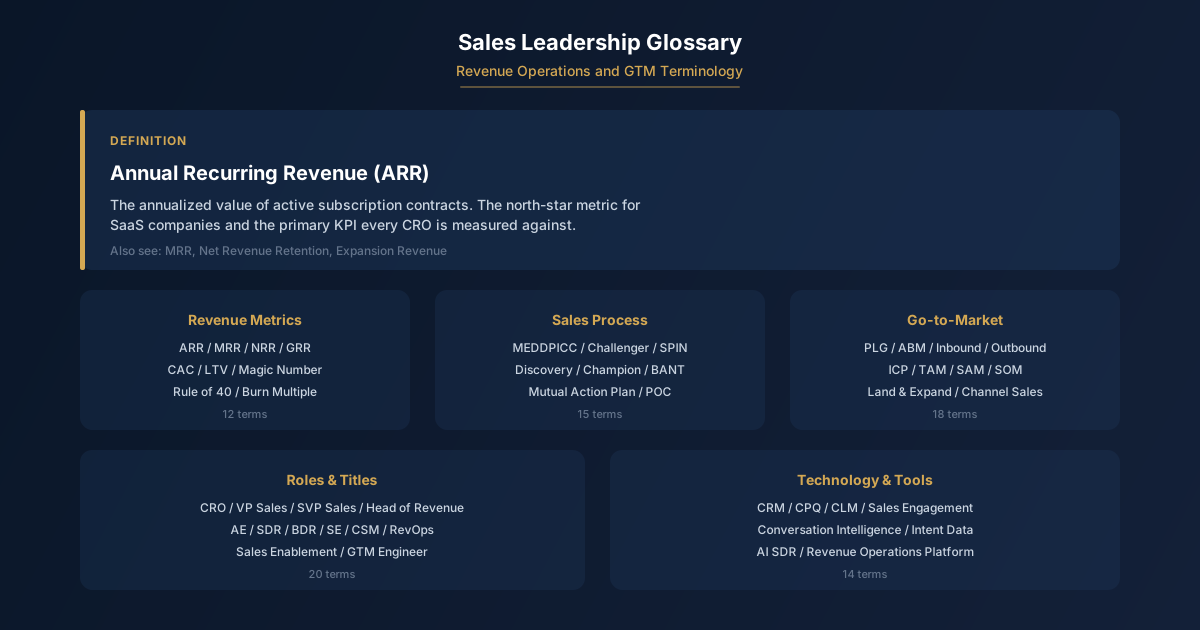
A Chief Revenue Officer (CRO) is a C-level executive responsible for all revenue-generating functions including sales, marketing, customer success, and partnerships.
What does a Chief Revenue Officer do?
A Chief Revenue Officer (CRO) owns all revenue-generating functions at a company — sales, marketing, customer success, and often partnerships. Unlike a VP Sales who manages the sales team, the CRO sets cross-functional revenue strategy and reports directly to the CEO or board. Most companies hire a CRO when they reach $10-30M ARR and need unified go-to-market leadership.
The Chief Revenue Officer is the executive who owns the entire revenue engine of a company. Unlike a VP of Sales who manages the sales team, the CRO aligns all go-to-market functions under a single leader to drive predictable revenue growth.
CRO vs VP of Sales
The CRO sits above the VP of Sales in the org chart and has a broader mandate. A VP of Sales owns the sales team and quota. A CRO owns the entire revenue number across sales, marketing, customer success, and often partnerships. Companies typically elevate to a CRO model when they reach $20M-$50M+ ARR and need cross-functional alignment.
CRO Responsibilities
A CRO's core responsibilities include: setting revenue strategy and forecasting, aligning sales, marketing, and customer success around shared metrics, owning the P&L for revenue-generating functions, reporting to the CEO and board on revenue performance, and building the leadership team across all GTM functions.
CRO Salary
Based on our analysis of current job postings, CRO base salaries range from $250K to $400K, with total compensation often exceeding $500K-$1M+ at growth-stage and public companies. Equity is a significant component, especially at pre-IPO companies.
Common Mistakes When Hiring a CRO
The biggest mistake boards make is hiring a CRO too early. A company at $5M ARR doesn't need a CRO. It needs a VP Sales who can build the first repeatable sales motion. Bringing in a CRO before you have product-market fit and at least two working GTM channels creates an expensive layer of management over a team that's still figuring out the basics. The second mistake: hiring a VP Sales and giving them the CRO title. If they only own sales, they're a VP Sales. The title inflation confuses the org and sets false expectations with the board.
Real-World Example
A Series C SaaS company at $45M ARR promoted their VP Sales to CRO and gave them ownership of marketing and customer success. Within two quarters, NRR improved from 105% to 118% because the CRO aligned CS expansion plays with the sales team's upsell motion. Marketing shifted from MQL targets to pipeline contribution metrics. The company's magic number went from 0.7 to 1.1. That's the CRO model working as designed: one leader removing friction between teams that used to operate in silos.
In Practice
The CRO's calendar tells you everything about whether the role is working. A CRO spending 60% of their time in deal reviews is acting as a VP Sales. A CRO spending 80% of their time in board meetings is acting as a strategist with no operational grip. The sweet spot: 30% on pipeline and deal reviews, 20% on marketing and CS alignment, 20% on strategy and board prep, 15% on hiring and coaching, and 15% on customer and partner meetings. CROs who find themselves pulled entirely into one function need to push back or delegate. The whole point of the role is cross-functional orchestration.